The short answer
A finance marker is an entry that a lender places with vehicle data companies to show it has a finance agreement, such as hire purchase or PCP, on a particular car. While the agreement runs the lender owns that car, and once the last payment has gone through, taking the marker off is the lender's job.
The sections below cover what the entry records, which kinds of borrowing create one, what to do when the car you want carries a marker, and what an owner can do when a marker outlives the finance.
What is a finance marker on a car?
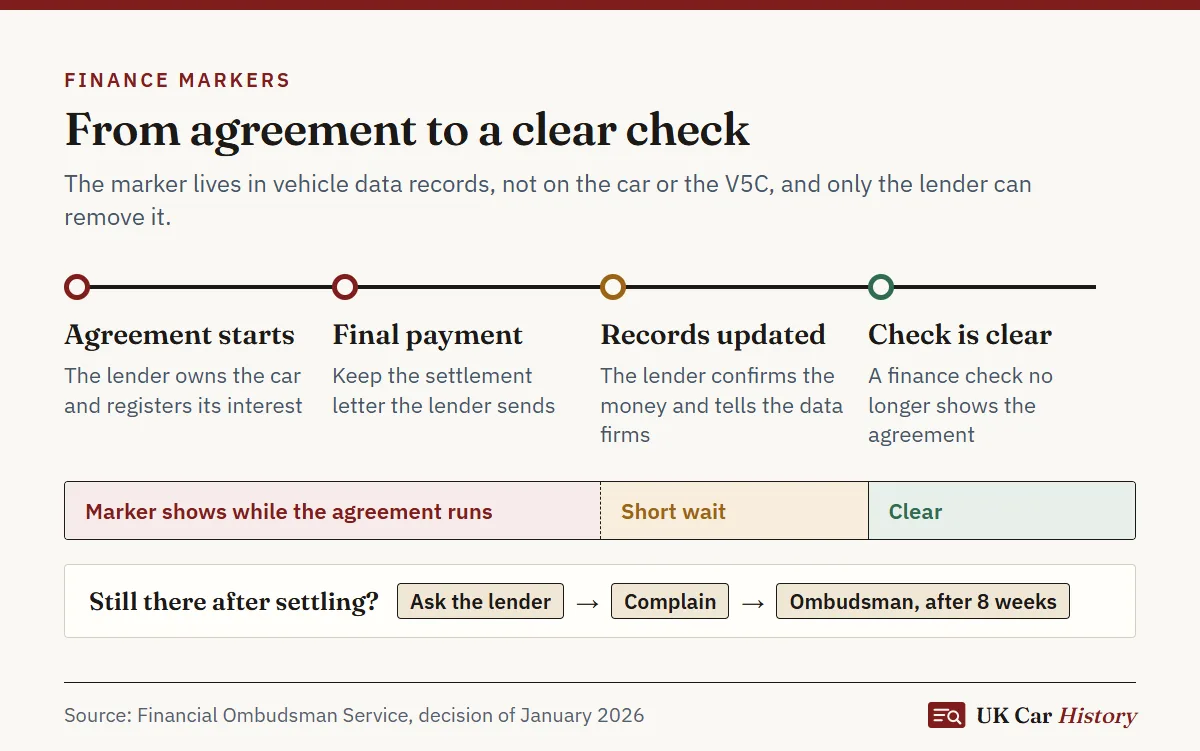
On hire purchase and PCP, the finance company pays for the car and you hire it from them until the final payment; the Financial Ombudsman is clear that the provider is the owner until then. Because the car is its property, the lender lets the vehicle data world know: it registers its interest against the car, normally showing who the lender is and what kind of agreement applies.
You will not find that entry on the car or in the V5C. The logbook records the registered keeper, and the PSNI points out that the keeper may not be the lawful owner, which can be a finance company. Put another way, a real V5C made out to the seller proves nothing about who owns the car. Only a search of the records brings the finance to light.
Which debts travel with the car when it is sold?
Whether a debt follows the car depends on how it was set up:
| Kind of borrowing | Who holds ownership meanwhile | Passes to a buyer? |
|---|---|---|
| Hire purchase (HP) | The finance company, up to the final instalment | Yes: the lender's rights attach to the car |
| PCP | The finance company, unless you pay the balloon at the end | Yes; PCP is a type of hire purchase |
| Conditional sale | The finance company, until the term is complete | Yes, just as with HP |
| Lease or contract hire | The leasing firm, for the whole contract | The driver never owns it to sell |
| Personal loan | The person who borrowed | No: it is owed by the person, not secured on the car |
| Logbook loan | The lender, by way of a bill of sale, until paid | Yes, and a buyer has no protection |
The last row causes the most grief. Bills of sale, the Law Commission says, give no protection at all to people who buy goods subject to them without knowing, and in 2018 the government decided against reform. Our guide to buying a car with a logbook loan explains why these loans are so hard to spot.
Why should a buyer care about a finance marker?
Because the lender behind it may still have a claim on the car after you have paid for it. If it recovers the car, your money has to come back from the seller, who may have spent it or vanished.
There is a legal backstop for some buyers. Under Part III of the Hire Purchase Act 1964, someone buying privately, honestly and with no notice of a hire purchase or conditional sale agreement can end up as the car's owner. Who qualifies, and who does not, is set out in our guide to buying a car with outstanding finance.
Seeing the marker counts as knowing. The Act protects only buyers with no actual notice of the finance, so going ahead after a check has shown one leaves you without that safety net.
Found a marker on the car you were about to buy?
You do not have to walk away. The deal can survive, as long as the debt is cleared within the sale itself and the lender gives you proof:
- Find out from the seller which lender holds the agreement, and ask them to request a settlement figure. Lenders have to supply that figure to the borrower on request, under the Consumer Credit Act 1974.
- Agree that the settlement sum goes directly to the lender, with only the balance going to the seller. Never pay the full price on a promise that the finance will be cleared afterwards.
- Wait for the lender to confirm, in writing, that the account is closed and the car released.
- Ring the lender to confirm that letter, using a number you found yourself rather than one printed on it.
- Hand over the remaining money last, at the moment you take the keys.
Our guide to the safest way to pay for a car privately covers moving the money without risk.
Dealers are a different matter: the Consumer Rights Act 2015 makes the right to sell, and freedom from undisclosed charges, part of every trader's sale, so any finance should be gone before the car reaches you.
Finance marker removal: who takes it off, and how quickly?
The lender, and nobody else. A check provider cannot delete a lender's entry, and the DVLA has no part to play, since its records show the keeper rather than any finance.
Do not expect it to vanish on the day you pay. A Financial Ombudsman decision from January 2026 is a useful guide. It found no duty on a lender to clear its marker on the very day of the last payment, because some days are needed to see the funds arrive, change internal systems and inform the third-party data firms, which must then change their own. A lender that finished within about 15 days was judged to have acted reasonably.
Hold on to the settlement or completion letter. Should you sell before the record has caught up, it is the document a careful buyer will want to see.
What if the marker is still there after you have paid off the car?
- Write to or call the lender with your agreement number and settlement date, asking for its interest in the car to be lifted.
- If nothing happens, put a formal complaint in writing and keep a copy.
- If eight weeks pass without a final response, or you are unhappy with the one you receive, take the complaint to the Financial Ombudsman Service, which costs you nothing.
Tell the lender if the delay has cost you a sale or a part-exchange. In the January 2026 decision, the Ombudsman looked at the distress and inconvenience the customer had suffered, as well as the marker itself.
Can a marker linger when nothing is owed?
Most markers are right. One can still appear when nothing is owed, for instance:
- A settlement so recent that the data firms have not yet been updated.
- A slip by the lender while closing the account.
As a buyer, never decide on your own that a marker is stale. Assume it means money is owed unless the named lender tells you otherwise in writing.
Where can you see if a car has a finance marker?
Neither the bodywork nor the logbook will tell you, so the records have to be searched. Our finance check reports any agreement recorded against the registration, with the lender's name, the agreement type, its start date and, if the record includes it, its length. You will find it in the Premium report (£7.99), next to the write-off and stolen checks.
Run it before any deposit, and again just before you pay if days or weeks have gone by: a seller can take out finance on a car at any point while they have it.
Questions and answers
Is it possible to buy a car that has a finance marker?
Yes, as long as the debt is paid off within the sale, preferably by sending the settlement sum straight to the lender, and you hold the lender's written word that nothing is owed before the seller gets the balance.
Will the V5C show that a car has finance on it?
No. A V5C records the keeper only, and finance never appears on it, which is how a seller can hold a real logbook for a car that a lender owns.
How long after the final payment does a finance marker disappear?
We found no official deadline. In one case the Financial Ombudsman accepted roughly 15 days as reasonable, noting that lenders need a little time after the last payment.
Is a seller able to clear a finance marker on their own?
No. Withdrawing the entry is for the lender, once the agreement is paid. If a seller insists the marker is a mistake, ask for the lender's letter saying so.
Will a personal loan show up as finance on the car?
No. A standard personal loan is unsecured, so it is the borrower's own debt and nothing passes to the person who buys the car.
Sources
- Financial Ombudsman Service: Car finance
- Financial Ombudsman Service: decision DRN-6070833 (removal of a finance marker)
- legislation.gov.uk: Hire Purchase Act 1964, Part III
- legislation.gov.uk: Consumer Credit Act 1974, section 97 (settlement statements)
- Law Commission: Bills of sale
- PSNI: Vehicle buying and selling advice
This guide is general information for people buying or owning a car in the UK, not legal or financial advice. UK Car History is an independent service, not affiliated with the DVLA, the DVSA or GOV.UK.