The short answer
Whether a car deposit is refundable in the UK hangs on three things: what the two of you agreed, whether the seller was a business or a private person, and who pulled out of the deal. Changing your mind gives you no automatic right to it. Against a dealer, though, an unfair term cannot be enforced, a dealer at fault should normally repay you, and most distance sales can be cancelled up to 14 days after delivery.
Below are the four situations buyers most often find themselves in, followed by ways to keep a deposit safe and a route to follow if a dealer will not pay up. All of it is general information rather than legal advice; for your own case, talk to Citizens Advice.
Which three questions decide most deposit disputes?
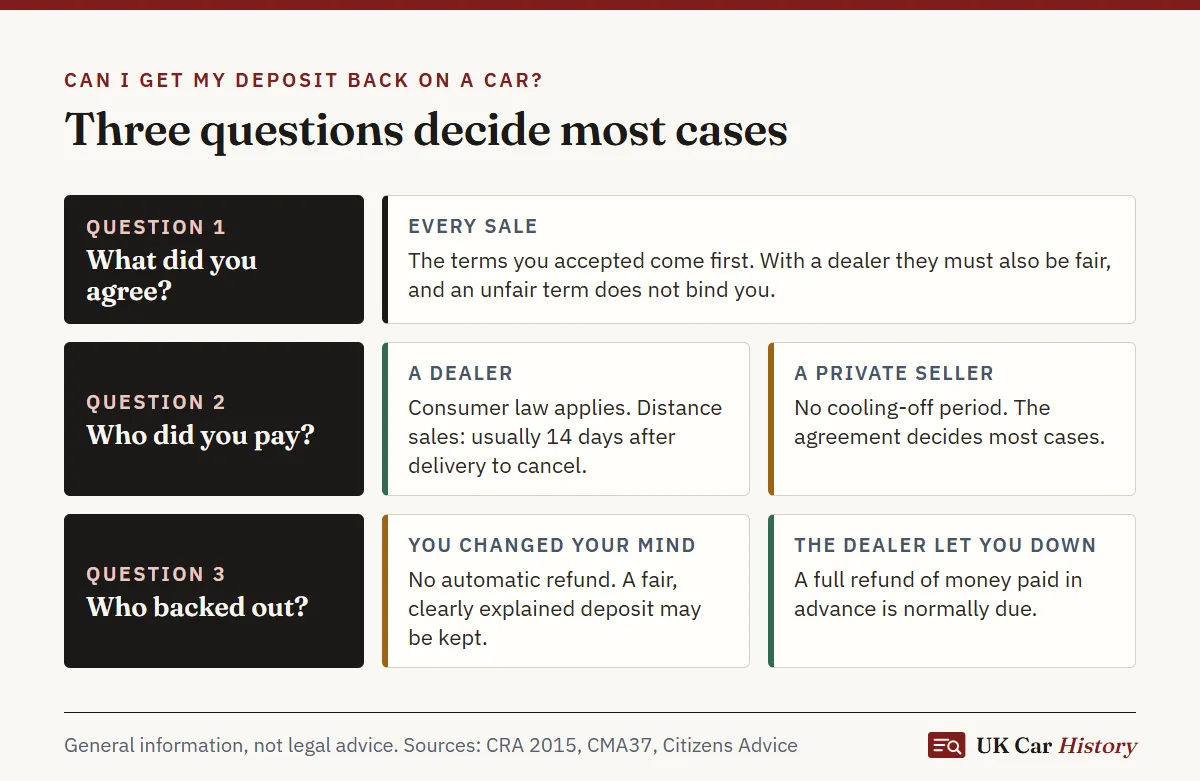
Anyone asking "can I get my deposit back on a car?" should start with the deal itself: handing over a deposit to reserve a car usually means one has been struck, even if nothing was signed. Before thinking about the law, answer these:
- What exactly was agreed: how long the car would be held for you, and in what circumstances the money would be returned or kept?
- Was the seller trading as a business? Consumer law protects you far more against a dealer than against a private individual.
- Who walked away, and for what reason? A sale that collapses through the seller's fault is a very different case from a buyer who has had second thoughts.
One point frames everything else. Citizens Advice explains that if you just change your mind and nothing is wrong with what you bought, you have no automatic right to a refund. The protections described below depend on how you answered the three questions.
You change your mind about a dealer car: can it keep the deposit?
Only on fair terms. Part 2 of the Consumer Rights Act 2015 covers contracts between a business and a consumer, and it says an unfair term does not bind the consumer. The test is whether a term, contrary to the requirement of good faith, creates a significant imbalance between the two sides' rights and obligations to the consumer's detriment.
Two entries on the Schedule 2 list of potentially unfair terms bear directly on deposits: letting the business hold on to a buyer's money when the buyer backs out, without the buyer getting the same amount back if the business is the one that cancels; and making a buyer who backs out pay a disproportionately high sum.
The Competition and Markets Authority has published guidance that applies these rules to prepayments. Making a substantial prepayment completely non-refundable whatever happens is more likely to be unfair. Keeping a genuine deposit in full can be fair when it acts as a binding reservation and the buyer was told at the earliest opportunity that it was required and precisely when it would be lost, with those circumstances kept clear and narrow; even then, the CMA expects it to be no more than a small percentage of the price in the normal case. Where the buyer is at fault, retaining what is reasonably needed for the dealer's unavoidable net costs, or the profit lost as a direct result, is more likely to be fair.
Wording that can be read two ways is read in the consumer's favour, under section 69 of the Act. Only a court can rule a term unfair, but these points give you a footing for a request.
A receipt marked "non-refundable" is not the last word. The term behind it must still pass the fairness test, and a term that fails it cannot be enforced against you.
You bought at a distance: does the 14-day right cover a car deposit refund from a dealer?
Usually, yes. Where the contract with a dealer is made without you meeting face to face first, online, by phone or by email, the Consumer Contracts Regulations 2013 normally give you a cancellation period lasting until 14 days after the car reaches you. Contracts concluded away from the business's premises, such as on your driveway, are treated the same way. Citizens Advice describes it as a cooling-off period of at least 14 days for things you have not seen in person.
Cancel within that window and the dealer has to repay what you paid, deposit included, inside the deadlines the regulations lay down. Before you commit, a dealer selling at a distance must also set out the conditions of any deposit it requires and how its cancellation process works.
Private sellers are outside these rules, and so is a deal concluded in person on the forecourt. A car reserved online but then signed for at the showroom after a viewing needs a careful read of the reservation terms. Returning the car and getting the money back are covered in buying a car online without seeing it.
The dealer lets you down: what then?
The balance tips your way. According to the CMA, when a business breaches a contract so badly that it is worthless to the consumer, the consumer is generally likely to be entitled to end it, with a swift and full refund of money paid in advance and possibly compensation on top.
- It is not the car you were promised. Goods from a business must match their description under the Consumer Rights Act 2015, and what the dealer told you about the car's main characteristics is treated as a term of the contract; altering it counts only if you expressly agree.
- It never turns up. With no agreed date, delivery is due without undue delay and no later than 30 days after the contract. You may treat the contract as finished where the dealer will not deliver at all, or misses a date that was essential; in other cases you can give a further reasonable deadline. Once the contract ends, the Act requires the business to repay everything paid under it, promptly.
- Your car goes to another buyer. That is a breach by the dealer, unless your agreement allowed it. One-sided terms that let a business keep a buyer's money but give the buyer nothing when the business cancels appear on the Act's list of terms that may be unfair.
Bought from a private individual: will you get the deposit back?
Your position rests mostly on the agreement itself. Citizens Advice lists purchases from private individuals among those with no cooling-off period, and the unfair terms protection is built for contracts between a business and a consumer.
You are not without rights, though. Under the Sale of Goods Act 1979 the seller must have the right to sell the car, and where a car is sold by description it must correspond with that description. When a private seller withdraws, sells to someone else or turns out to have misdescribed the car, put your request for the deposit in writing, and take advice if it is refused.
A seller who claims to be private but is really trading can owe you more. The guide to private seller vs dealer shows how to tell the difference.
Five ways to keep a deposit safe before you pay
- Check the car's records first. Outstanding finance, a write-off or a theft record is far better found before money moves, while backing out is free. The finance check page explains why a lender's claim on a car matters to the person buying it.
- Put the deal in writing. Get the amount, the registration and VIN, the agreed price, the holding period and the refund conditions on a receipt or in an email. Putting a deposit on a car lists what to agree.
- Keep the amount modest. A smaller deposit is a smaller loss if things go wrong.
- Use a credit card with a dealer. Citizens Advice says section 75 can apply when any part of the cost, a deposit for instance, goes on a credit card, making the card company jointly responsible for the whole item, if it costs over £100 and no more than £30,000 and was bought directly. Debit card payments rely on chargeback instead, which normally covers only what was paid on the card.
- Never reserve sight unseen. If either the car or the seller is fake, a deposit can vanish for good. Paying at the handover instead is explained in the safest way to pay for a car privately.
A dealer refuses to refund: what route can you follow?
- Gather the order form, the receipt and every message, and decide which ground you rely on: a distance sale cancelled in time, a car never delivered or not as described, or a term you consider unfair.
- Write to the dealer, by email or post, setting out the facts, what you are asking for, the reason and a fair date to respond by. Save copies and jot down the details of any phone conversations.
- Work through the dealer's own complaints process. Where the dealer is in a trade association or signed up to The Motor Ombudsman's code, Citizens Advice says you can take the matter up through that body.
- For card payments, ask the card company about section 75 or chargeback. A rejected section 75 claim can go to the Financial Ombudsman Service, Citizens Advice says, though there is no certainty of getting the money back.
- Get advice on your circumstances from Citizens Advice, which publishes separate guidance for England, Scotland, Wales and Northern Ireland.
- If nothing else works, a court claim is the final option. GOV.UK covers claiming through a county court, notes that the court may offer free mediation depending on the sum, and points to separate procedures in Scotland and Northern Ireland.
None of this is legal advice: the outcome in any dispute depends on the terms you accepted and the particular facts.
Questions and answers
I have had second thoughts about a dealer car. Is the deposit lost?
Not necessarily. If the terms allow it to keep the deposit and are fair, it may. The CMA says a properly explained reservation deposit can be kept in full, but should not normally be more than a small percentage of the price.
The dealer sold my reserved car to someone else. Do I get my deposit back?
Unless your agreement allowed a sale to someone else, the dealer is in breach. CMA guidance says a breach that leaves the contract worthless to you normally means a prompt, full refund of money paid in advance.
I reserved the car online. Can I cancel?
If the contract with the dealer was made without meeting first, you can usually cancel up to 14 days after delivery and get back what you paid. Signing at the showroom after a viewing may change that, so read the reservation terms.
Does a private seller have to give my deposit back?
That turns largely on your agreement, since private sales carry no cooling-off period. Agree in writing, before paying, the circumstances in which the money will be returned.
Is paying the deposit by credit card worth it?
With a dealer it can be. Citizens Advice explains that putting any part of the price on a credit card can bring the whole purchase within section 75, subject to its price limits.
Can a dealer take its costs out of my deposit?
Possibly, if the terms allow it and are fair. The CMA treats retention as more likely to be fair when the buyer is at fault and the dealer keeps only its unavoidable net costs or directly lost profit.
Sources
- legislation.gov.uk: Consumer Rights Act 2015, Part 2 (unfair terms)
- legislation.gov.uk: Consumer Contracts Regulations 2013, Part 3 (right to cancel)
- GOV.UK (CMA): Unfair contract terms guidance, CMA37
- Citizens Advice: Changing your mind about something you've bought
- Citizens Advice: Getting your money back if you paid by card or PayPal
- GOV.UK: Make a court claim for money
This guide is general information for people buying or owning a car in the UK, not legal or financial advice. UK Car History is an independent service, not affiliated with the DVLA, the DVSA or GOV.UK.