The short answer
MOT advisory meaning, in short: the tester found a part that is still legal but heading towards a fail, such as a tyre near the tread limit, thin brake pads or surface rust, and wrote it down. Advisories go on a pass, never a fail. The official instruction is to monitor the part and repair it if necessary, and you can keep driving as long as the car stays roadworthy.
This guide places advisories on the scale of MOT results, explains why testers record them, answers whether you can drive with them, decodes the standard phrases, and shows how to use them as an owner or a buyer.
Where does an advisory sit on the scale of MOT results?
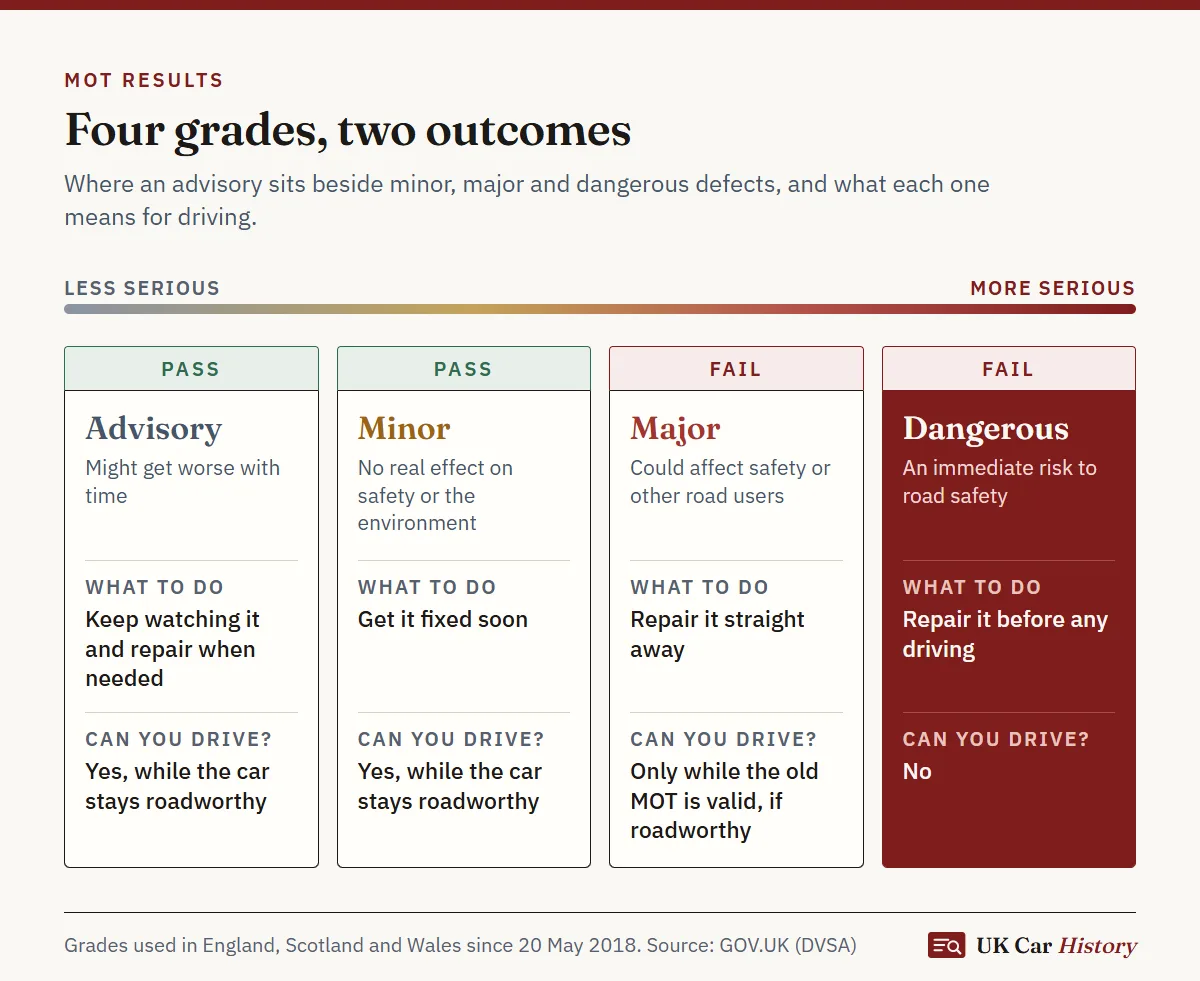
Since 20 May 2018, every problem found at an MOT in Great Britain has been placed on one of four levels. In GOV.UK's terms, put simply and starting with the most serious:
- Dangerous: an immediate threat to road safety, or serious harm to the environment. The result is a fail, and the car stays off the road until the repair is done.
- Major: a problem that could make the car less safe, endanger other road users or affect the environment. Also a fail, with the repair to be made straight away.
- Minor: no real effect on safety or the environment. The car passes, but the fault is to be fixed soon.
- Advisory: something that might get worse with time. The car passes, and the instruction is to monitor it and repair it if necessary.
Minor defects and advisories are easy to confuse, but the manual treats them differently. A minor defect is a real fault, and testers must record one wherever it applies. An advisory is optional: a heads-up about something that has not yet worn far enough to justify a fail.
MOT histories from before 20 May 2018 do not use these grades. Their entries are split only into reasons for failure and advisories.
Why do testers write advisories?
In the manual's terms, an advisory is available when something has worn, but not far enough for a rejection. Good practice, the manual adds, is to point out:
- wear that is approaching a fail but is not there yet;
- something unusual about the car that caught the tester's eye;
- a defect on a part the MOT does not cover.
Some advisories have nothing to do with wear. Where a structural repair is hidden under paint or underseal, the manual tells the tester to pass and advise, because the method cannot be seen. A defect on the spare tyre is advised rather than failed, and so is an asymmetric tyre fitted the wrong way round.
Testers judge condition with their own knowledge, experience and judgement, so two tests of the same car a few weeks apart can produce different advisories.
Can you drive with MOT advisories?
Yes. Advisories, with or without minor defects, sit on a pass certificate, so the car has passed. The catch is that the law does not stop at the MOT. GOV.UK places the duty to keep a car roadworthy on you every day of the year, and points out that a car with a valid MOT can still be unsafe. Driving one in a dangerous condition risks a fine of up to £2,500, 3 points on your licence and a ban.
Tyres are the clearest example. The legal minimum for a car tyre is 1.6mm of tread over the middle three-quarters of its width, all the way round. A note such as "worn close to legal limit" means that line could be crossed long before the next test, and from then on the tyre is illegal whatever the certificate says.
A fail is a different matter. After one, the car may leave the test centre under its own power only if two conditions hold: the old certificate has not yet expired, and nothing on the list is dangerous. Even then it must be roadworthy, and a dangerous item has to be repaired before the car is used.
Tyres and brakes are the two advisories not to sit on. Each wears with every mile, and either can drop below a legal or safe limit while the certificate still looks fine.
MOT advisory codes list: what does the standard wording mean?
An MOT history shows advisories in words, not codes. Testers pick the text from a set list in the DVSA's computer system, in which each advisory is linked to the defect that would fail the same part, and the DVSA releases those links in the lookup tables that come with its open MOT data.
Where an item carries a reference like 5.2.3, that points to the inspection manual, where 5.2.3 deals with tyres and 1.1.13 with brake pads and linings. The table explains common phrases, with the failing defect each is linked to, in plain words.
| Standard wording | Part | In plain words | What would fail instead |
|---|---|---|---|
| "wearing thin" | Brake pads or shoes | Friction material running low | Down to the wear indicator (major); thinner than 1.5mm (dangerous) |
| "worn, pitted or scored, but not seriously weakened" | Brake discs or drums | Grooves or pitting on the braking surface | Wear that is significant and obvious (major); cracked, or likely to fail (dangerous) |
| "corroded, covered in grease or other material" | Metal brake pipes | Rust, or grime hiding the pipe's state | Corrosion gone too far (major) |
| "close to minimum mark" | Brake fluid | Reservoir near its lower line | Well below the minimum line (major) |
| "worn close to legal limit/worn on edge" | Tyres | Tread nearly gone, or one shoulder wearing faster | Under 1.6mm of tread (dangerous) |
| "has a cut but not deep enough to reach the ply or cords" | Tyres | A cut in the outer rubber only | A cut down to the ply or cords (major) |
| "slightly damaged/cracking or perishing" | Tyres | Fine cracks, light damage or ageing rubber | The structure giving way and causing a tear (major or dangerous) |
| "corroded but not seriously weakened" | Suspension arms, sub-frames and spring mounts | Rust present, strength largely intact | Rust that has seriously weakened the part (major) |
| "ball joint has slight play" | Steering and suspension joints | Slight looseness | Play or wear beyond the limit (major) |
| "has light misting of oil" | Shock absorbers | An oily film on the outside of the damper | Fluid leaking seriously (major) |
| "leak, but not excessive" | Oil and other fluids | A slow seep | Enough to form a 75mm pool within 5 minutes (major); continuous and a serious risk (dangerous) |
| "is corroded but structural rigidity is not significantly reduced" | Body structure or chassis | Surface rust on the structure | Rust that has seriously cut rigidity (major) |
A pairing is not a prediction. How soon an advised part reaches its failing defect depends on the part, the car and the miles it covers.
Could an advisory fail the car next year?
It can. Parts that wear with distance, such as tyres and brake pads, can go from advised to failed within a year on a car that covers big mileages, and rust keeps spreading whether the car is driven or not.
Ask rather than guess: a garage can measure what is left of a pad or a tyre and price the job. If a later fail brings the car back for a partial retest, the tester is required to look again at whatever was advised first time round.
Your car passed with advisories: what next?
- Sort the list. Advisories on tyres, brakes and steering go to the top; minor and cosmetic notes can wait.
- Get someone qualified to show you each part and explain how worn it is. The tester is the obvious first person to ask.
- For rust on structural or load-bearing parts, get a quote now, while the repair is still small.
- Between tests, keep an eye on those parts yourself: tread depth, sidewall damage, new dashboard warning lights.
- Keep every invoice. A future buyer who reads the MOT history will see the advisory, and your receipt shows it was dealt with.
How should a buyer read a car's advisories?
On a car you are thinking of buying, advisories work as a free estimate of the bills ahead. Enter the registration in the free look-up on this page and go back two or three tests, reading from the oldest.
- The same note, test after test: nobody acted on it. A seller who says it has since been sorted should be able to show the receipt.
- Tyres, brakes or suspension on the newest test: costs to deduct from your offer.
- Rust notes that multiply over the years: spreading from one part to several suggests the underside needs a proper inspection.
The rest of the record, including test gaps and the mileage trail, is covered in what to look for in MOT history.
Where an advisory hints at an old repair, such as a covered structural weld, how to tell if a car has been in an accident explains the other signs to look for.
Questions and answers
Does an advisory make the MOT certificate any less valid?
No. A pass with advisories is a full pass, and the certificate runs for its normal term. The advisories are simply printed with it for you to act on.
Is a minor defect worse than an advisory?
Yes. A minor defect is an actual fault that testers must record wherever it applies, and it should be fixed soon. An advisory is a heads-up the tester may choose to give.
Why do different testers give different advisories?
Advisories are optional and rest on each tester's judgement of how worn a part is. Parts also wear, or get damaged, between one test and the next.
Do old MOT records show advisories?
Yes. Older tests simply list reasons for failure and advisories; the three defect grades only began on 20 May 2018.
Will the tester look at advisories again if my car is retested?
Yes. At a partial retest after a fail, the manual says testers must re-examine the minor defects and advised items from the first test, as well as the failures.
Should I fix advisories before selling a car?
It helps. Buyers can read every advisory in the public MOT history, so a receipt showing the work was done answers their first question before they ask it.
Sources
This guide is general information for people buying or owning a car in the UK, not legal or financial advice. UK Car History is an independent service, not affiliated with the DVLA, the DVSA or GOV.UK.