The short answer
A car with a SORN has been declared off the road: SORN is short for Statutory Off Road Notification, a notice from the keeper to the DVLA. While it is in force the car needs no tax or insurance, but it has to stay on a drive, in a garage or on other private land, and its only permitted trip on a public road is to or from a booked MOT or test.
Whether you own a car that is laid up or are thinking of buying one, this guide covers who must make a SORN, what it allows, how to check SORN from the number plate, what happens at a sale, the penalties when a car is neither taxed nor SORN, and how to start and end one.
What does a SORN actually do?
It takes the place of tax and insurance. Every vehicle on the DVLA's register must be taxed, unless its keeper says it will stay off the road and out of use; that statement is the SORN. GOV.UK says a vehicle under a SORN does not need insuring, and the DVLA automatically repays every full month of tax that was left.
There is nothing to renew. A SORN stays in force until the car is taxed again, sold, scrapped or permanently exported, and only while the car remains in the UK.
Who has to make a SORN?
GOV.UK lists four situations in which a keeper must declare the car off the road:
- The car is untaxed.
- It is uninsured, even for a few days, such as when a renewal is late.
- You plan to take it apart for parts before it is scrapped.
- It has just come to you, bought or as a gift, and you are not ready to use it on the road. The previous keeper's SORN does not carry over.
A car you have already sold is the exception: GOV.UK says no SORN is needed for it, even if a tax reminder for it turns up. What matters then is that the DVLA knows about the sale.
Where does a SORN car have to stay, and can it move?
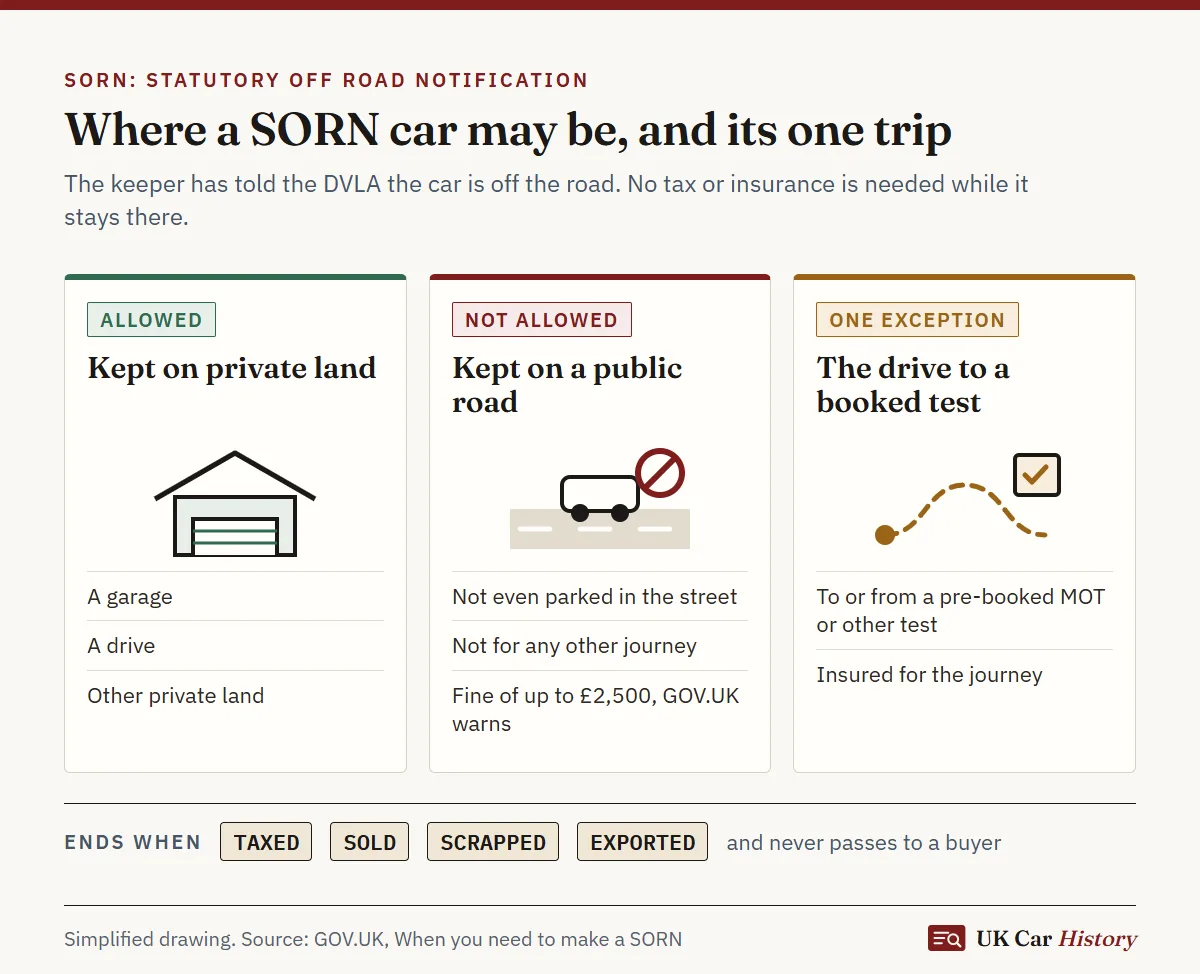
Anywhere except a public road. A garage, a driveway or other private land are the examples GOV.UK uses. What counts is where the car sits, not whether it moves: parking a SORN car on a public road breaks the rule.
The exception is a test. GOV.UK allows the car on a public road only when it is being driven to or from an MOT or other testing appointment booked in advance. Using it for anything else can end in court, with a fine of as much as £2,500. Insure it for that trip too: GOV.UK requires motor insurance for any vehicle used on roads and in public places.
How do you check SORN on a car you are looking at?
Type the registration into the free look-up on our car check home page. The result gives the tax position (taxed, with an end date, or SORN) and the MOT status. GOV.UK's own vehicle tax check gives the same answer from the DVLA's records.
Records lag a little: GOV.UK allows up to 2 working days for a newly approved tax or SORN to appear, so yesterday's tax may not show until tomorrow.
The status will not say why the car came off the road, so ask, and read the MOT history beside the answer. The last test date tells you how long it has been since the car was examined, and that test's advisories may hint at what needed doing.
Buying a SORN car: how do you get it home legally?
Nothing stops you buying one. Driving it away is another matter: that needs tax in your name and insurance first. So plan the journey home before any money changes hands:
- Look up the MOT first. An expired MOT on a car old enough to need one means a pass comes before tax.
- MOT still valid: arrange insurance from the moment you will drive, tax the car with the 12-digit number on the green new keeper slip, and drive it home.
- MOT expired: SORN it in your name, book the test, and take out insurance that covers the drive to the test centre and back. Once it passes, tax it.
- Keeping it off the road as a project: declare your own SORN at once and keep the car on private land.
Standing still for a long time is hard on a car, so look it over carefully, or pay for an inspection, before you agree a price. The taxing steps are in our guide to taxing a car you have just bought.
A seller's SORN does not survive the sale. From the day you become the keeper, the car needs tax or a SORN in your name; without either, the DVLA's penalties for an untaxed car fall on you.
Does a SORN pass to the buyer?
No. GOV.UK says the sale ends it and it cannot be transferred, so the buyer takes over an untaxed car and must tax it or declare a fresh SORN.
For a buyer, the DVLA's online SORN service has a route for new keepers that uses the reference from the front of the green V5C/2 slip, so a SORN in your name does not have to wait for your own logbook.
Untaxed and not SORN: what are the penalties?
The DVLA's enforcement policy, last updated on 15 July 2026, sets out what follows when a vehicle is untaxed without a SORN, or is used on the road while declared off it:
| Situation | The penalty | If it is not settled |
|---|---|---|
| On the register, untaxed and without a SORN | £80 late licensing penalty (£40 if paid within 33 days) | Debt collectors are brought in |
| On a public road, untaxed and without a SORN | £30 plus 1.5 times the unpaid tax | Court: the greater of £1,000 or 5 times the tax |
| Driven on a public road while SORN | £30 plus 2 times the unpaid tax | Court: the greater of £2,500 or 5 times the tax |
| No insurance and no SORN (Great Britain) | £100 fixed penalty (£50 if paid within 33 days) | Court: up to £1,000 |
The car itself can be clamped or taken away. The policy charges £100 to release a clamp within 24 hours, £200 once the car has been removed, and £21 a day for storage, and a car nobody claims within the storage period can be sold, broken up or crushed.
Making a SORN, and cancelling it later
GOV.UK offers three routes:
- Online, using the logbook's 11-digit number or the 16 digits on a tax reminder; new keepers use the reference on the green slip instead.
- By phone, at any time of day: 0300 123 4321.
- By post, on form V890, sent to the DVLA in Swansea.
Timing follows the tax. With the tax already expired, the SORN takes effect immediately; apply in the month the tax ends, and it begins on the 1st of the following month. GOV.UK says a SORN cannot be backdated.
Cancelling needs no separate step: once the car is taxed, the SORN falls away by itself. To be taxed, a car old enough for an MOT must have a valid one, and it should be insured before its first trip back on the road. What the tax will cost is set out in our guide to road tax costs.
Questions and answers
Can a SORN car be parked on the street outside my house?
No. A street is a public road, and keeping a SORN car there breaks the rule even if it never moves. It needs a drive, a garage or other private land.
Does a SORN have to be renewed every year?
No. It runs on, as long as the car stays in the UK, until the car is taxed, sold, scrapped or permanently exported.
Is there a tax refund after a SORN?
Yes, for each full month of tax still left. The cheque comes automatically and is posted to the keeper named on the logbook, at the address shown there.
Do I need insurance for a SORN car?
Not while the SORN is in force and the car stays off the road. The moment it returns to a public road, even just to reach a booked MOT, it needs cover.
Can I check SORN without the logbook?
Yes. The DVLA's tax status, SORN included, can be looked up free with nothing more than the registration number.
Is a SORN car a write-off?
Not necessarily. A SORN tells you nothing about damage: it only shows the keeper's declaration that the car is off the road. Insurance write-offs are recorded separately and found with a write-off check.
Sources
This guide is general information for people buying or owning a car in the UK, not legal or financial advice. UK Car History is an independent service, not affiliated with the DVLA, the DVSA or GOV.UK.