The short answer
Your cambelt change interval comes from the car maker, and it is really two limits: a mileage and an age. Whichever the car reaches first, the belt is due. Look in the handbook or service schedule for the figures, then ask a garage whether they still apply. If the engine uses a timing chain instead, there is no routine replacement: a chain is designed to last the engine's lifetime.
This guide shows how to work out when a particular car is due, why age matters as much as distance, what the belt does and what happens when one breaks, how belts, chains and "wet" belts differ, what sets the cost of the job, and what a used-car buyer should ask to see.
When to change a timing belt: the two limits
As soon as the car reaches the first of the maker's two limits. To pin that moment down for a particular car, collect five facts:
| What you need | Where to find it |
|---|---|
| Belt, chain or wet belt? | The handbook, or a garage that knows the make |
| The interval in miles and in years | The handbook or service schedule, confirmed with a garage |
| Any shorter schedule for town use | The same schedule, or the garage |
| Date and mileage of the last change | The invoice for that job |
| The car's age, if there is no invoice | The month of first registration, on the V5C or in our free look-up |
The sum is then simple. Add the maker's years to the date of the last change, and its miles to the mileage at that change: the deadline is whichever of those two points comes first.
No invoice, no evidence. In that case work on the basis that the original belt is still fitted, and date it from the car's first registration.
Why does age count as well as mileage?
A cambelt is rubber, and rubber ages whether or not it is working: over time it can turn brittle and crack. GEM Motoring Assist, a road safety organisation, says the belt should be replaced once the time limit has passed even if the mileage has not been reached.
How the car is driven matters too. GEM notes that a belt wears more in stop-start traffic than on long motorway runs, and that some manufacturers give a different schedule for cars used frequently in urban conditions.
Nor is the handbook figure fixed forever. GEM reports that some manufacturers cut their intervals once warranty data revealed belts failing ahead of time, so an older handbook may be out of date, and a garage can check. Technicians sometimes advise a different interval after looking at how a particular car has been used and maintained.
What does the cambelt actually do?
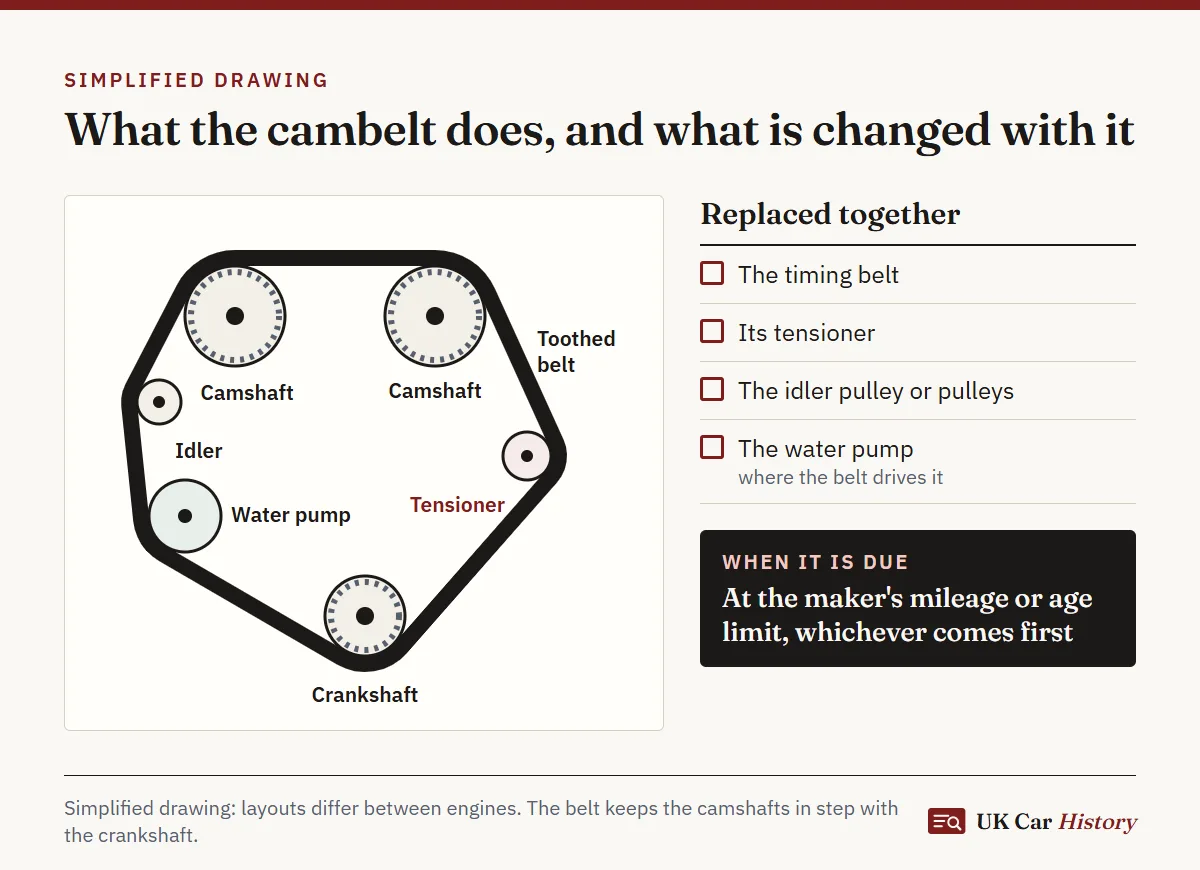
It keeps the top and the bottom of the engine in time. The crankshaft, at the bottom, is turned by the pistons; the belt carries that motion up to the camshaft or camshafts at the top, which open and close the valves. Because the belt has teeth, the valves always move at the right moment in relation to the pistons.
Two helpers keep it in place: a tensioner holding it taut and, usually, an idler pulley or two steering its path. Where the belt also turns the water pump, the pump tends to be renewed at the same visit.
What happens if the cambelt breaks?
Expect the engine to cut out immediately; GEM says it will likely seize. How much damage follows comes down to the engine's layout. In an interference engine, losing the belt can let the valves and pistons crash into each other. In a non-interference engine they should stay clear, though you will still need a tow and a new belt.
GEM puts the typical outcome of a snapped belt or chain plainly: an engine beyond saving and a huge bill. Measured against that, paying for a change on schedule is the economical choice.
A worn belt can give some signs, such as rough running, a lack of power, misfiring, stalling or difficulty starting, but they are not a reliable warning, and other faults cause the same symptoms.
The interval is a limit, not a suggestion. Running past it to save money, or waiting for symptoms, gambles the whole engine on one worn part.
Belt, chain or wet belt: which does your engine use?
Three designs do the same job in different ways:
| Design | Where it runs | What it needs |
|---|---|---|
| Cambelt (dry timing belt) | Outside the engine block, under a cover | Replacing at the maker's interval, with its tensioner and idler |
| Wet belt ("belt in oil") | Inside the engine, lubricated by the engine oil | Replacing as the maker specifies, with the engine oil kept in good order |
| Timing chain | Inside the engine, lubricated by the engine oil | Regular oil and filter changes, and a check if it starts to rattle |
GEM says wet belts are used on some engines, notably from Ford and the Stellantis group, and that many of those engines have since gone back to chains. A chain is intended to last the life of the engine, but that is not always how it turns out: a worn chain tends to rattle at idle, especially straight after a cold start, and neglected oil changes shorten its life.
Not sure which you have? The handbook should say, and any garage that knows the make can confirm it.
What sets the timing belt change cost in the UK?
No single price covers every car. The bill depends on:
- Access. Some engines give up their belt easily; on others much more must be dismantled, and every extra hour is charged at the garage's labour rate, which differs from place to place.
- What goes in. A proper job replaces the tensioner and idler with the belt. Whether a water pump is in the kit varies, so check the quote names one where the belt drives it.
- Whose parts. Genuine manufacturer parts and alternatives from other suppliers rarely cost the same.
- Chain instead of belt. By GEM's reckoning a chain job can cost at least double a belt change, above all when reaching the chain means taking the engine out.
Compare like with like: the same engine and the same list of parts, in writing from more than one garage. Make sure each is a quote and not an estimate. Citizens Advice draws the line clearly: a quote commits the trader to an agreed price for stated work, whereas an estimate is a best guess that can be exceeded within reason.
How can a buyer tell if the cambelt has been changed?
Raise the belt before any haggling starts: a change that is nearly due is effectively a bill attached to the car.
Only an invoice really proves it. Look for the garage's name, the car's registration, the date and mileage of the work, and a parts list that names the belt kit, plus the pump where one was fitted. A one-word stamp in the service book is a much weaker clue. Ask the garage named on it to confirm the work; our guide on how to check service history explains how.
Cross-check the invoice with the MOT readings, which our mileage history check page explains: the mileage on the bill ought to sit between the test before the work and the test after it. The MOT itself tells you nothing about the belt, because GOV.UK says the test does not cover the condition of the engine.
Low-mileage older cars catch buyers out. The odometer may suggest the belt has years left when the calendar says it is overdue. Without proof, either deduct the cost of a change from your offer or make the change a condition of the sale. Missing paperwork in general is weighed up in our guide to buying a car with no service history.
What if a new belt fails soon after it was fitted?
The invoice is worth keeping for the life of the car, and buyers will want it when you sell. Should the new belt, or anything fitted with it, fail shortly afterwards, put your complaint to the garage in writing without delay.
Work has to be done with reasonable skill and care, and Citizens Advice says that when it is not, you can ask for it to be redone or for money off. A written view from a second garage helps you make that case. If the garage belongs to a trade association, The Motor Ombudsman being one example, the association may offer free help to resolve the dispute.
That is a general outline only. For your own situation, contact Citizens Advice, or Consumerline if you live in Northern Ireland.
Questions and answers
Does the countdown restart when a car changes hands?
No. The interval runs from the last change on record, not from the day you bought the car. Without an invoice for a change, count from the car's first registration.
What is a cambelt tensioner?
The part that keeps the belt at the right tightness. It is replaced with the belt, along with the idler pulley that guides it, rather than being reused.
Should I buy a car whose cambelt is overdue?
Only with the cost of a change taken off the price, or with the change done before you pay. Until the belt is replaced, every journey puts the engine at risk.
What are the signs of a worn cambelt?
Rough running, a lack of power, misfiring, stalling or difficulty starting can all point to a worn belt, but they have other causes too. Do not rely on them: follow the maker's interval.
Can a garage recommend a different interval for my car?
The manufacturer sets the interval, but a technician may suggest changing the belt sooner based on the car's history or use. Makers have also revised some intervals, so ask whether yours has changed.
Sources
This guide is general information for people buying or owning a car in the UK, not legal or financial advice. UK Car History is an independent service, not affiliated with the DVLA, the DVSA or GOV.UK.