The short answer
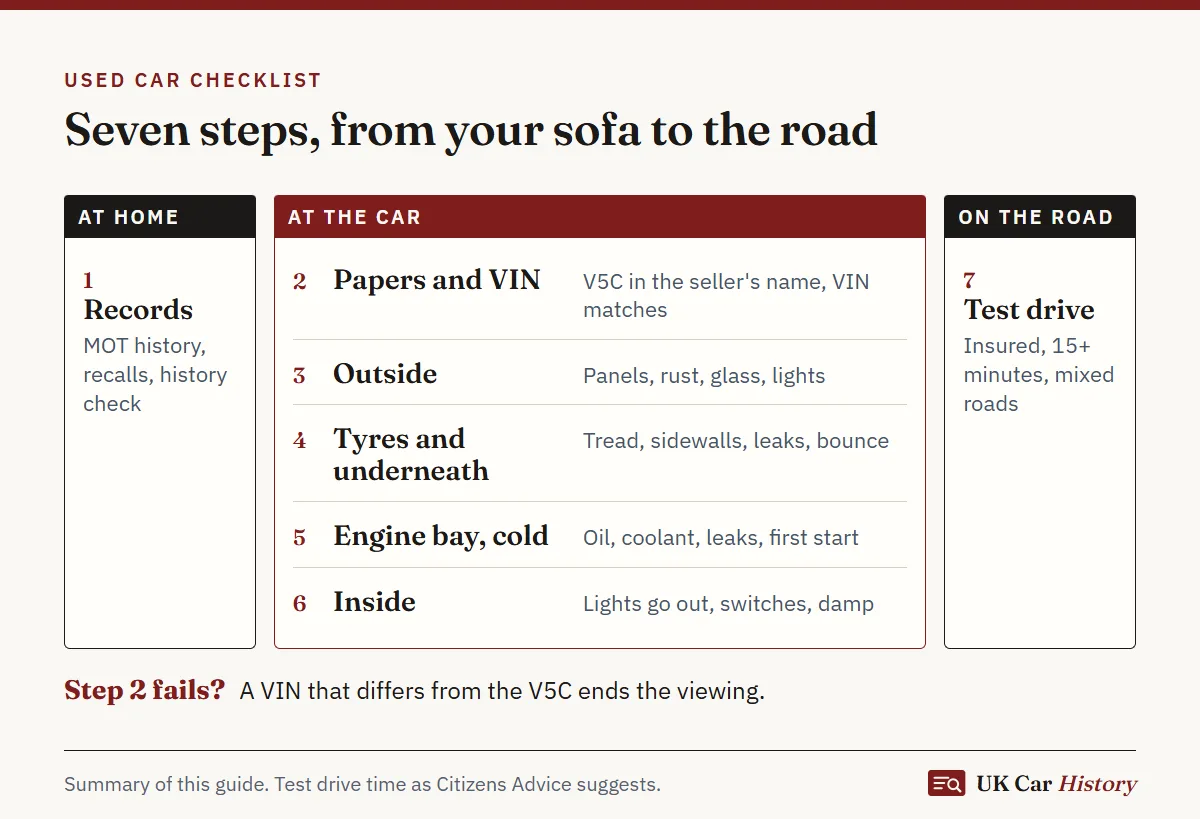
Knowing what to check when buying a used car starts before the viewing: read its MOT record and history records at home. At the car, check the V5C and VIN first, then the body, tyres and underside, the engine bay from cold, the interior, and finally drive it. View in daylight, preferably dry, and leave if the car and its papers do not agree.
This used car checklist follows a viewing from start to finish. Each step says what to look at and what a bad sign can mean, and the last section turns the common warning signs into a quick table.
What should you do before the viewing?
Get the registration from the seller. GOV.UK suggests asking for the make, model and MOT test number at the same time, comparing them with what the DVLA holds, and looking up whether a serious safety recall applies.
Next, the MOT history: for cars it reaches back to 2005 in England, Scotland and Wales, and to 2017 in Northern Ireland. Our free MOT history look-up lists each test with its result, advisories and mileage. Note every advisory: it is a place to look at the viewing.
Finance still owed, an insurance write-off or a theft report cannot be seen on the car. A car check by registration covers them, along with keepers, plate changes and a mileage verdict, in the Premium report (£7.99). A bad result saves you the journey.
Pack a small kit:
- a torch for the engine bay, wheel arches and underneath, even on a bright day;
- a tread depth gauge if you own one, and a rag for the dipstick;
- your licence and confirmation that you are insured to drive the car;
- a friend who knows cars, if you do not.
Does the car match its paperwork?
Check this first. A fault can be priced into an offer, but a car that is not the one on its documents cannot be fixed by a discount.
| Check | What should agree |
|---|---|
| Original V5C logbook | Name and address are the seller's, and the address is where you are |
| VIN | Read it off the car (ideally at two points) and compare every character with the V5C |
| Engine number | Matches the V5C, as GOV.UK advises |
| Make, model, colour, engine size | Same on the V5C, the MOT record and the car |
| Service record | Dates and mileages fit the MOT readings |
| Big jobs claimed | Invoices for any cambelt, clutch or brake work the seller mentions |
For the watermark and serial numbers, see checking a V5C is genuine; to confirm stamps with the garages, see how to check service history.
If the VIN on the car is not the VIN on the V5C, stop there. No price makes that car a safe buy.
What should you look for on the outside?
Walk round slowly, then crouch at each corner and look along the flanks. Daylight and, ideally, a dry day help: Citizens Advice notes that damage is harder to see when the car is wet.
- Panels and paint. Gaps should be even, colour and finish consistent, and there should be no paint on rubber seals. The guide on how to tell if a car has been in an accident explains repair signs.
- Rust. Wheel arches, sills, door bottoms and the boot lid edge. Bubbling paint means corrosion underneath.
- Windscreen. The MOT manual treats damage over 10mm across in zone A, a strip in front of the driver, or over 40mm elsewhere in the area the wipers sweep, as reasons for failure where it significantly affects the driver's view. A chip there may mean a repair or a new screen.
- Lights. No cracked or misted lenses. Stand outside while the seller operates every light, including indicators and brake lights.
- Doors, bonnet, boot. Each opens and closes easily, sits flush and locks.
- Stance. On level ground, no corner sits lower than the others.
What can tyres, wheels and the underside tell you?
- Tread. Legally, says the Highway Code, a car tyre needs 1.6mm of tread or more over the middle three-quarters of its width, all the way round. Check the inner edges too.
- Sidewalls. Cuts, cracks or bulges. A bulge means internal damage and a replacement.
- Wear pattern. One edge worn more than the other, or one side of the car more than the other, can mean alignment or suspension trouble.
- Matching. Same size and type across each axle.
- Spare and tools. Spare wheel or repair kit, jack, and the locking wheel nut key if fitted.
- Brakes and wheels. Heavily kerbed or cracked wheels; through the spokes, discs with deep grooves or a lip at the edge.
- Underneath, by torch. Fresh drips, heavy rust on sills, floor or subframes (especially if the MOT record mentions corrosion), and an exhaust that is holed, wired up or blowing.
- Bounce test. Push each corner down hard and let go. If it keeps bouncing, the Highway Code says the shock absorbers are worn.
What should you check in the engine bay, from cold?
Ask for the car to be left unused before you come, and touch the bonnet on arrival. Heat masks a hesitant start and smoke that disappears once things warm up.
- Oil. Wipe the dipstick, reinsert, read: the level should sit between the marks. A creamy deposit under the filler cap can mean coolant in the oil, though short trips can leave condensation there too.
- Coolant. Between the marks on the expansion tank. Open nothing on the cooling system unless the engine is cold.
- Leaks. Oil or coolant on the engine, below it, or where the car stood. An oddly spotless engine on a dirty car may be hiding something.
- Battery, belts, hoses. Corroded terminals; cracked, frayed or perished rubber.
- First start. Watch the exhaust. Blue smoke usually means oil burning, black smoke too much fuel; either deserves a mechanic's view.
Electric cars have no oil or exhaust to check; the battery is what matters. The guide to buying a used electric car covers battery and charging checks.
What should you check inside?
- Dashboard. Per the Highway Code, the warning lamps light up with the ignition and, apart from the handbrake lamp, switch off when the engine runs. A light that stays on needs an explanation, and so does one that never lights at all.
- Wear for the miles. A polished steering wheel, worn pedals or a sagging driver's seat on a low-mileage car is a reason to compare the odometer with the MOT readings.
- Switches. Windows, mirrors, locking, wipers, horn, heater, heated screens, and air conditioning that blows cold.
- Seats and belts. Every seat adjusts; every belt fastens, releases and retracts.
- Damp. A musty smell, wet carpet or misted glass. Press each footwell and lift the boot floor.
- Keys. Count them against what the advert or the seller promised, and check that each one locks the doors and starts the car.
What about the test drive?
Only drive once you know you are insured. Citizens Advice says not to drive an uninsured car, and suggests at least 15 minutes on different types of road. Keep the radio off. For a stage-by-stage route, from cold start to the last look underneath, see the test drive checklist.
Why check the seller as well as the car?
A sound car from the wrong seller is still a risk. You want the keeper named on the V5C, at the address it shows, with a clear account of how long they have owned the car and why they are selling. A "private" seller who turns out to be trading may be trying to avoid a dealer's legal duties.
Which questions to put, and which answers should worry you, are in questions to ask when buying a used car. If you cannot judge the car's condition yourself, a pre-purchase car inspection goes further than any checklist, with a ramp for the underside and a reader for stored fault codes.
Things to check when buying a second hand car: what each sign means
Almost every used car shows something. Here is what the common signs can mean, and the sensible next step.
| Sign | Possible cause | Next step |
|---|---|---|
| VIN or details differ from the V5C | Not the car on the paperwork | Walk away |
| Advisory on the MOT, no invoice for the fix | Work still to pay for | Inspect that item and price it into your offer |
| Warning light stays lit | A fault the car has detected | Get it diagnosed before agreeing a price |
| Pulls to one side when braking | Brake fault or wrong tyre pressures | Check pressures, then have the brakes looked at |
| A corner keeps bouncing | Worn shock absorbers | Allow for replacement in your offer |
| Tyre worn on one edge | Alignment or suspension problem | Ask for an alignment check |
| Blue or black smoke | Oil burning (blue), too much fuel (black) | Have a mechanic look first |
Questions and answers
Is it a bad idea to view a used car in the rain?
It makes the job harder. Rain on the bodywork masks scratches, dents and colour differences between panels. Citizens Advice recommends daylight and, if possible, dry weather.
I know nothing about cars. Can I still use this checklist?
Yes. Nearly everything here is done with your eyes, ears and a torch. If you are unsure what you are seeing, bring a friend who knows cars or book an independent inspection.
Which documents should a used car come with?
The original V5C logbook, the service book or digital record, invoices for work done, the handbook and every key. Without the V5C, do not buy.
What if the engine is already warm when I arrive?
Ask why. A warm engine can hide a slow start, smoke that clears as it heats up, or a rattle that fades. If you can, arrange to come back when it is cold.
What matters most on a used car checklist?
That the car is the one on its papers and has a clean record: a VIN matching the V5C, and no finance, write-off or theft record. Wear can be priced in; an identity or record problem usually cannot.
Sources
This guide is general information for people buying or owning a car in the UK, not legal or financial advice. UK Car History is an independent service, not affiliated with the DVLA, the DVSA or GOV.UK.