The short answer
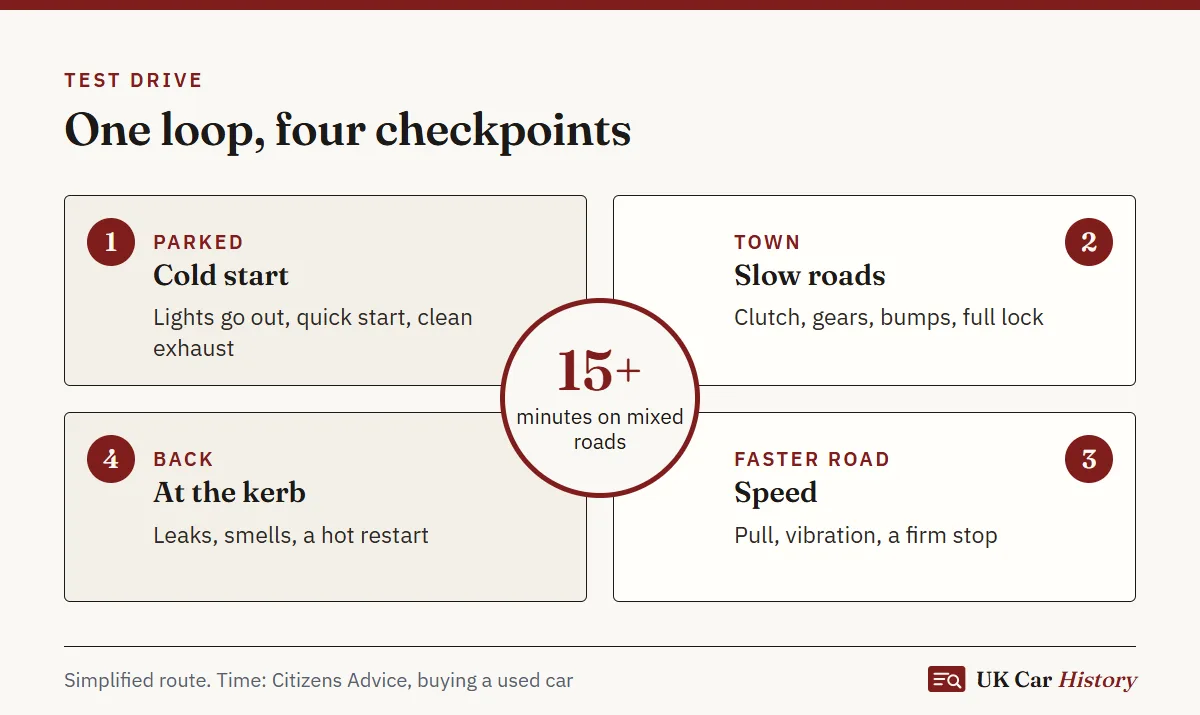
Work through a test drive checklist in four stages: before setting off (insurance, licence, a cold start), on town roads (clutch, gears, low-speed brakes, bumps, full lock), on a faster road (power, vibration, a firm stop) and back at the kerb (leaks, smells, a hot restart). Citizens Advice suggests at least 15 minutes on different types of road.
This guide follows that route and says what to feel, hear and smell at each point. For what to inspect before you get in, from paperwork to tyres, see the used car checklist.
What must be sorted before you take the keys?
Insurance comes first. Citizens Advice suggests asking your own insurer whether you are covered to drive someone else's car, or asking the trader or private seller whether their insurance covers you. Driving without cover, it warns, leaves you paying for any damage and risking points on your licence. The guide on how to check if a car is insured explains the options.
Bring your driving licence. If your licence covers category B automatic only, GOV.UK says you can drive an automatic car and nothing else, so a manual is off the list.
Agree the route with the seller in advance: some town driving, a faster road and a quiet place to manoeuvre. Expect them, or someone from the dealer, to ride along.
If you are not certain you are insured for this car, do not drive it, whatever the seller says about their policy.
What does a cold start tell you?
An engine that has been running for a while can hide faults, so ask for the car to be cold when you arrive, start it yourself, and have someone watch the exhaust.
- Dashboard lights. With the ignition on, the warning lights come on. According to the Highway Code, all but the handbrake light should switch off as the engine fires. One that stays lit needs explaining.
- How it fires. A quick, eager start is what you want. Slow, reluctant cranking can point to a weak battery or starter.
- Early noises. Rattles, ticks or knocks that fade as it warms may be harmless, but are worth a mechanic's opinion before you pay.
- Exhaust. Thin white vapour on a chilly morning is usually condensation and clears quickly. Dense white smoke that persists once warm can mean coolant is getting into the engine.
- Tick-over. It should settle to a steady idle, without the revs rising and falling or the body shaking.
What should you check on town roads?
Slow, stop-start driving shows up the clutch, the gearbox and the low-speed manners of the car.
| Check | Good sign | Worth asking about |
|---|---|---|
| Pulling away | Smooth take-up, same feel each time | Judder, or a bite right at the top of the pedal |
| Each gear and reverse | Clean engagement, stays in gear | Crunching, or jumping out when you lift off |
| Automatic gearbox | Prompt, gentle changes | A heavy clunk into drive, flaring revs, jerks |
| Speed bumps | Quiet, settles at once | Knocks or clunks, or the car keeps bouncing |
| Full lock in a car park | Smooth and silent each way | Clicking or knocking as you turn |
| Hill start | Parking brake holds and releases fully | Rolling back, or a warning message |
Electric and hybrid cars run quietly, which makes suspension and wind noise easier to pick out. Their battery checks are covered in the guide to buying a used electric car.
What should you check on a faster road?
- Pull. The engine should gather speed smoothly through the revs, with no hesitation, surging or misfire.
- Clutch slip. In a higher gear, where it is safe, press the accelerator firmly. If the revs climb but the speed does not follow, the clutch may be slipping.
- Tracking. On a straight, level stretch the car should hold its line with the wheel straight, without drifting.
- Vibration. A shake through the wheel that appears at a particular speed can come from wheel balance or a damaged tyre.
- Hum or whine. If the noise follows the car's speed, not the revs, a wheel bearing or the gearbox may be the source.
- A firm stop. With nothing close behind, brake firmly. The pedal should feel firm and progressive, not spongy, with no shudder through the pedal or wheel and no grinding.
Which warning lights and smells mean stop?
The Highway Code is direct on these. If a warning light comes on while you are driving, it says to stop and investigate, because it could mean a serious fault. A charge warning light, for instance, may mean the battery is not charging.
A car that veers to one side under braking most likely has a brake fault or tyres at the wrong pressure, according to the Code. It also says to look into any odd smell at once, for example burning rubber, petrol or an electrical fault.
Keep an eye on the temperature gauge, if there is one. It should reach its usual position and stay there; a rising needle or a coolant light points to overheating.
Which controls are worth trying on the move?
Some faults only show while driving. Try these yourself, or ask a passenger:
- indicators, and whether they cancel after a turn;
- heater and demister clearing the screen, and air conditioning blowing cold;
- wipers at each speed, and the washers;
- cruise control or speed limiter, if fitted;
- parking sensors and reversing camera as you back into a space.
How long should a test drive be?
Citizens Advice suggests at least 15 minutes on different types of road. Think of that as a starting point. You want the engine fully warmed up, because some faults wait for heat, and you want every gear used, at town speeds and faster ones.
A loop that starts and ends where the car is parked, with town streets, a faster road and a car park in between, covers it. If the seller wants to cut the drive short or keep to a few quiet streets, ask why, and be ready to leave if the answer is weak.
What should you check back at the kerb?
- Hot idle. Leave it running for a minute. It should still tick over smoothly now it is warm.
- Underneath. Look for fresh drips of oil, coolant or other fluids on the ground.
- Smells. Sweetness from the engine bay can be coolant; a sharp burning smell after the hill start can be a hot clutch.
- The dashboard. Make sure no warning light came on during the drive.
- Hot restart. Switch off, wait briefly, start again. Reluctance to restart when hot is worth getting to the bottom of before you pay.
Then hold your notes against the car's MOT record, which our free MOT history look-up shows. Your notes gain weight when they echo the record: a knock from the suspension where a tester flagged worn joints, or uneven braking where the brakes drew an advisory.
What should you do with what you noticed?
Write it down straight away, while it is fresh. A single fault is rarely a deal-breaker on a used car. Still, ask the seller about each one and let the price take account of it.
Where you are out of your depth, say a clutch you suspect of slipping or a warning lamp nobody can account for, book a pre-purchase car inspection and settle the price afterwards.
Questions and answers
Will the seller let me test drive alone?
Rarely. A private seller usually comes along, and a dealer may send someone or ask for your licence details first. Whoever is in the car, check your insurance before setting off.
Should the radio be on during a test drive?
No. Keep it off so you can hear knocks over bumps, a whine that rises with speed, grinding from the brakes or gearbox, and clicks on full lock.
A warning light came on during my test drive. What now?
Stop when safe and find out what it means before driving further. Hold off on any price until someone has found the cause and the seller has explained or repaired it.
Can a test drive find every problem?
No. It shows how the car behaves on the day, not hidden wear or faults that come and go. For the rest, you need an inspection and the car's records.
Is a test drive in an electric car any different?
Brakes, steering, suspension and controls get the same checks. The main extra is the battery, so ask about its health and check the charging cable and port work.
Sources
This guide is general information for people buying or owning a car in the UK, not legal or financial advice. UK Car History is an independent service, not affiliated with the DVLA, the DVSA or GOV.UK.