The short answer
To learn what insurance group your car is in, enter its registration or its exact version into a car insurance group checker, or ask an insurer for a quote. The group is a number from 1 to 50 given to each version of a model: for the same driver, a low number usually means a lower premium than a high one. It rates the car, not the person driving it, and insurers treat it as advice.
Below: how to look the group up and make sure it is the right version, who works the groups out and from what, why two cars with the same badge can sit far apart, what else decides your price, the newer rating system that is taking over, and how a write-off or a modification changes the picture.
How do you find out what insurance group your car is in?
- Pin down the exact version: the trim level, the engine size and fuel, the year, and the make and model. Most of it is in the advert; ask the seller for the rest.
- Put the registration, or the make, model and version, into a free car insurance group checker. Insurers and price comparison websites offer them.
- Read what the checker found and compare it with the car: the same engine and the same trim. A near miss can land you on a different group.
- Ask for a quote on that exact car before you agree a price with the seller.
Step 4 is the one that matters. The group is a starting point, and the quote is the figure you will actually pay.
Insurance groups are not part of our reports. What the free look-up on our car check page does give you is the version detail a checker needs: make, model, fuel, engine size and the month of first registration.
Who works out insurance groups, and from what?
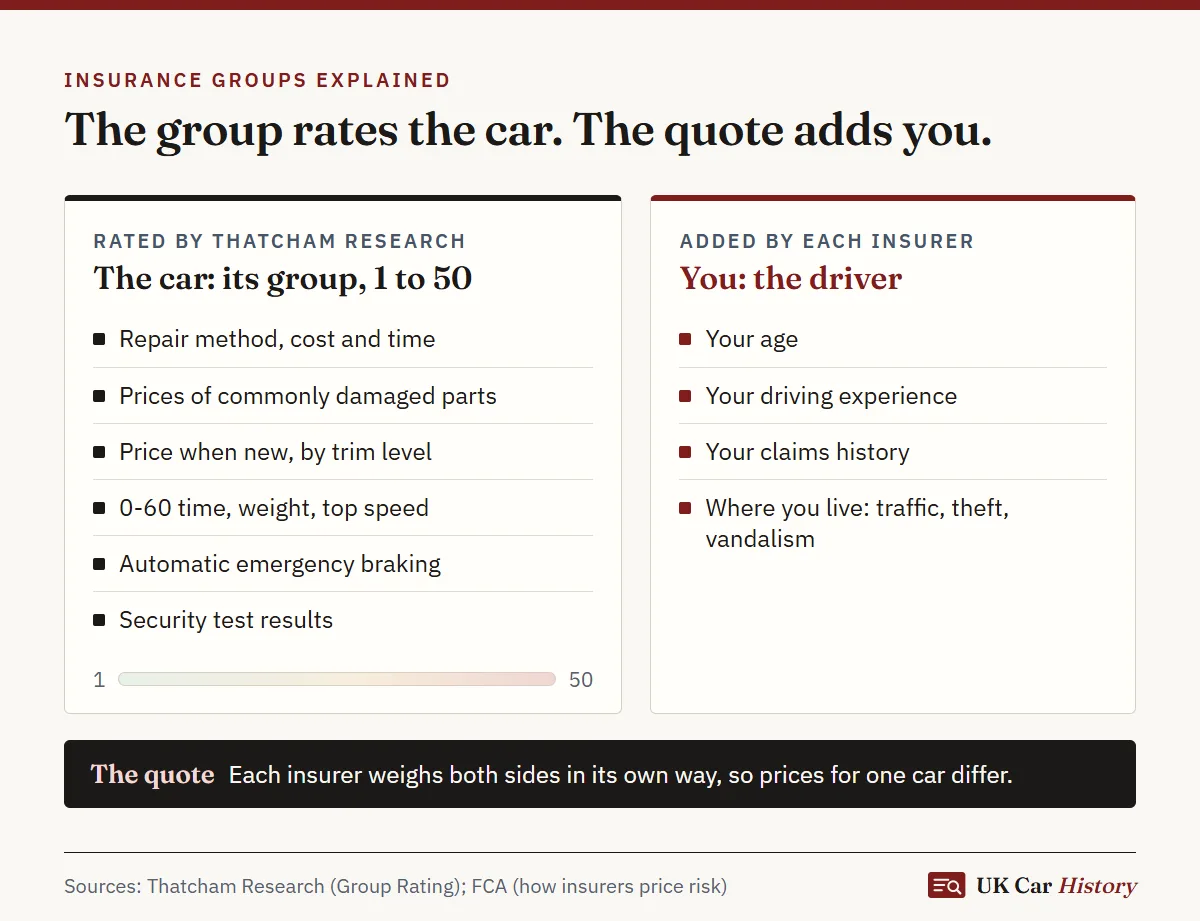
The government plays no part in setting groups: the insurance industry runs the system. Thatcham Research gathers 125 attributes for each vehicle and sends the data weekly to a panel of the Association of British Insurers (ABI), where a standard formula, overseen by insurance industry experts, turns it into an advisory group.
Cars are placed between 1 and 50. Light vans use the same scheme but start higher, between 21 and 50. Thatcham itself calls the result an indicative view of how risky a vehicle is compared with others.
Each vehicle also has a unique eight-digit ABI code, a standard description of the model and version used across the insurance industry. Comparison sites, insurers and their software suppliers all draw on these same codes and groups, which is why a checker and an insurer are working from identical data.
Which features put a car in a higher insurance group?
Most of what Thatcham weighs comes back to one question: how much would a claim on this car cost?
| Factor | What is looked at |
|---|---|
| Repair | How the car would be put right after a claim, what that costs and how long it takes |
| Parts | Costs taken from a set list of the panels and components that accidents damage most |
| Price new | The new price, with the differences between trim levels |
| Performance | Acceleration from 0 to 60, top speed and weight |
| Safety | Whether automatic emergency braking (AEB) comes as standard, and how well it performs |
| Security | Results in a benchmark set of security tests, shown as a suffix to the group |
Why can two cars with the same badge be in different groups?
Groups are given version by version, so the badge on the boot is only part of the story. Two of the factors above, the price when new and the performance, change from one version to the next.
A higher trim level usually costs more new, and a bigger or more powerful engine makes a car quicker. Either can put one version in a higher group than the entry-level car of the same model. That is why a group checker asks for the exact version, and why it is worth confirming the engine and trim against the car before you trust the number.
What else decides the price you are quoted?
The group describes the car. The rest of the price describes you. According to the Financial Conduct Authority, which regulates insurers, pricing is based on risk: your age, how long you have driven and your claims record, plus local factors such as heavy traffic, theft and vandalism where you live.
Insurers also weigh those risks differently from one another. So one car can be quoted very differently for two drivers, and one driver can get very different quotes for the same car. A low group is a good sign, not a promise of a cheap policy.
What is the Vehicle Risk Rating, and is it replacing groups?
Yes, gradually. On 24 September 2024 Thatcham Research launched a Vehicle Risk Rating made of five assessments: performance, damageability, repairability, safety and security. Each one is scored from 1 to 99.
Thatcham set a dual-rating period of 18 months in which the old groups and the new rating both apply, after which the new rating becomes the only reference. Where an old-style group stays fixed from the model's launch, the new rating is dynamic and can be revised as new risk information arrives during the car's life.
The scales are different, so do not try to turn one number into the other. For a recent model, a checker may show the new rating beside the group or in its place; whichever you see, only a quote for that exact car tells you the price.
Does a past write-off change what you pay to insure a car?
It can, even though the group stays the same, because the insurer asks about the individual car as well as the model. GOV.UK's guide to buying repaired write-offs says not all insurers will automatically cover a car that has been written off, and that insuring one can cost more.
The same guide tells buyers to let their insurer know that the car was declared a total loss, and warns that a claim can otherwise be rejected for non-disclosure. It also suggests getting a quote before you buy, so a lower price is not eaten up by a higher premium. The guide to Cat S and Cat N insurance and finance goes into the detail.
So check for a write-off record first, then ask for quotes. Any write-off on record, with its category, appears in the Premium report (£7.99); the category car check page explains what each category means.
Tell the insurer about a repaired write-off when you ask for the quote, not after a claim. GOV.UK warns that leaving it out can give the insurer grounds to reject a claim.
Which modifications do you need to tell your insurer about?
The Financial Ombudsman Service says to tell your insurer about any change to the car as soon as possible, and to check your policy for what has to be declared. Its examples run from tinted windows and alloy wheels, which can raise a premium, to engine tuning such as a remap.
If you claim without having declared a significant change, the insurer may argue that the policy is invalid, for instance because it would have charged more or not covered the car at all. Buying a car that might have been remapped? The bhp check guide shows how to set its power against the logbook figure.
Questions and answers
Does a low insurance group mean cheap insurance?
Not by itself. A low group means the car is rated as a lower risk, but your quote also depends on your age, driving experience, claims history and where you live.
What insurance groups do vans have?
Vans share the scheme with cars but sit on a narrower band, 21 to 50, where cars use the full 1 to 50.
Will my car stay in the same group for its whole life?
Under the 1 to 50 system a group is fixed when the model is launched. Its replacement, the Vehicle Risk Rating, can be revised during a car's life whenever new evidence about its risk appears.
Does the government set insurance groups?
No. They come from the insurance industry: Thatcham Research supplies the vehicle data, and a panel of the Association of British Insurers turns it into an advisory group.
Can an insurer price a car above or below its group?
Yes. The group is advisory, an indicative view of the car's risk. Each insurer adds its own claims experience and weighs the risks in its own way.
Do I have to tell my insurer the car is a repaired write-off?
GOV.UK's guide says buyers should tell their insurer that the car was declared a total loss, and warns that a claim can be rejected for non-disclosure if they do not.
Sources
- Thatcham Research: Group Rating
- Thatcham Research: Vehicle Risk Data (ABI codes, car and van scales)
- Thatcham Research: New Vehicle Risk Rating model launching (September 2024)
- FCA: Motor insurance pricing and local area ethnicity
- Financial Ombudsman Service: Car modifications and insurance
- GOV.UK: Buying repaired written-off vehicles, a consumer guide
This guide is general information for people buying or owning a car in the UK, not legal or financial advice. UK Car History is an independent service, not affiliated with the DVLA, the DVSA or GOV.UK.