The short answer
For a bhp check that costs nothing, open the car's V5C logbook and find the box marked P.2, which records the engine's peak output in kW. Multiply that number by 1.341 and you have the brake horsepower, so a car listed at 85 kW has about 114 bhp.
Below you will find where the box sits and why it can be blank, a conversion table for kW, bhp and PS, what a check by registration can and cannot tell you, and the five usual reasons an advert claims a different power from the logbook.
Where is the power figure on the V5C logbook?
The vehicle details on a V5C are labelled with letter-and-number codes taken from a shared European layout for registration papers, which the UK began using in 2004. Two of them sit close together and are easy to mix up:
| Code | What it records | Unit |
|---|---|---|
| P.1 | Cylinder capacity: the size of the engine | cc (cubic centimetres) |
| P.2 | Maximum net power of the engine | kW (kilowatts) |
P.2 is the one you want. The number comes from the manufacturer's rating for that version of the model, not from a test of the car on your driveway. When a new car is registered, the DVLA's guidance asks for the power to be copied from the Certificate of Conformity and rounded to a whole kW.
Do not be surprised by an empty P.2 box. The European layout only asks for the power where it is available, so some logbooks leave it out. The maker's handbook or a report holding the car's specifications can fill the gap.
Kilowatts, bhp and PS: what is the difference?
All three measure the same thing, the rate at which the engine can do work. They differ only in the size of the unit, which is why one engine can carry three different numbers.
- kW is the metric unit of power. It is what the logbook prints.
- bhp (brake horsepower) is based on the imperial horsepower of 745.7 watts. It is what most UK adverts quote.
- PS is metric horsepower, 735.5 watts, common in brochures from European makers. It is a little smaller than a bhp.
Because a PS is about 1.4% smaller than a bhp, the PS figure for an engine is always slightly higher. At low power the gap hardly shows (120 PS is 118 bhp), but it widens as power rises: 200 PS comes to about 197 bhp.
A specification that says only "hp" could mean either kind of horsepower. Find out which before you set it beside another figure.
How do you turn the logbook's kW into bhp?
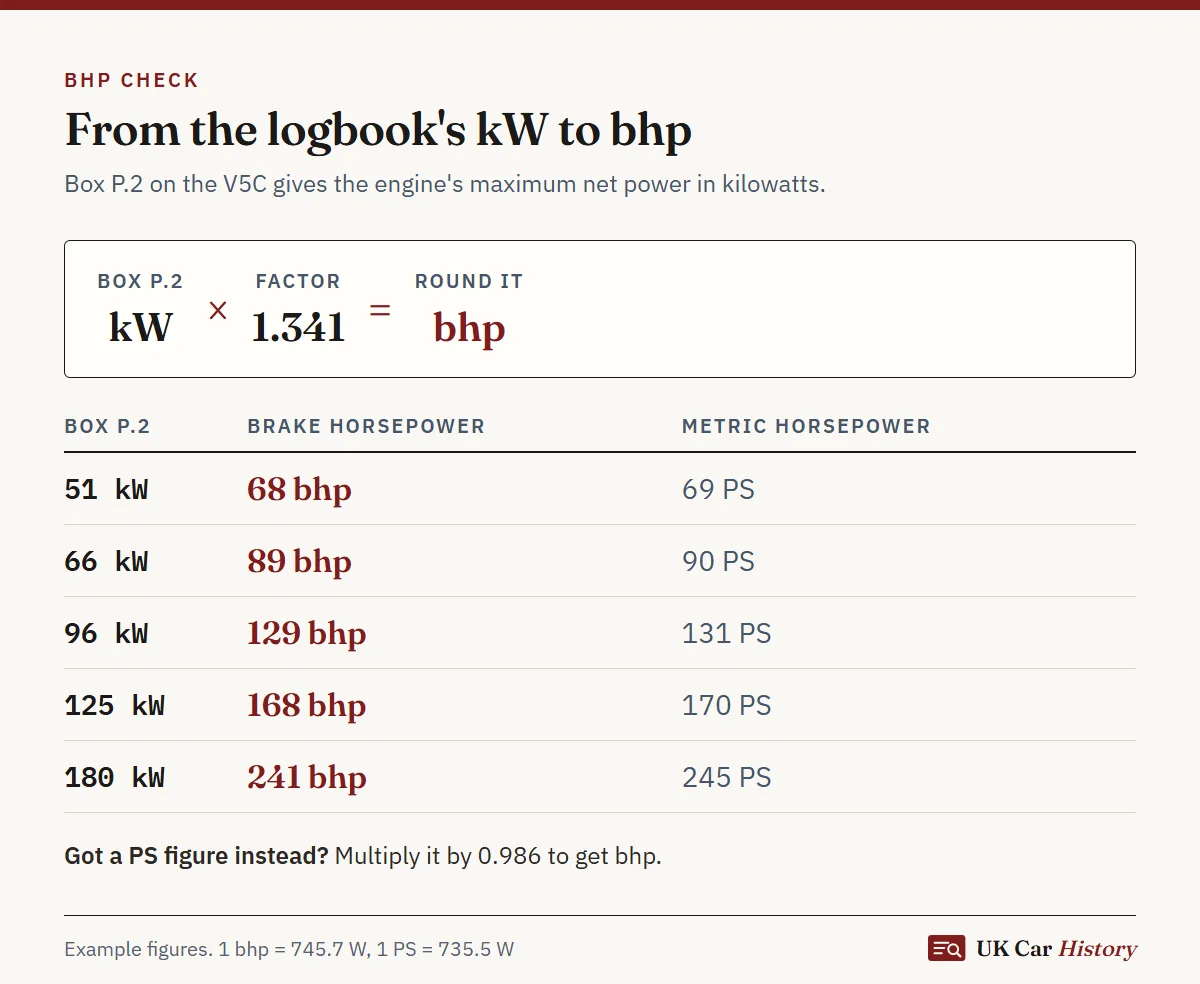
One multiplication does it: kW × 1.341, rounded to the nearest whole number. To test an advert, run it backwards and divide the bhp by 1.341. A car sold as 120 bhp should show about 89 or 90 kW on its V5C.
| Box P.2 | Brake horsepower | Metric horsepower |
|---|---|---|
| 51 kW | 68 bhp | 69 PS |
| 66 kW | 89 bhp | 90 PS |
| 96 kW | 129 bhp | 131 PS |
| 125 kW | 168 bhp | 170 PS |
| 180 kW | 241 bhp | 245 PS |
Allow for rounding. The logbook holds whole kilowatts, and each one is worth more than a bhp, so your answer can sit a bhp or so either side of the brochure figure without anything being wrong. A gap of ten bhp or more needs an explanation.
Is there a BHP reg check that works from the number plate?
Not through the free government services. The DVLA's vehicle enquiry on GOV.UK shows the engine size, fuel, CO2 emissions and the tax and MOT status, and its data for developers includes the engine capacity in cc but no power figure at all.
Our free look-up on the car check home page works from the same records: make, model, colour, fuel, engine size, year, CO2, tax, every MOT test and recalls. It does not show the bhp either.
You also cannot work the power out from the cc. Engine size is the volume swept by the cylinders; power depends on much more, such as turbocharging and tuning, so two 1,500 cc engines can be far apart.
For the power by registration you need specification data. The Premium report (£7.99) shows a specifications section, with the power, torque, 0-60 mph time and top speed where the data provider holds them, next to the finance, write-off and stolen checks.
Why check the horsepower before you buy?
A minute with the logbook can save you from three costly surprises.
- Your insurance quote. Insurers use the group ratings from 1 to 50 set by Thatcham Research. Performance, such as the 0-60 time and top speed, is among the factors, as is the price when new, which tracks the trim. Ask for a quote on the exact version first.
- Paying for the right model. If the advert names a stronger version than the logbook shows, the price you agree may be for an engine the car does not have.
- Hidden tuning. When a seller talks of more power than P.2 allows, the engine may have been remapped. That affects what your insurer needs to know.
The advert says more power than the logbook: why?
There is usually an innocent reason, but rule each one in or out before you pay:
- The units differ. The seller may have quoted PS or kW. Convert first with the table above.
- Rounding. One or two bhp either way is normal.
- It is another version. The car may simply be a lower trim than the advert says. Our guide to car specs by reg helps you pin down the exact model.
- The engine was replaced. GOV.UK lists a change of engine or of cylinder capacity among the changes that must be recorded on the V5C. Ask to see the updated logbook and the invoice.
- It has been modified. Ask who did the work, when, and for the paperwork, then get an insurance quote that includes it.
If the VIN or engine number on the car does not match the logbook, the question is no longer about power. It is about whether the car is what it claims to be, and the guide on how to spot a cloned car explains the warning signs.
Do you need to tell your insurer about a remap?
The Financial Ombudsman Service gives "remapping the Electronic Control Unit (ECU) for better engine performance" as one example of a modification insurers expect to hear about, alongside changes as small as tinted windows or new alloy wheels.
It warns that an undeclared modification can leave a policy invalid, because the insurer may say the change made the car a higher risk or would have meant a higher premium. Where a policy clearly asks for modifications to be declared and one was not, it says a complaint is unlikely to be upheld.
For buyers, the Ombudsman suggests asking the seller questions and going through the paperwork to find out whether the car was modified before. Check your policy wording and ask your insurer what it needs. This is general information, not advice on your own cover.
More power than box P.2 suggests can mean a tuned engine. Find out before you insure the car, and declare what you know, even if the work was done by an earlier owner.
Questions and answers
Which box on the V5C shows how powerful the engine is?
The box coded P.2, which gives the maximum net power in kilowatts. P.1, just above it, is the engine size in cc, not the power.
Is a kilowatt more than one horsepower?
Yes. One kilowatt equals about 1.341 brake horsepower, so the kW figure on the logbook is always smaller than the same engine's bhp figure.
Can I work out the bhp from the engine size?
No. Engine size measures the volume of the cylinders, while power depends on the whole design, including any turbocharger. Two engines of the same size can have very different outputs.
What is 150 PS in bhp?
About 148 bhp. Multiply a PS figure by 0.986 to turn it into bhp, or by 0.7355 to turn it into kilowatts.
Why is my result a little different from the brochure?
The logbook rounds the power to a whole kilowatt, and one kilowatt is worth more than one bhp, so a difference of a bhp or so is just rounding.
Does a free registration look-up show horsepower?
No. The free government records give the engine size, fuel and CO2 but not the power. Use the logbook, or a report with specification data, which shows it where the data is held.
Sources
- GOV.UK: Change vehicle details on a V5C registration certificate
- GOV.UK: First registration of a new motor vehicle (V55/4, with the V355/4 guide)
- legislation.gov.uk: Council Directive 1999/37/EC, Annex I (code P.2)
- GOV.UK: Get vehicle information from DVLA
- Financial Ombudsman Service: Car modifications and insurance
- Thatcham Research: Group Rating
This guide is general information for people buying or owning a car in the UK, not legal or financial advice. UK Car History is an independent service, not affiliated with the DVLA, the DVSA or GOV.UK.