The short answer
A VIN number check settles two questions: which manufacturer the 17-character code belongs to, and whether the car you are looking at really matches its V5C logbook. Finance, theft and write-off records are beyond it. In the UK those are reached through the registration, so the VIN is your test of identity and a history report is your test of the car's past.
Below you will find the three things people mean by a VIN check, how the 17 characters are built, where a free VIN check runs out, three ways to get the VIN when all you have is a number plate, and the steps that turn the VIN into a test of identity at a viewing.
Which kind of VIN check do you actually need?
Every modern vehicle leaves the factory with a vehicle identification number (VIN), a 17-character code chosen by its manufacturer. "VIN check" gets used for three quite different jobs, and only one of them looks at a car's past:
| Job | What it involves | What it can answer |
|---|---|---|
| Decoding | Reading what the code itself says | Which company built the car, and possibly its model year |
| Matching | Setting the car's VIN beside the logbook and the record | Whether the car and its paperwork belong together |
| A history check | Searching records held against the vehicle | Finance owed, write-offs, theft, keepers and plate changes |
Decoding and matching cost nothing but a few minutes. A history check needs access to records, and in the UK those are searched by the registration rather than by the VIN.
How is a 17-character VIN built?
The type-approval rules kept in UK law set the layout. A VIN has three sections: a three-character world manufacturer identifier, which is the maker's code; a six-character vehicle descriptor section, which sets out the vehicle's general characteristics; and an eight-character vehicle indicator section, whose last four characters must be digits.
Those rules also demand that no two vehicles share a VIN, that the maker can still trace the vehicle from it three decades later, and that I, O and Q never appear. A number containing one of those letters has been misread or is not genuine.
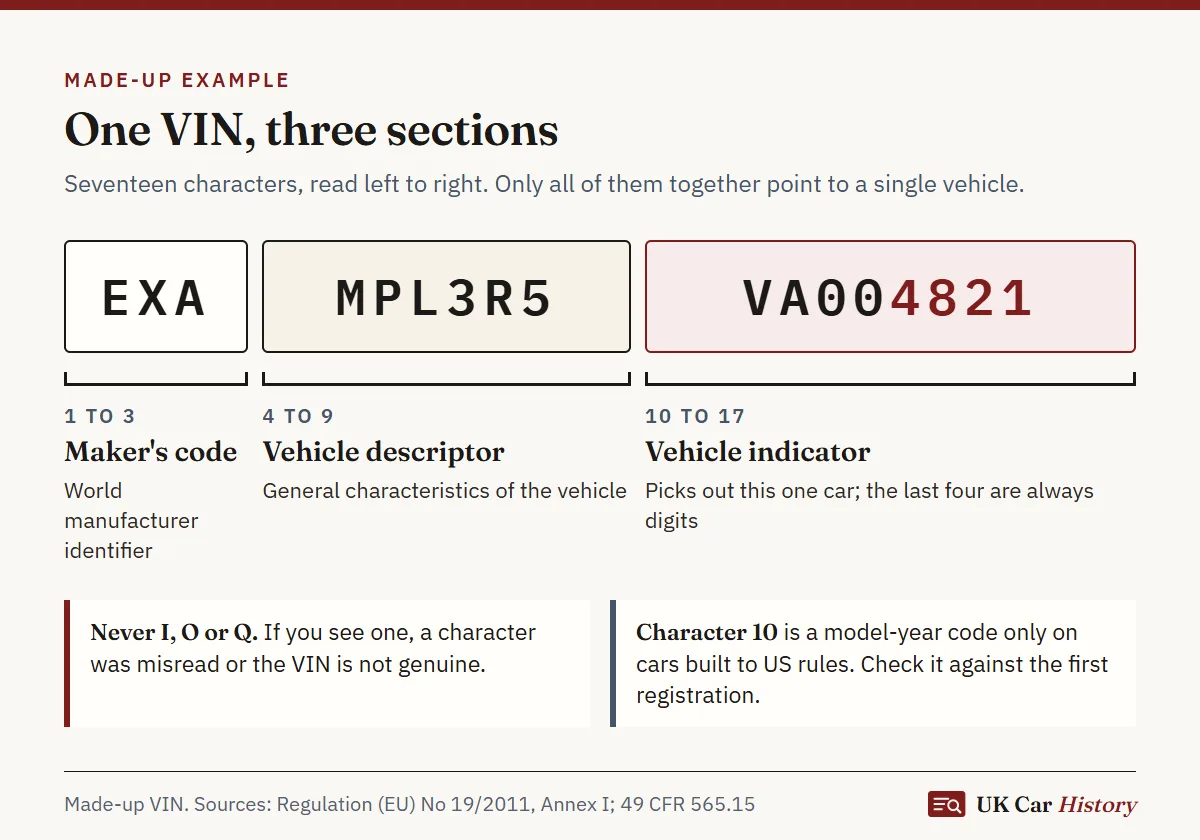
Decoders often read the tenth character as a model year. That comes from American rules, which oblige makers to put a year code there on vehicles for the US market, and because the letters are reused, one letter can point to two years three decades apart. Britain's VIN rules contain no year code at all, so on a car built for other markets that position may hold something unrelated. A decoded year is only worth something once it agrees with the month of first registration on the V5C.
Is a free VIN check worth doing?
A free VIN check is a decoder: you type the code in and it reads the parts that follow public standards. Most name the maker from the opening three characters and offer a model year based on the tenth. Better decoders flag a code of the wrong length, or one containing I, O or Q, as invalid.
That makes it a useful first filter. Suppose the seller's VIN comes back as a different make, or as a year the registration rules out: you have found a serious problem before spending anything on travel.
What a decoder reads, though, is only the label. It knows nothing about what has happened to the car since it left the factory.
Where does a free VIN check stop?
Set the two side by side and the gap is clear:
| Question | Free VIN decoder | History report by registration |
|---|---|---|
| Which company made the car? | Yes | Yes |
| Roughly when was it built? | A possible model year | The month it was first registered |
| Is a finance agreement still recorded? | No | Yes |
| Has an insurer written it off? | No | Yes, with the category |
| Is it recorded as stolen, scrapped or exported? | No | Yes |
| Which number plates has it carried? | No | Yes, previous registrations |
Our Premium report (£7.99) answers every row on the right, gives the full VIN on record for the registration and adds keepers, a mileage verdict and a valuation. You start it from the registration with our UK car check.
Some websites advertise theft and accident results from a VIN at no cost. Before trusting one, find out where its data comes from, because a foreign database cannot cover the time a car has spent registered here.
How do you find the VIN number from a registration plate?
Both free government look-ups start from the number plate, and neither returns the VIN: the DVLA's vehicle enquiry lists details such as tax, MOT expiry and engine size, while the DVSA's MOT history shows the test results. That leaves three routes:
- Ask the keeper. The VIN is printed in the vehicle details of the V5C logbook, so the seller can read it out or send it before you travel.
- Read it on the car. Look behind the windscreen, in a door opening, in the engine bay or under the carpet; our guide to where the VIN number is pictures every spot.
- Get it from a report. The Premium report gives the full VIN on record for the registration, so you hold it before the viewing and do not depend on the seller.
Asking for it in advance is normal, and an honest seller loses nothing by sharing it. One who refuses before you travel has given you something to think about.
How can the VIN expose a car that is not what it seems?
Matching the VIN and the engine number on the car with the logbook is one of GOV.UK's checks for buyers. With a report you have a third copy to compare, and the whole check takes a few minutes at the viewing:
- Look for the VIN in two separate spots on the car; the copies should be identical.
- Hold the V5C next to the car and compare its VIN one character at a time, then do the same with the engine number.
- Compare both with the VIN in your report, which comes from the record behind the registration on the plates.
- Finally, run it through a decoder: the manufacturer should be right for the badge on the bonnet, and any year it suggests should sit near the first registration date.
Read all 17 characters, every time. A clone can carry a VIN that starts exactly like the real car's, since the opening characters only identify the manufacturer and the kind of vehicle. Our guide on how to spot a cloned car covers the other warning signs.
If any copy of the VIN differs from the others, or the number looks scratched, re-stamped or covered, do not buy the car.
What if the VIN and the paperwork do not agree?
A mismatch means the car and the documents do not belong together, whatever the explanation offered. The usual reasons are a stolen car wearing the identity of a similar legitimate one, or a logbook that is forged or was stolen blank. To examine the logbook itself, see our guide on whether a V5C is genuine.
A match proves less than people think if the logbook is fake, which is why the record behind the registration matters. Our stolen vehicle check page explains the identity records in the Premium report: stolen, scrapped and exported markers, previous plates and the VIN on record.
For the way one VIN stays with a car while its plates change over the years, see our guide to the history of a VIN number.
Questions and answers
Can I run a car history check with only the VIN?
Not on the UK's main records, which are searched by registration. A VIN on its own can be decoded, but finance, write-off and theft searches start from the number plate.
What does it mean if a VIN has the letter O in it?
The rules on the VIN forbid the letters I, O and Q, so an O is almost always a misread zero. If the character really is a letter, the number is not genuine.
Is the VIN the same thing as the registration number?
No. The registration is the number on the plates, and it can be changed, for example when a private number is put on. The VIN is fixed to the car when it is built and stays with it.
Does the tenth character always give the model year?
Only on vehicles built to US rules, which require a year code there. Britain's rules on the VIN have no such requirement, so on many cars the character means something else.
Can a seller refuse to give me the VIN?
They can, but there is little reason to. The VIN is printed on the logbook and visible on the car, and a buyer needs it to compare the car with its records before paying.
Sources
This guide is general information for people buying or owning a car in the UK, not legal or financial advice. UK Car History is an independent service, not affiliated with the DVLA, the DVSA or GOV.UK.