The short answer
The history of a VIN number is the history of one vehicle. The VIN is fixed to the car when it is built and stays with it for life, while its number plate can change. In the UK, vehicle records are searched by registration, so you trace a VIN's history by checking the registration the car carries now, then making sure the VIN on record matches the one on the car.
This guide explains what a VIN is, why UK checks start from the registration, how a car can change plates without changing identity, what a history report adds, and what to do if the VIN does not add up.
What is a VIN, and why does it carry a car's history?
The vehicle identification number (VIN) is a 17-character code that the manufacturer gives a vehicle on the production line. The rules on vehicle approval, kept in UK law, say each VIN must be unique to one vehicle and that the manufacturer must be able to trace the vehicle by it for 30 years. The letters I, O and Q are never used in it.
GOV.UK says every vehicle registered in the UK must have a unique VIN stamped into it, usually into the chassis. That is what makes it the car's permanent identity. Owners come and go, plates can be swapped and colours can change, but the VIN stays the same from the factory to the scrapyard.
So when people ask for the history of a VIN, they are really asking for the history of the car that wears it: who has kept it, whether it has been written off or stolen, and which registrations it has carried.
Can you check a car's history by VIN in the UK?
Not directly through the free government services. The DVSA's MOT history and the DVLA's vehicle enquiry both ask for the number plate, and the list of what the vehicle enquiry shows does not include the VIN. UK history checks, ours included, are run on the registration too.
That is less of a limit than it sounds. The DVLA's record links the registration to the VIN: its online service for a replacement logbook, for instance, asks the keeper for both. A check by registration therefore reaches the same vehicle record that the VIN belongs to, and a good report gives you the VIN on record so you can compare it with the car.
| What you want to know | Where it comes from | What you type in |
|---|---|---|
| MOT tests and mileage | DVSA MOT history (free) | Registration |
| Tax, MOT expiry, logbook date | DVLA vehicle enquiry (free) | Registration |
| Finance, write-off, stolen records | A paid vehicle history report | Registration |
| Is this the car on the record? | The VIN on the car, the V5C and the report | Compare all three yourself |
How can a car change plates but keep the same VIN?
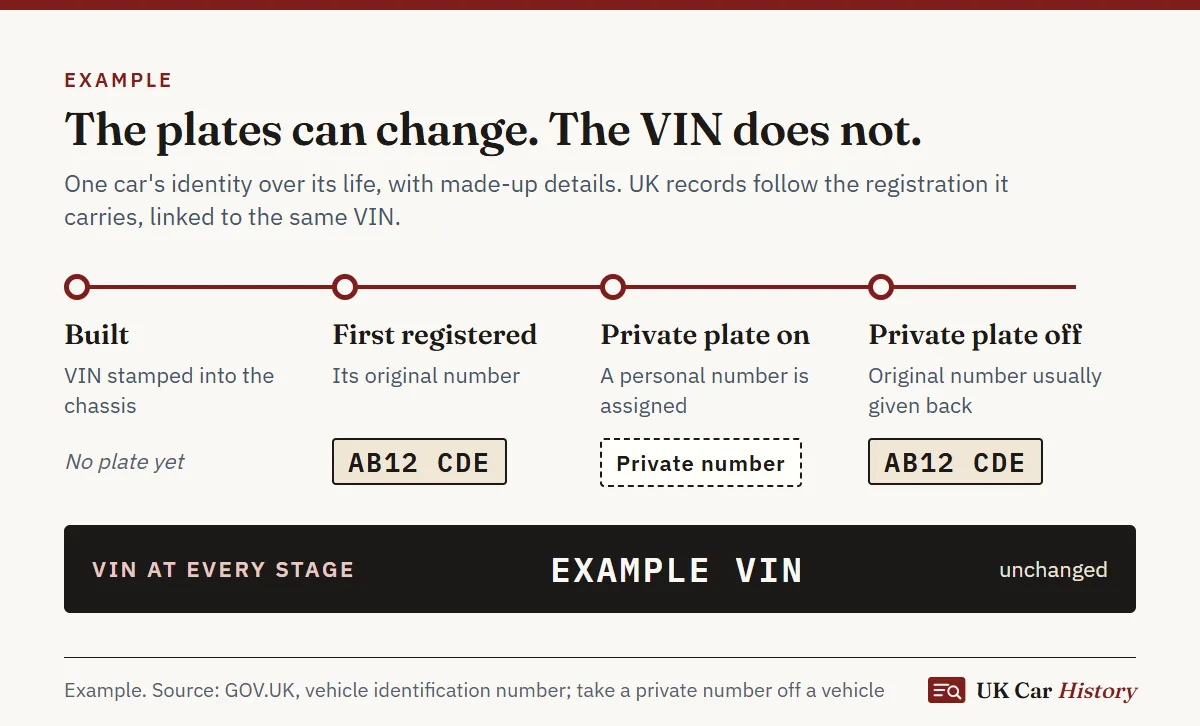
A registration number stays with the car until it is moved, but it can be moved: private numbers are put on cars and taken off again. When a private number is taken off, GOV.UK says the original registration is usually given back to the car automatically, and the keeper receives a new V5C logbook showing it.
Through all of this the VIN does not change. That is why a car's past can sit under more than one registration: its first few MOT tests may have been done under one plate and the rest under another. A history report that lists previous registration numbers joins those pieces together, so older paperwork, such as service invoices or an old MOT certificate, can be matched to the car you are looking at.
What does a VIN code history show in a report?
A history report run on the registration reads the records held against the vehicle. In our Premium report (£7.99), the parts that tie most closely to the VIN are:
- the full VIN on record for the registration, to compare with the car and its logbook
- previous registration numbers, so a plate change cannot hide part of the car's past
- whether the car is recorded as stolen, scrapped or exported
- whether an insurer has recorded it as a write-off, and in which category
- whether a finance agreement is still recorded against it
Keepers, plate changes, a mileage verdict and a valuation come in the same report. The stolen vehicle check page explains the identity records in more detail, and the guide to what a full car history shows goes through every record one by one.
How do you check the VIN matches the car?
GOV.UK's advice to buyers is to check that the VIN and the engine number on the car match the V5C logbook. A report adds a third copy to compare against. At the viewing:
- Find the VIN on the car in at least two places, such as the base of the windscreen, a door pillar or under the bonnet, and check they agree.
- Compare it with the VIN in the vehicle details on the V5C, character by character.
- Compare it with the VIN in your history report, which comes from the record for the registration on the plates.
- Check that the make, model and colour on the V5C and in the report fit the car in front of you.
Read all 17 characters. Cars of the same model can share most of the first half of the code, so a VIN that only "looks about right" proves nothing.
What if the VIN is missing, damaged or has been changed?
A VIN can be lost when a car is repaired, restored or modified. GOV.UK says the DVLA will usually assess the vehicle if its identity is in question, for example when the VIN has been moved. A car that passes is stamped with a new VIN under the DVLA's authority, and it may keep its registration if the original VIN can be proved; otherwise it needs a replacement identity number.
Where the DVLA is not satisfied about a vehicle's age or identity, it issues a Q registration number. A car on a Q plate can be perfectly legal, but the plate tells you its identity could not be fully established, and that is worth understanding before you buy.
A VIN that has been scratched, drilled, re-stamped, covered up or does not match the logbook is a reason to walk away, not to negotiate.
How does the VIN history work for an imported car?
An imported car gets a UK registration when it is registered with the DVLA. GOV.UK says the application must include the foreign registration certificate, which shows when the vehicle was made, and that the DVLA may ask to inspect the vehicle.
From then on, the car builds a UK record under its UK registration, and a UK history check covers that part of its life. Its years abroad were recorded, if anywhere, in the other country's systems. If a car was imported, ask the seller for the import paperwork and the foreign documents, and check that the VIN on them matches the car.
Can you check recalls by VIN or by registration?
For a car with a UK registration, GOV.UK points you to the MOT history service, which shows safety recalls that have not been fixed, alongside the MOT results. You only need the registration. For a vehicle without one, the recall checker asks for the make, model and year of manufacture instead.
GOV.UK also says the manufacturer will contact the keeper about a serious safety defect. If you are buying, ask the seller whether any recall work has been done, and check the result on the MOT history yourself. If you just want a quick look at a car first, our free car check look-up shows its MOT history and recall status from the registration.
Questions and answers
Is the VIN the same as the chassis number?
In everyday use, yes. GOV.UK says the VIN is usually stamped into the chassis, and the DVLA's online logbook service asks for the VIN or chassis number as one item.
Does a VIN ever change?
Not in normal life. A new VIN is stamped only when the DVLA has assessed a vehicle whose original number was lost or whose identity was in question. Number plates can change many times while the VIN stays the same.
Can I get a free car history from the VIN alone?
Not from the UK government services, which work from the registration. A free VIN decoder can read the maker and type from the number, but it does not search finance, write-off or theft records.
Why does my report show a different registration from the plate?
A car can carry more than one registration over its life, for example after a private plate was put on or taken off. The report lists previous numbers so that every part of the record can be linked to the same car.
Where do I find the VIN before I see the car?
Ask the seller to read it from the V5C, or get it from a history report run on the registration. Then check it on the car itself at the viewing.
Sources
This guide is general information for people buying or owning a car in the UK, not legal or financial advice. UK Car History is an independent service, not affiliated with the DVLA, the DVSA or GOV.UK.