The short answer
To check the history of your car, start with two free GOV.UK services that need only the registration: the MOT history, with every test since 2005 and its mileage, and the DVLA's vehicle enquiry. With the 11-digit number from your V5C you can also see where each MOT was done. Keepers, finance, write-offs and theft records are not in the free services.
This guide is for owners and new owners. It shows what you can see for free, what your logbook unlocks, what the DVLA will tell you by post, and when a history report is the quicker way to answer a question about your car's past.
Why would you check your own car's history?
- You have just bought it and want to confirm what the seller told you, from the mileage to the number of owners.
- You are about to sell it and want to know what a careful buyer will find when they check the registration.
- Something does not add up: a service book that stops, an odd mileage, a logbook issued recently, or a part that looks newer than the rest.
- You want to know whether a safety recall on your model has been done on your car.
Whatever the reason, the steps are the same, and most of them cost nothing.
What can you check about your own car for free?
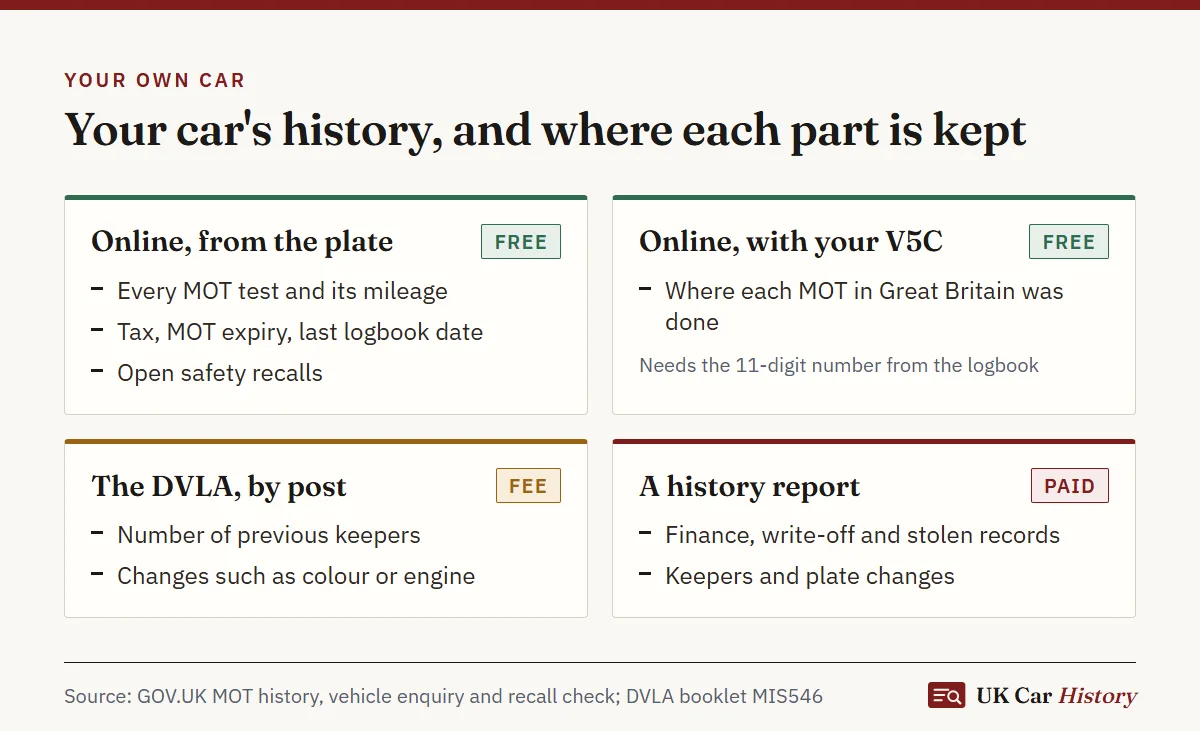
Two GOV.UK services hold most of the free information, and both work from the number plate alone:
| Free service | What it shows about your car | What you need |
|---|---|---|
| DVSA MOT history | Each MOT test, pass or fail, the mileage, when the next MOT is due, and, depending on the maker, open safety recalls | Registration |
| DVSA MOT history, with your V5C | Where each test in England, Scotland or Wales was done | Registration and the 11-digit V5C number |
| DVLA vehicle enquiry | Tax and SORN status, MOT expiry, first registration, year of manufacture, engine, fuel, emissions, export status, last logbook date | Registration |
Our free car check look-up puts the DVLA details and the full MOT history on one page from the registration, if you would rather not use two services.
How do you check your car's MOT history and where each test was done?
- Open the MOT history service on GOV.UK and type your registration.
- Read the list of tests from the newest down: the result, the mileage, and any failures and advisories.
- For tests done in England, Scotland or Wales, enter the 11-digit document reference from your V5C to see which test centre did each one.
For cars, the history goes back to tests done since 2005. In Northern Ireland, GOV.UK says results are available for tests done since 2017. A car under three years old may have no MOT yet, because the first one is due by the third anniversary of its registration in Great Britain.
Knowing where each test was done helps if you are piecing together your car's past: the garages near a previous keeper may also have serviced it, and a test centre far from where the car was kept can explain a gap in the paperwork.
What does the DVLA vehicle enquiry tell you about your car?
Beyond tax and MOT dates, two items are worth reading closely. The date the last logbook was issued tells you when the DVLA last sent out a V5C, which happens when a car changes keeper, and also after changes such as a new address or a new number plate. If you bought the car recently, it should be close to the date you registered as its keeper.
The export status says whether the car has been marked as exported. On a car that is sitting on your drive, that should not be the case; if it is, contact the DVLA.
The date of first registration and the year of manufacture are also worth checking against what you were told, especially on an imported car, which can be older than its UK registration suggests.
How do you check your vehicle's history with the DVLA by post?
The DVLA holds more than its free service shows, and the registered keeper can ask for some of it. Its booklet MIS546 sets out two routes:
- Form V888, option A: as the current keeper, you can ask for the number of previous registered keepers and for changes made to the vehicle, such as its colour or engine. The form lists a fee of £5 per vehicle, paid by cheque or postal order.
- A subject access request (form MIS1065): a copy of the personal data the DVLA holds about you on its driver and vehicle records. MIS546 says this information is free.
The names and addresses of earlier keepers are released only where the law allows, for example for court proceedings. If you only want the number of previous keepers, a history report gives it straight away, with the date of the last change. The guide on how many owners a car has had compares the ways to find it.
Was my car ever written off, on finance or stolen?
None of the free services can tell you. These records are held by finance companies, insurers and data providers, not in the MOT history or the vehicle enquiry.
Your logbook may hold part of the answer. GOV.UK says that when a Category S write-off is kept and put back on the road, the keeper applies for a new logbook and the DVLA records the category in it. A Category N car can keep its existing logbook, so its paperwork may say nothing. A write-off check reads the insurers' record either way, and our category car check page explains each category.
Finance matters most if you bought the car recently. If an earlier keeper still owed money on it under hire purchase, the finance company may still have a claim. Our finance check looks for a recorded agreement by registration, and Citizens Advice can explain your position if one is found.
Does my car have a safety recall that has not been fixed?
GOV.UK sends you to the MOT history service for this: for a car with a registration, it shows safety recalls that have not been checked or fixed, next to the MOT results, though the MOT history page notes that this depends on the manufacturer. GOV.UK also says the manufacturer will contact you if your vehicle has a serious safety defect.
If a recall shows as outstanding, contact a dealer for that make. If you bought the car second-hand, the previous keeper may have received the letter, so it is worth checking even if you have heard nothing.
Where do you find your car's service history?
Not in the official records. Servicing is not part of the MOT history or the DVLA's vehicle enquiry, so it lives in the service book, the invoices, and the records of the garages that did the work.
If pages are missing, ask the garages whose stamps you can see whether they hold copies, and ask a franchised dealer for the make whether it keeps service records for your car. Put the dates and mileages beside the MOT history: they should tell the same story.
Questions and answers
Can I check my car history with just the registration?
Yes. The MOT history, the DVLA vehicle enquiry and the recall check all work from the number plate. You need the V5C only to see where each MOT was done, and a paid report for finance, write-off and theft records.
Is it free to check my vehicle's history?
The MOT history, the vehicle enquiry and the recall check are free. Asking the DVLA for the number of previous keepers costs £5 by post, and finance, write-off and stolen checks are only in paid reports.
Why does my V5C have a recent issue date when I bought the car years ago?
The DVLA sends a new logbook after changes such as a new address or a new number plate, not only after a sale. If you made no change and did not ask for a replacement, contact the DVLA.
Can I find out who owned my car before me?
Only in limited cases. The DVLA releases earlier keepers' details where the law allows, such as for court proceedings. A history report shows how many keepers there were and when the car last changed hands, not who they were.
Does the MOT history show accident damage?
Only if the damage was still there at a test and caused a failure or an advisory. It is a record of each test, not of repairs, so a write-off check is the way to find an insurance write-off.
Sources
This guide is general information for people buying or owning a car in the UK, not legal or financial advice. UK Car History is an independent service, not affiliated with the DVLA, the DVSA or GOV.UK.