The short answer
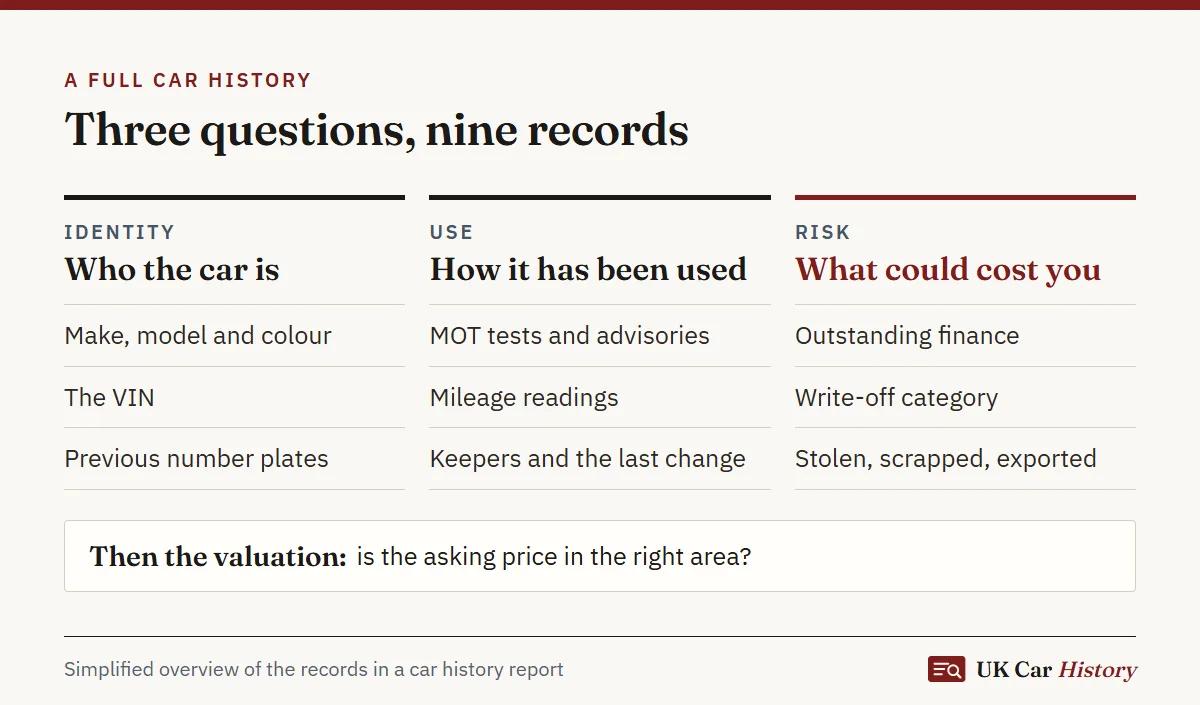
A full car history brings together everything on record about one car: its identity (make, model, VIN and past plates), how it has been used (MOT tests, mileage readings, keepers), and the records that can cost a buyer money (outstanding finance, an insurance write-off, a theft report, a scrapped or exported marker). Each part answers a different question about the car.
This guide takes the records one at a time: what each one means, what a clear or a flagged result tells you, and what to do next. The free and paid parts are marked, so you know which ones need a report.
What is in a full vehicle history?
The records fall into three groups. The first confirms which car you are looking at, the second shows how it has been used, and the third covers the problems that stay with a car when it is sold.
| Record | The question it answers | Where it comes from | In our reports |
|---|---|---|---|
| Vehicle details and MOT history | Is this the car described, and how has it fared at its tests? | DVLA and DVSA | Free look-up |
| Mileage verdict, keepers, plate changes, valuation | Do the miles, owners and price add up? | MOT records and licensed data providers | Basic and Premium |
| Finance, write-off, stolen, scrapped, exported, full VIN | Could the car be taken back, or is it not what it seems? | Licensed data providers | Premium only |
Identity: make, model, VIN and previous plates
The first part tells you what the records say the car is: its make, model, colour, fuel, engine size, year of manufacture and date of first registration. Read it with the car in front of you. A different colour or engine size from the one you can see is a reason to ask questions before anything else.
The VIN is the car's permanent identity, unique to one vehicle and stamped into it, usually on the chassis. Compare the VIN in the report with the one on the car and in the V5C logbook. If they differ, the plates and the car may not belong together.
The previous registrations list every number plate the car has carried. A plate change is normal, often a private number put on or taken off, but it splits the car's past between two numbers. The list lets you match older invoices and MOT certificates to this car. The guide to the history of a VIN number explains how plates and VINs fit together.
MOT history and mileage: how has the car been used?
The MOT history lists each test with its result, the failures, the advisories and the mileage recorded on the day. GOV.UK holds car tests done since 2005, or since 2017 for tests in Northern Ireland. Advisories that come back test after test show what an owner chose not to fix.
The mileage verdict looks at the readings in order. Normally each one is higher than the last. A reading lower than an earlier one is flagged, because it can mean the odometer has been wound back, though it can also be a typing error at a test. A long gap between tests is worth asking about too. Our mileage history check page shows how to read the readings.
Keepers: how many and how recently?
The keeper record gives the number of previous registered keepers and the date of the last change. It does not give names or addresses. Read the two figures together: what matters is less the total than whether the car has changed hands quickly, and whether the date fits what the seller says about how long they have had it.
If the count in the report is not the one in the advert or on the V5C, the guide on how many owners a car has had lists the usual reasons.
Outstanding finance: is money still owed on the car?
Citizens Advice says a history check can show whether the seller still owes money on the car, so you know who really owns it. Under hire purchase and most similar agreements, the finance company owns the car until the agreement is paid off.
A clear result means no agreement is recorded against the car. A flagged one gives the finance company and the type and date of the agreement. Do not hand over money while an agreement is recorded: ask the seller to settle it, get the finance company's confirmation in writing, and check again. Our finance check page goes into more detail.
Write-off category: has an insurer written the car off?
When an insurer decides a damaged car is not worth repairing, it records the car as a write-off in one of four categories. The category tells you what the car may legally be used for now:
| Category | What GOV.UK says about it |
|---|---|
| A | Cannot be repaired. The entire vehicle has to be crushed. |
| B | Cannot be repaired. The body shell has to be crushed, but other parts can be salvaged. |
| S | Can be repaired after structural damage, and used again once roadworthy. |
| N | Can be repaired after non-structural damage, and used again once roadworthy. |
A Cat S or Cat N car can be sold and driven legally, but it is worth less than the same car with a clean record, and you should know how well it was repaired. A Cat A or Cat B car offered for the road is a serious warning. The category car check page explains the older Cat C and Cat D labels too.
Stolen, scrapped and exported: is the car what it seems?
These three markers are about whether the car should be for sale here at all.
- Stolen: the car has been reported stolen. Citizens Advice says the police will try to return stolen goods to their original owner, so a buyer can lose the car and then has to seek a refund from the seller.
- Scrapped: the car has been recorded as taken off the road for good. GOV.UK says a keeper must tell the DVLA once a vehicle is at an authorised treatment facility. A "scrapped" car on sale may be carrying another car's identity.
- Exported: the car has been recorded as leaving the UK, and the DVLA's vehicle enquiry shows an export status. A car marked as exported but offered for sale here needs a clear explanation, with paperwork.
If any of these three is flagged, stop before paying anything. A stolen marker in particular is a matter for the police, not for haggling over the price.
Valuation: is the asking price fair?
The valuation is an estimate of what a car of this kind is worth. It does not see the car's condition, its service history or local demand, so treat it as a guide to whether the asking price is in the right area, not as a final figure.
It is most useful beside the rest of the record. A price well below the valuation on a car with a clean history deserves a closer look at the car; a price close to the valuation on a Cat N car may be too high.
How do you check the full history of a car?
- Type the registration and your email address into the form on this page.
- Check that the make, model and colour shown are those of the car you are looking at.
- Choose the Premium report (£7.99) for every record above, or the Basic report (£3.99) for keepers, plate changes, the mileage verdict and a valuation. Pay by card or PayPal: the report opens on screen and is emailed to you.
- At the viewing, compare the VIN in the report with the car and the V5C.
A full history shows what is on record, so it cannot show damage that was repaired without an insurance claim, or servicing that was never written down. Look at the car, read its service paperwork and take a test drive as well. You can start with our free car check look-up for the vehicle details and MOT history.
Questions and answers
Is a full car history check free?
Partly. The vehicle details and the MOT history with its mileage are free. Finance, write-off, stolen, keeper and plate records come from licensed data providers, so they are in paid reports.
What is the difference between a car history and a service history?
A car history comes from official and industry records: MOT tests, keepers, finance, write-offs and theft. A service history is the record of maintenance kept in the service book and on invoices, which is not part of those records.
Does a full vehicle history show every accident?
No. It shows accidents that ended in an insurance write-off, with the category. Damage repaired without a write-off leaves no write-off record, though it may show at an MOT if it was still there.
How far back does a full car history go?
The MOT history covers car tests since 2005, or since 2017 in Northern Ireland. The other records cover what was registered against the car while it had a UK registration.
Do I need the V5C to check the full history of a car?
No. The check runs on the registration alone. You need the V5C at the viewing, to compare its VIN and keeper details with the car and the report.
What should I do if one record is flagged?
Stop before you pay, ask the seller to explain it in writing, and check the evidence they give you. For outstanding finance or a stolen marker, do not go ahead until the record is resolved.
Sources
This guide is general information for people buying or owning a car in the UK, not legal or financial advice. UK Car History is an independent service, not affiliated with the DVLA, the DVSA or GOV.UK.