The short answer
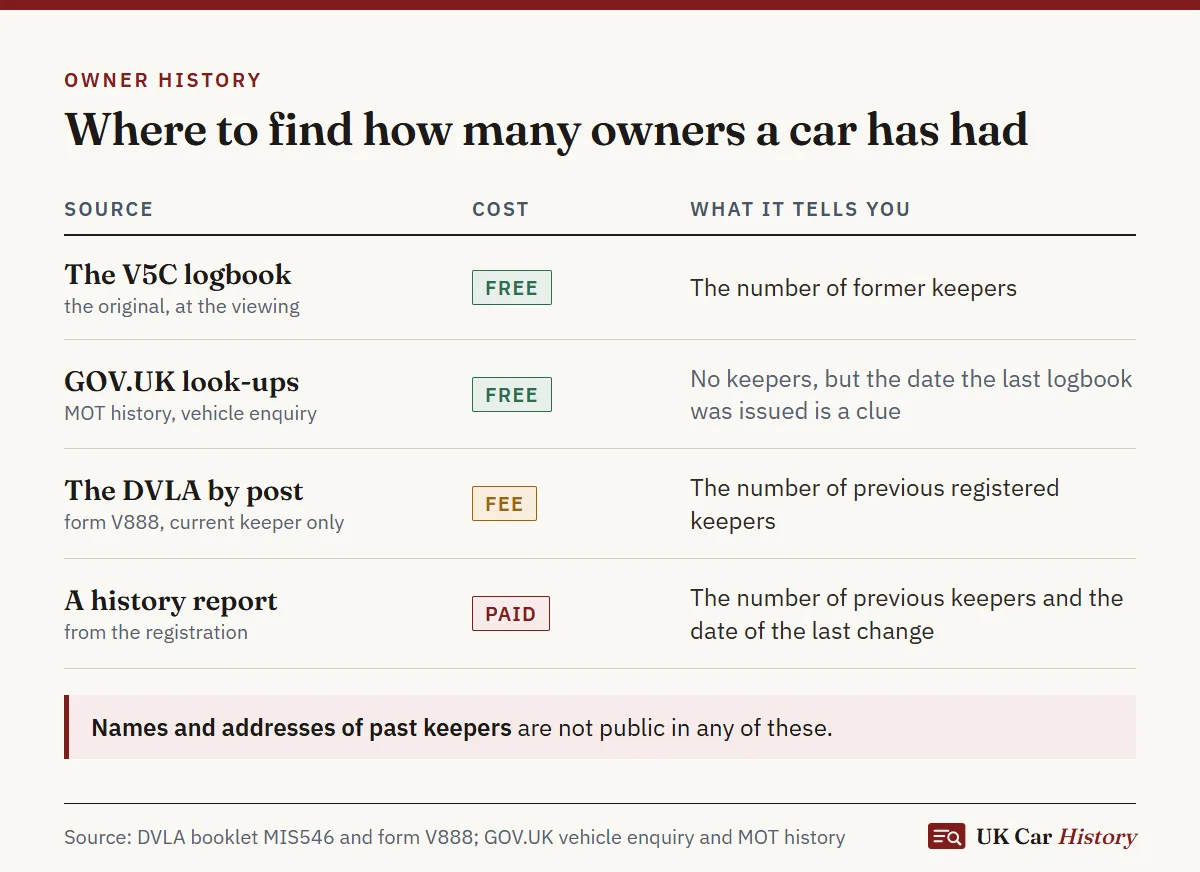
You can find out how many owners a car has had for free by reading the V5C logbook, which prints the number of former keepers. The free GOV.UK look-ups do not show owners. Without the logbook, a history report by registration gives the count and the date the car last changed hands, and the current keeper can ask the DVLA by post for a small fee.
This guide shows where to find the number, what each source can and cannot tell you, how the DVLA's form V888 works, why two sources sometimes give different answers, and what the number should make you ask.
Where does the V5C show how many owners a car has had?
The V5C, the registration certificate most people call the logbook, names the current registered keeper and prints the number of former keepers: everyone who was registered before them. Add one for the current keeper and you have the total so far. If you buy the car, you become the next one.
It is the one free source, but it only works when the seller shows you the original document. A photo can be old, and a logbook from before the last sale will show a smaller count. At the viewing, check that the name and address on it are the seller's, and that the VIN printed on it matches the car.
The logbook says on its front that it is not proof of ownership, and the count is a count of keepers: the people or businesses registered as responsible for the car. That is usually, but not always, the person who owned it.
Do the free GOV.UK checks show the number of owners?
No. The DVSA's MOT history shows each test, its result and the mileage. The DVLA's vehicle enquiry shows the tax, the MOT expiry, the date of first registration, the engine and emissions details and the export status. Neither lists keepers, and neither does our free car check look-up, which shows the same DVLA details and MOT history on one page.
One item on the vehicle enquiry is a useful clue, though: the date the last logbook was issued. The DVLA sends out a new V5C when the keeper changes, but also for other reasons, such as a change of address or a change of number plate. A logbook issued a few weeks ago on a car the seller says they have owned for years is worth a question.
How do you check owner history of a car online?
Keeper records are not published, so the online route is a history report run on the registration. Ours shows the number of previous keepers and the date of the last keeper change, together with any plate changes. That is in the Basic report (£3.99), and in the Premium report (£7.99) with the outstanding finance, write-off and stolen checks.
A report never shows keepers' names or addresses. Nobody can lawfully publish those, so treat any website that promises a free car owner history check with names as a reason for caution, not a shortcut. Our car registration history page explains the keeper and plate records in more detail.
Can the DVLA tell you how many owners your own car has had?
Yes, if you are the current registered keeper. The DVLA's booklet MIS546 says a keeper can ask for the number of previous registered keepers of their vehicle, and for changes made to it such as its colour or engine. It is not free: the V888 form lists a fee of £5 per vehicle.
- Download form V888 from GOV.UK and fill in option A: information about a vehicle as its current or previous keeper.
- Give the registration number and the make and model, and say exactly what you want, why, and how you will use it.
- If your address is not the one on the DVLA's record, include a proof of address issued in the last three months, such as a utility bill or a bank statement.
- Sign the declaration and post the form with a cheque or postal order made payable to "DVLA Swansea" to Vehicle Record Enquiries, DVLA, Swansea, SA99 1AJ.
The details of earlier keepers, as opposed to the number, are another matter. MIS546 says the DVLA releases them only where the law allows, for example when they are needed for court proceedings, and that it depends on the circumstances.
What counts as an owner on the record?
The count goes up each time a new keeper is registered with the DVLA. A business can be a keeper, so a car that started life with a leasing firm may show that firm as its first keeper, however many drivers it had.
Changing the number plate does not change the keeper. When a private number is taken off a car, GOV.UK says the keeper receives a new logbook showing the replacement registration, but the person responsible for the car is the same. That is why a good report lists plate changes and keeper changes separately.
Why might the advert, the V5C and the report disagree?
Most differences have an ordinary explanation, and a few do not. Check which of these fits:
- The advert counts differently. "Two owners" may mean two before the seller, or two including them.
- The logbook is out of date. If the seller shows a V5C issued before they bought the car, it will not include them.
- The car changed hands very recently, and the latest change is still going through.
- The seller is not the registered keeper at all. If the name on the V5C is not theirs, ask why before going any further.
If the count in a report is higher than the seller says and none of these explains it, ask to see the full service history, which should show the car's life under each keeper.
What should the number of owners make you ask?
The number on its own decides very little. A car that has had several keepers over many years can be a sound buy, and a one-keeper car can still have been neglected. What helps is putting the count beside the dates: how long the seller has had the car, and when it last changed hands.
If the last change was only weeks ago, ask the seller why they are selling so soon. If the dates, the logbook and the story do not line up, slow down and check the rest of the car's record. Our guide to what a full car history shows explains each of the other records you will see in a report.
Questions and answers
Does the number of former keepers include the current one?
No. The V5C names the current keeper separately and counts only those registered before them, so a count of two means the car is on its third keeper.
Can I find out how many owners a car has had from the registration alone?
Not from the free GOV.UK services, which do not show keepers. A history report run on the registration shows the number of previous keepers and the date of the last change.
Is the DVLA keeper enquiry free?
No. The V888 form lists a fee of £5 per vehicle for information about a vehicle you keep or used to keep. Only a request for your own personal data held by the DVLA is free.
Will a report tell me who the previous owners were?
No. Keepers' names and addresses are personal data and are not shown in any report. The DVLA releases them only where the law allows, such as for court proceedings.
Can I find out the number of owners before I travel to see the car?
Yes. Ask the seller to read you the count of former keepers from the V5C, or run a history report on the registration. A photo of the logbook helps, but only the original at the viewing shows it is current.
Sources
- DVLA: Giving people information from our vehicle record (MIS546)
- GOV.UK: Form V888, request by an individual for information about a vehicle
- GOV.UK: Get vehicle information from DVLA
- GOV.UK: Check the MOT history of a vehicle
- GOV.UK: Action to protect second hand car buyers (V5C not proof of ownership)
This guide is general information for people buying or owning a car in the UK, not legal or financial advice. UK Car History is an independent service, not affiliated with the DVLA, the DVSA or GOV.UK.