The short answer
Some of a car's specs by reg are free to look up. The MOT history names the make and model, and the DVLA's record gives the engine size in cc, the fuel, the CO2 figure and the year of manufacture. The power, the trim level and the VIN are another matter: they sit in the V5C logbook, the car's paperwork and on the car itself, not in any free record.
This guide maps which record holds which detail, shows how to check a car's model and engine size from the registration, explains why the exact version is the hard part to prove, and covers what to do when the specs on record do not describe the car in front of you.
Which car specs can you get from the registration alone?
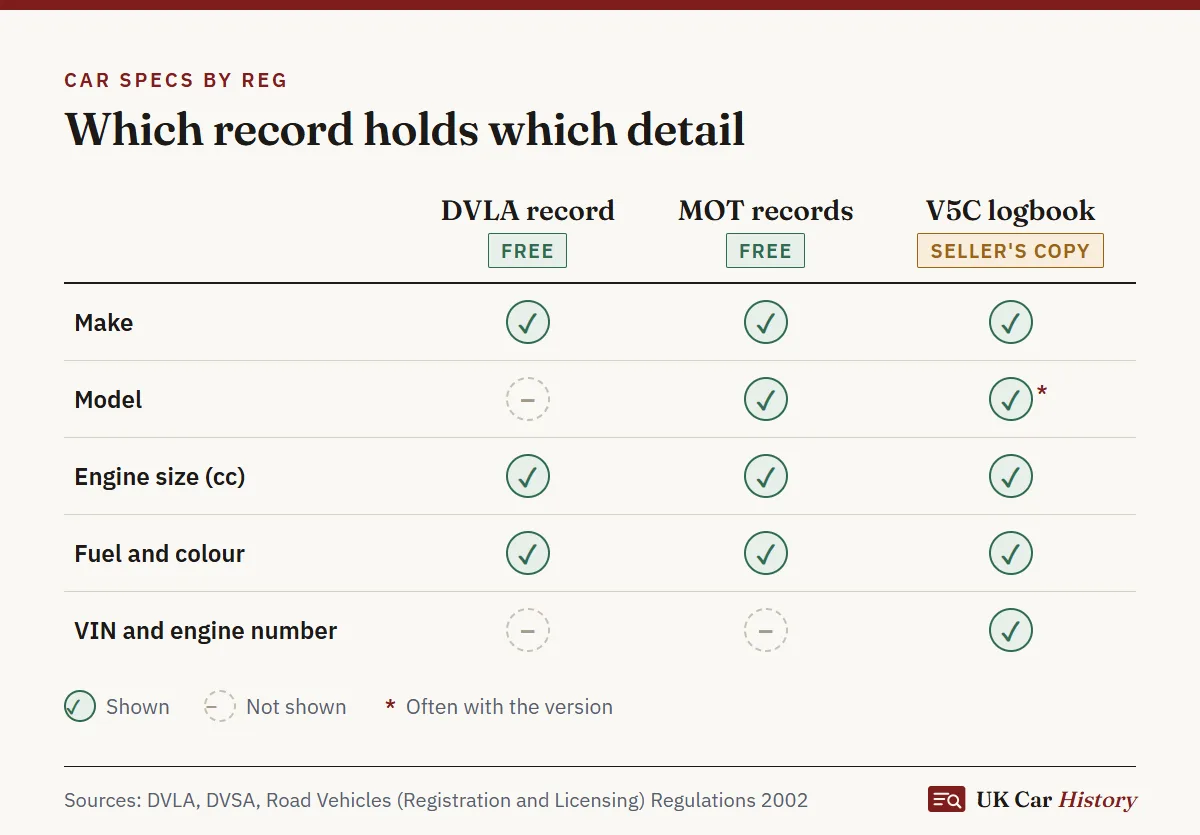
Type a registration into a free check and it reads two government sources: the register the DVLA keeps and the MOT records held by the DVSA. They overlap, which lets you check one against the other, and each has a gap the other fills.
| Detail | DVLA record | MOT records | V5C logbook |
|---|---|---|---|
| Make | Yes | Yes | Yes |
| Model | No | Yes | Yes, often with the version |
| Engine size (cc) | Yes | Yes | Yes |
| Fuel and colour | Yes | Yes | Yes |
| VIN and engine number | No | No | Yes |
Where does the model name come from when you check a car model by reg?
Use the MOT history. The DVSA's MOT records list the make and the model of the car with every test, along with its colour, fuel type and engine size, so a free look-up by registration names the model straight away.
The DVLA's record will not give it. The DVLA's technical description of its vehicle enquiry lists a field for the make but none for the model, so the model shown by any free check has come from the MOT records. Our free car check look-up puts the two side by side on one page.
The logbook can go further. When a new car is registered, the DVLA's form asks for the model "including full vehicle specification", with examples such as a model name followed by its trim and engine, so the model line on a V5C may name the version as well.
How do you check car engine size, and what does the cc figure tell you?
What a record calls engine size is the capacity of the cylinders, in cubic centimetres (cc). The same figure appears in the DVLA's record, in the MOT records and on the V5C logbook, so you can check car engine size three ways and expect three matching answers.
Sellers tend to quote litres instead. Dividing the cc figure by 1,000 and rounding to the nearest tenth converts one into the other, so 1,197 cc is sold as a 1.2 and 1,968 cc as a 2.0.
The cc figure measures size, not strength. Two engines of the same capacity do not necessarily produce the same power, which is the next detail to find.
A new engine or a change of cylinder capacity is one of the changes a keeper must report for the V5C, and the DVLA asks for evidence before it updates the logbook. Three different answers from the advert, the record and the logbook are a question for the seller before anything else.
Where do you find a car's power?
Not in the free records: the DVLA's enquiry has no field for it, and neither do the MOT records. When a new car is registered, the DVLA asks for its maximum net power in kilowatts (kW), taken from the manufacturer's certificate, and adds it to its records.
So the logbook and the manufacturer's figures are where to look. The bhp check guide explains how to read the figure and turn kilowatts into the brake horsepower most adverts quote.
What else does the V5C logbook record?
The law lists what a registration document must contain, where the DVLA holds it. Among the vehicle details:
- the make, type and model
- the engine cylinder capacity and the engine number
- the vehicle identification number (VIN)
- the type approval number
- the fuel type and the seating capacity
The colour is recorded in plain terms. The DVLA uses only basic colour descriptions, and its own example is a lavender car shown as purple. A car with two colours has both recorded, and one with three or more is entered as multi-coloured, so a fancy paint name in an advert will not appear on the record.
Which clues reveal a car's trim level?
Within one model range, the trim level sets much of what is fitted and much of what the car cost new. You will not find it reliably in any free record, so piece it together from clues that point the same way:
- Read the model line on the V5C, which may include the version.
- Set the equipment you can see, such as the wheels, seats, lights and screens, against the maker's brochure or price list for that version and year.
- Look at the badges last: they are easy to add or remove, so they confirm the other clues rather than replace them.
- Ask for the original order or sales invoice, which names the version and any options paid for.
- Still unsure? A franchised dealer for that make may be able to look up how the car was built from its VIN.
What a VIN can and cannot reveal is covered in VIN check UK.
Why does the exact version matter when you buy?
Because price and insurance both follow the version, not the model name. Thatcham Research's group rating, which insurers use, takes account of the price when new, which changes with the trim level, and of the car's performance, so two versions of one model can sit in different insurance groups. The guide to car insurance groups explains how to check one.
The same goes for value. Compare an asking price with cars of the same version and engine, not just the same model, or a well-equipped car can look expensive and a basic one cheap.
What if the specs on record do not match the car?
A clone is a car disguised with the number plates of a genuine one of the same kind: look up its registration and you are reading the genuine car's record. When the model, the colour, the engine size or the fuel on record differ from the car on the drive, the plates may not belong to it.
At the viewing, check that the VIN and engine number on the car match the logbook. The Premium report (£7.99) adds the full VIN held on record for the registration, a third copy to compare, along with the stolen, write-off and finance checks: the stolen vehicle check page explains where to find the VIN on the car.
A difference in model, engine size or fuel needs a written explanation, such as an invoice for a new engine shown on the logbook. Without one, do not hand over any money.
Questions and answers
Can a number plate tell me what model a car is?
Yes: the make and model are part of the MOT history, which anyone can search free by registration. The DVLA's own record has the make but no model field.
Is a car's engine size the same as its power?
No. Engine size measures how much the cylinders hold, in cc. The power is a separate figure, usually given in kW or bhp, so the size alone does not tell you how powerful a car is.
How do I turn cc into litres?
Take the cc figure, divide by 1,000 and round to the nearest tenth. A 1,499 cc engine is sold as a 1.5, and a 2,993 cc engine as a 3.0.
Why is the colour on the record plainer than in the advert?
The DVLA records basic colour descriptions only, such as purple for a lavender car, and a car of three or more colours is entered as multi-coloured.
Can I find the trim level from the registration?
Not reliably. The logbook's model line may name the version, and the equipment and original invoice confirm it. A franchised dealer may be able to look up the original build from the VIN.
What should agree before any money changes hands?
Five details on the record, the logbook and the car itself: make, model, colour, engine size and fuel. Then the two numbers on the car, the VIN and the engine number, against the V5C. Any difference needs an explanation backed by paperwork.
Sources
- DVLA: Vehicle Enquiry Service API, the details it returns
- DVSA: MOT history data formats
- legislation.gov.uk: Road Vehicles (Registration and Licensing) Regulations 2002, regulation 10A
- GOV.UK: First registration of a new motor vehicle (V55/4, with the V355/4 guide)
- GOV.UK: Change vehicle details on a V5C registration certificate
- Thatcham Research: Group Rating
This guide is general information for people buying or owning a car in the UK, not legal or financial advice. UK Car History is an independent service, not affiliated with the DVLA, the DVSA or GOV.UK.