The short answer
A car database check searches several separate records, because no single UK car database holds a car's whole history. The DVLA's register covers keepers, tax and registration; the DVSA's holds every MOT test and its mileage; finance agreements, insurance write-offs and theft reports are held by licensed data providers. The first two are partly free on GOV.UK. The others are paid searches.
This guide takes each database in turn: who keeps it, what it records, what you can see of it for free and what reaches a history report. It ends with what no database holds, so you know what to check on the car itself.
Is there one UK car database?
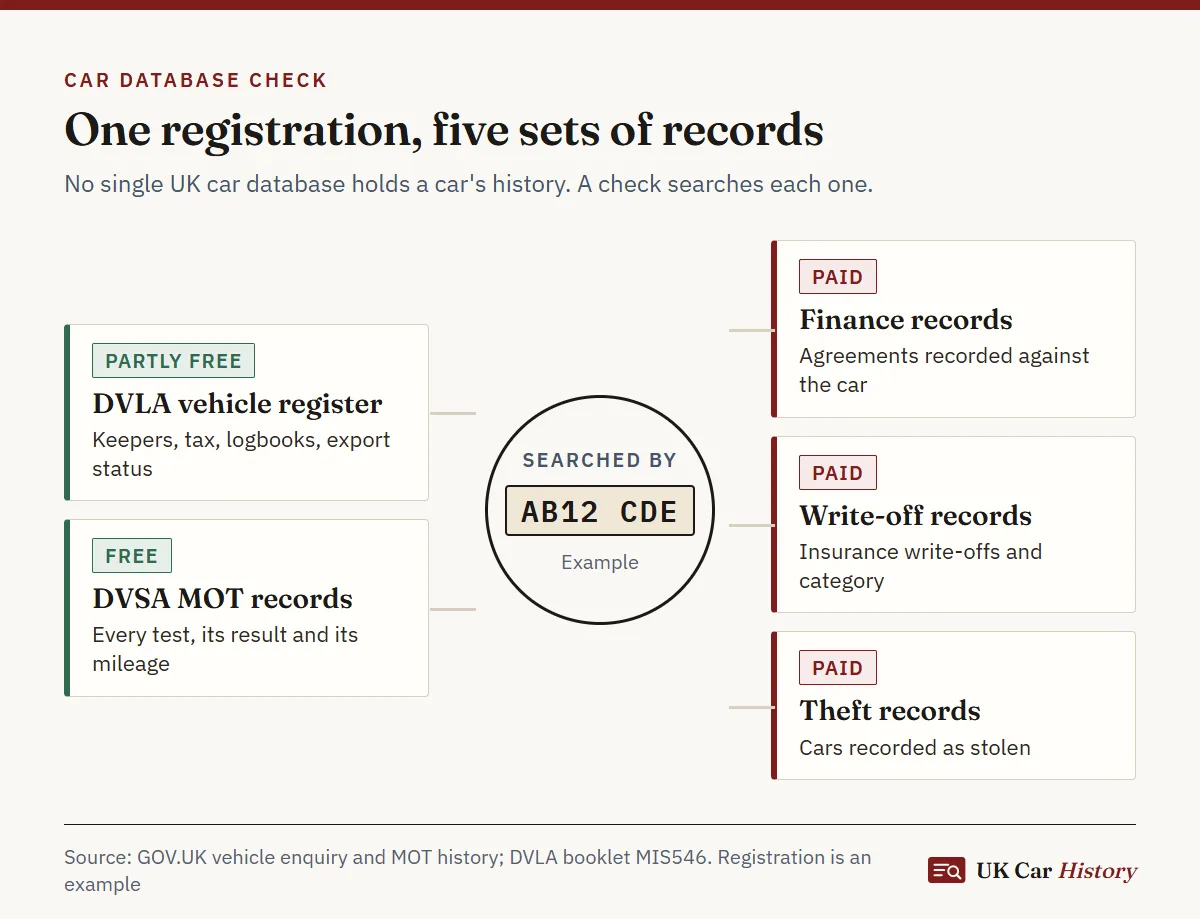
No. Each part of a car's history is recorded by whoever deals with that part of its life: the DVLA when the car is registered, taxed or changes keeper, the DVSA when it is tested, a lender when it is bought on finance, an insurer when it is written off, the police when it is stolen. A history check is a set of searches across those records, all run on one registration.
| Record | Who keeps it | What it holds | Free to see? |
|---|---|---|---|
| Vehicle register | DVLA | Keepers, registration, tax and SORN, logbooks, export status, theft notices from the police | In part, through the vehicle enquiry |
| MOT testing records | DVSA | Each test, its result, failures, minor problems and mileage | Yes, through the MOT history |
| Finance agreements | Licensed data providers | Agreements registered against the car | No |
| Write-off records | Licensed data providers | Insurance write-offs and their category | No |
| Theft reports | Licensed data providers | Cars recorded as stolen | No |
What does the DVLA vehicle register hold?
The DVLA's register is the record behind every UK registration: the vehicle's details, its current and earlier keepers, its tax and SORN status and its logbooks. GOV.UK says the police tell the DVLA when a car is stolen, and again when it is found.
Only a slice of it is open. The free vehicle enquiry shows the tax, MOT expiry, first registration, engine and emissions details, export status and the date the last logbook was issued. Keeper details stay private: the DVLA's booklet MIS546 sets out who may ask for them by post, and why. Our guide to checking a car's history with the DVLA goes through the enquiry line by line.
What does the MOT database record?
The DVSA records every MOT test: the result, the parts that failed or had minor problems, and the odometer reading, which the tester enters into the MOT testing service. The free GOV.UK MOT history shows car tests in England, Scotland and Wales since 2005, and in Northern Ireland since 2017.
Because a tester captures the mileage at each test, these readings are the main independent record of how far a car has gone. The DVLA's own guidance says the details captured at the MOT should be used to verify a car's mileage. Our guide to whether the DVLA can check a car's mileage explains how to read them.
Where are finance, write-off and theft records kept?
Outside government. Records of finance agreements, insurance write-offs and theft reports are held by licensed data providers, which charge for every search. That is why they are never part of a free check, and why a history report that includes them costs money.
- Finance: whether an agreement such as hire purchase or PCP is recorded against the car, and with which lender. The finance check page explains the record.
- Write-offs: whether an insurer wrote the car off, and in which category. The category car check page sets out the categories.
- Theft: whether the car is recorded as stolen. The stolen vehicle check page explains what goes with it.
Our Premium report (£7.99) searches all three, and adds whether the car is recorded as scrapped or exported, the full VIN, the number of previous keepers and the date of the last change, plate changes, a mileage verdict and a valuation.
Which databases can you search for free?
The DVLA's vehicle enquiry and the DVSA's MOT history are free on GOV.UK and need only the registration. Insurance is recorded on the Motor Insurance Database, which you can search free for your own vehicle through askMID, but that shows whether a vehicle is insured now and says nothing about its past.
Our free car check look-up shows the DVLA details and the MOT history on one page. For the private records there is no free route, so be wary of any free UK car database search that claims to cover finance or theft, and read what its free result includes before you rely on it.
How does a history check search the databases?
You give the registration. The check finds the vehicle and searches each record for it, and the results are what each database holds at that moment. Three things follow from that:
- Records change. A finance agreement can be paid off or a new one taken out, so run the check close to the day you buy.
- The registration is the key. If a car wears plates that belong to another vehicle, every search describes the other vehicle, which is why the VIN in the report must match the car.
- A record holds only what was reported. Damage repaired without an insurance claim, or a theft not yet reported, is in no database.
Why can two checks of the same car disagree?
Usually because they were run on different days, or read different things from the same records. Three explanations cover most cases:
- Time. A finance agreement paid off last week, or a new keeper registered since the first search, changes the result. The later check is the one to trust, so note the date of each.
- The registration. A check run before a plate change finds the car under its old number; one run afterwards finds it under the new one. A report that lists previous registrations links the two.
- What is counted. One check may count the current keeper among the owners and another may not, so compare the date of the last change as well as the number.
If two results still disagree on finance, a write-off or theft, treat the worse one as true until the seller shows you paperwork that settles it.
What does no car history database hold?
Servicing and repairs are not in any of these records. The service history lives in the service book, on invoices and in the records of the garages that did the work, so ask the seller for it and read it beside the MOT readings.
The car's condition today is not in a database either. Look at it, drive it, and have it inspected if you are unsure. Our guide to what a full car history shows explains each record you will see in a report, and what a clear or a flagged result means.
Questions and answers
Is there a free UK car database for checking a car?
Partly. The DVLA's vehicle enquiry and the DVSA's MOT history are free on GOV.UK. Finance, write-off and theft records are held privately and charged for each search.
Who keeps the record of a car's keepers?
The DVLA, on its vehicle register. It releases keeper details only by post to people with a reason it accepts. A history report gives the number of previous keepers and the date of the last change, never names.
Does the MOT database show accidents?
Not as such. It shows what the tester found at each test, so damage still there at a test can appear as a failure or a minor problem, but a repair made between tests leaves no MOT record.
Is the Motor Insurance Database part of a car history check?
No. It records whether a vehicle is insured now, and you can search it for your own vehicle through askMID. It says nothing about the car's past.
How up to date is a car database check?
It shows what each record holds on the day of the search. Run it close to the day you pay, and again if the sale is delayed.
Sources
- GOV.UK: Get vehicle information from DVLA
- DVLA: Giving people information from our vehicle record (MIS546, October 2026)
- GOV.UK: Check the MOT history of a vehicle
- DVSA Matters of Testing: Improving mileage recording errors in the MOT testing service (April 2023)
- GOV.UK: What to do if your vehicle has been stolen
- askMID: the Motor Insurance Database
This guide is general information for people buying or owning a car in the UK, not legal or financial advice. UK Car History is an independent service, not affiliated with the DVLA, the DVSA or GOV.UK.