The short answer
Did a dealer arrange your car, van or motorbike finance at any point from 6 April 2007 up to 1 November 2024 without properly telling you about its commission, or a tie to one lender? You may be owed compensation. Your car finance claim would be a free complaint to that lender under the FCA's redress scheme, PCP included; scheme payments are on hold while a legal challenge runs its course.
Below: who qualifies, the court ruling behind the scheme, the free route through your lender, the letters and offers to expect, how amounts are worked out and other "mis-sold" complaints. We do not take on claims, and this summary of what the FCA, the Ombudsman and the courts have published is no substitute for legal or financial advice.
Which car finance deals can lead to a claim?
Three conditions have to be met. The agreement paid for a motor vehicle, such as a car, van, motorbike or campervan, and started no earlier than 6 April 2007 and no later than 1 November 2024. Commission was payable by the lender to the broker that set the deal up, usually the dealer. And at least one of these arrangements was never properly explained to you:
| Arrangement | What it meant for you |
|---|---|
| Discretionary commission (DCA) | The dealer could set your interest rate, and a higher rate earned it more commission. The FCA stopped these in January 2021. |
| High commission | The dealer's commission reached two thresholds at once: 10% of what you borrowed, and 39% of what the loan cost you in interest and charges. |
| Contractual tie | All the dealer's finance went through a single lender, or one lender always got the first chance at your application. |
Ties have one exception: they do not count where the lender, car maker and franchised dealer were obviously connected, for example through a shared or similar name. Roughly 37% of the agreements signed over those years qualify, by the FCA's estimate: about 12.1 million.
Do PCP car finance claims count, and what about leasing?
Yes. A personal contract purchase counts as a hire purchase agreement, and those sit squarely inside the scheme, so PCP car finance claims face the same three tests as every other deal.
Leasing is different: personal contract hire (PCH) is outside the scheme, so a lease customer with a grievance complains to the finance company through its normal process.
Nor does it matter that the deal is long finished. The 1974 Consumer Credit Act lets a court find a credit relationship unfair even after it has ended (section 140A(4)), so agreements settled years ago, or PCP cars handed back, remain within reach.
Which deals does the scheme leave out?
Being inside the dates is not enough. These deals are treated as fair, or excluded:
- Small commission: up to £120 on agreements made before 1 April 2014, rising to £150 for later ones, sums the FCA considers unlikely to have influenced you or the dealer.
- No interest: a deal that charged you no interest counts as fair.
- Cases already dealt with: complaints the Financial Ombudsman has considered or a court has determined, and deals for which you accepted compensation.
- Big loans: over £25,000 and either signed before 6 April 2008, when credit of that size was unregulated, or taken out for a business.
- High-value loans: bigger than 99.5% of all loans made in their year, unless the vehicle was adapted for accessibility. Such borrowers keep the normal complaints route, starting with the lender.
Why does the scheme exist? The 2025 Supreme Court ruling
The Supreme Court's judgment of 1 August 2025 settled three joined appeals over hire purchase deals in which lenders had paid dealers commission. Claims that the commission was a bribe or a secret profit failed, because a dealer arranging finance is still pursuing its own sale and owes no fiduciary's "single-minded loyalty"; on that point the Court of Appeal's October 2024 decision was overturned.
Section 140A of the 1974 Consumer Credit Act, on unfair relationships, still gave one customer a win. The commission nobody mentioned came to 25% of the sum lent and 55% of the credit charges (interest and fees), the paperwork hid the lender's right of first refusal under a tie, and the buyer had little commercial sophistication. The remedy: the commission, repaid with interest.
The judges added that silence about commission is not unfair by itself; how much it matters depends on everything else in the case. Within two days the FCA announced plans for an industry-wide scheme, subject to consultation, and it confirmed the rules on 30 March 2026. Why start in 2007? Section 140A came into force on 6 April that year, and the FCA's position is that lenders' liabilities run from then.
What are the steps to claim directly from your lender?
If an old agreement worries you, the FCA recommends going straight to the lender. It is free, and no claims firm is needed to see whether you qualify.
- Identify the lender. Your credit file, free to view, may name it; so may old bank statements showing the monthly payments, or the dealership that sold you the car.
- Complain. Each lender on the FCA's car finance list has an entry telling you how to complain, with a template to fill in or a link to its own form.
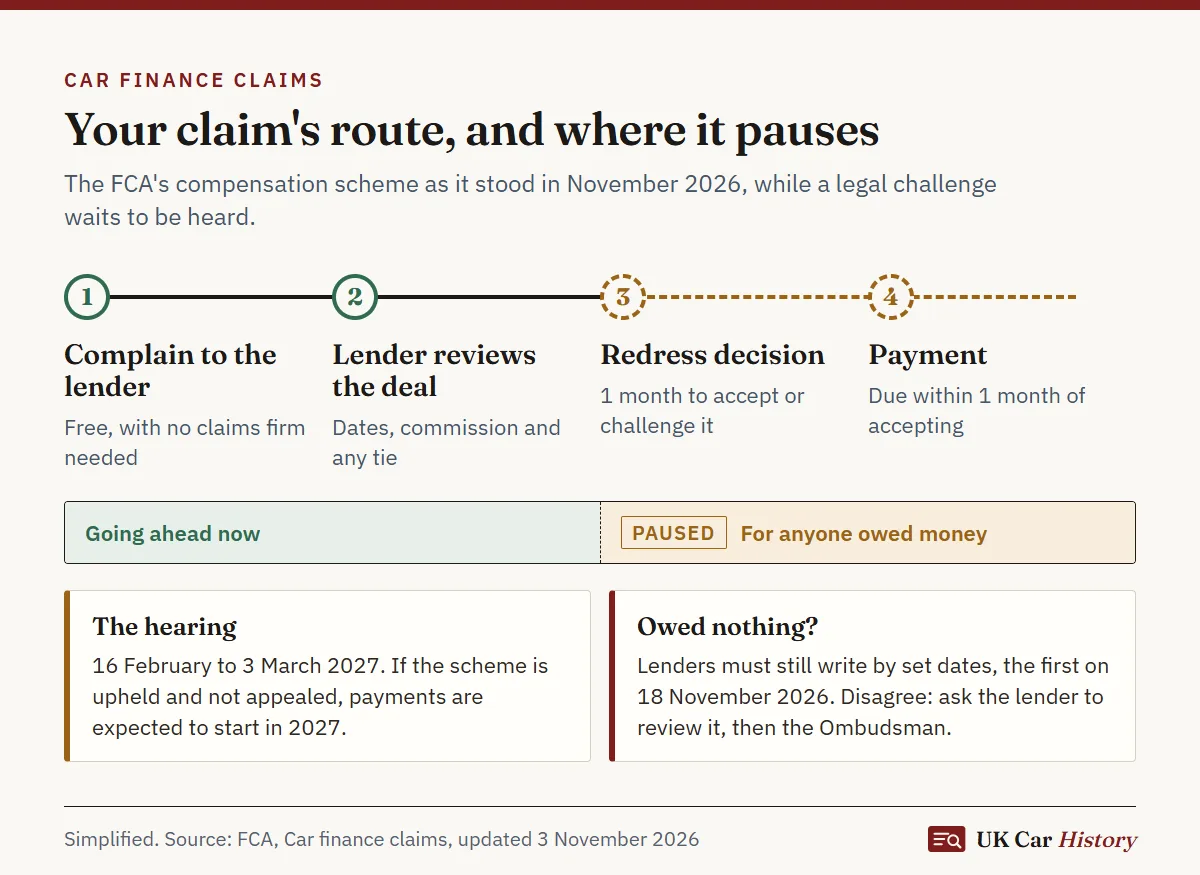
- Wait for the reply. It should state whether any compensation is due and, if so, the amount; for anyone owed money, the legal challenge holds that up.
- Respond within one month. Accept, or say why you disagree. The lender's last word is called a redress determination, and the Financial Ombudsman Service will review it free if you contact it by the deadline the letter gives.
- Payment. Once you say yes, payment is due within a month.
If the Ombudsman already had your complaint before 30 March 2026, the scheme leaves it alone. Otherwise it wants the lender's answer first, and on a scheme case it checks only whether the scheme rules were applied, so say which rule you think was broken.
When will car finance compensation be paid?
Under the scheme, not yet. Of the four legal challenges made public on 1 May 2026, three came from lenders, and the Upper Tribunal ordered a partial suspension of the scheme on 2 July 2026. It will hear the case from 16 February until 3 March 2027, with judgment expected some months later.
Until the legal process ends, no lender has to work out or pay what the scheme says it owes. Afterwards:
- Upheld, with no appeal: the FCA expects scheme payments to start in 2027.
- Overturned, wholly or partly: the FCA decides what next. A revised scheme could be challenged again, delaying compensation to 2028 or beyond, so the FCA may instead tell lenders to deal with complaints individually, answering within eight weeks, with the Ombudsman as the next step.
What might your lender send before the hearing?
Parts of the scheme still run, so two kinds of letter can arrive before the hearing.
"You are not owed compensation." If you complained and the rules still in force show nothing is due, the lender should write by these dates:
| You complained by | Your agreement began | Lender should write by |
|---|---|---|
| 30 June 2026 | 1 April 2014 or later | 18 November 2026 |
| 31 August 2026 | Before 1 April 2014 | 18 January 2027 |
| After those dates | Any date | 5 months after the lender receives it |
Two exceptions apply: complaints the lender judges out of time, and ties it discounts because lender, maker and dealer were visibly linked. Silence is therefore no sign that money is coming. If a "not owed" answer looks wrong, ask the lender to review it, and go to the Ombudsman if you are still unhappy.
A settlement offer. Some lenders may offer to pay early, and the FCA expects offers to match or beat the scheme. Accepting is full and final: the money stays yours whatever happens, but any claim to more is gone and the Ombudsman will not review it. If you refuse, the lender must still answer your complaint, though the timing is uncertain until the legal process ends.
A real scheme letter quotes your unique reference number and gets your agreement details right; one without them may be a scam. Nobody genuine charges a fee to release compensation, and fraudsters pose as lenders and as the FCA.
How much is a car finance claim worth?
The FCA expects an average of around £830 for each agreement, with some people getting more and some less. The method depends on your case:
| Your case | What you get |
|---|---|
| Like the case the Supreme Court found unfair: a hidden tie or discretionary commission, plus commission of 50% or more of your total cost of credit and of 22.5% or more of the loan | All the commission, plus interest |
| Most other eligible cases | Commission and estimated overpayment, added together and halved, plus interest |
| Your rate was among the cheapest 5% on offer then, 0% deals aside | Nothing: the deal was already among the cheapest |
The overpayment estimate takes a percentage off the interest rate you paid: 21% for deals signed before April 2014, 17% for later ones. Interest is then added, worked out from the Bank of England base rate (its average over each year) plus 1%, with a minimum of 3% a year.
About 1 in 3 awards are capped: the lender tests the result against three limits, such as 90% of the commission paid with interest added, and if it is above any of them, cuts it to the lowest. And should the lender go bust, there may be nothing to collect, because the Financial Services Compensation Scheme does not protect this kind of borrowing.
Should you hand your claim to a paid firm?
Not for the scheme. Joining it, or finding out whether you qualify, needs no claims management company (CMC) or law firm, the FCA says, and one could take up to 36% of your compensation in fees, VAT included.
An authorised CMC's fee for a financial services claim begun from 1 March 2022 onwards is capped by the size of the award:
| Compensation awarded | Largest fee, VAT included | Largest share, before VAT |
|---|---|---|
| £1 to £1,499 | £504 | 30% |
| £1,500 to £9,999 | £3,000 | 28% |
| £10,000 to £24,999 | £6,000 | 25% |
| £25,000 to £49,999 | £9,000 | 20% |
| £50,000 and above | £12,000 | 15% |
Court action is outside the cap, so a CMC that goes to court for you may take a larger share. An authorised CMC must give you a one-page summary of the key information before you sign, and 14 days to cancel free. After that, a firm you leave may charge only a reasonable fee for the work it has done, and the FCA warns that most car finance claims have hardly progressed.
Use one firm at most, or risk paying several fees and waiting longer. Signed with more than one? Tell the lender which should act for you, or that none should.
If the firm itself lets you down, raise it with that firm first. After eight weeks without a reply, or an answer you reject, the Legal Ombudsman handles law firms and the Claims Management Ombudsman handles CMCs.
Court is another route; the FCA suggests independent legal advice first, and considers the scheme the simpler, surer route; legal fees could also leave you worse off.
What if your mis sold car finance claim is not about commission?
People call all sorts of car finance complaints "mis-selling", but the scheme deals with one narrow problem: commission or ties that nobody properly explained. Any other mis sold car finance claim goes through the normal complaints process. The car finance complaints the Financial Ombudsman handles include:
- a car or an agreement that was mis-sold or misdescribed;
- a faulty car, or one not of satisfactory quality;
- unaffordable lending, or unfair treatment in financial difficulty;
- unfair charges when the agreement ends, for example for excess mileage or damage.
Complain to the lender first; after eight weeks without a final response, or with one you reject, the Ombudsman can investigate free. Affordability depends on the checks a lender must make before lending, set out in the no deposit car finance guide.
Does a claim affect the car you drive now, or the next one?
No. The complaint concerns the way the finance was sold, not the vehicle. The one practical link is money you still owe: a lender making a settlement offer on a live agreement may deduct your remaining payments and pay only the balance, known as set-off.
On HP or PCP the car belongs to the finance company until the last payment, balloon included, and a sale cannot complete until the lender has been paid, as the guide to selling a car that still has finance explains.
Shopping for a replacement? A used car can still carry someone else's finance. Run the registration through our finance check to see whether a lender has an agreement recorded against it, which company that is and what kind of agreement it is; the Premium report (£7.99) includes it, as well as checks for a write-off or theft record.
Questions and answers
Is there a time limit on claiming for an old car finance deal?
The usual limit for a legal claim is six years, counted from when the agreement ended. Where commission was deliberately concealed, that clock is likely to start later, and the FCA has said it does not expect many cases to be ruled out of time.
Can I claim for someone else, or for a relative who has died?
Eligibility is limited to the borrowers named on the agreement, but any of them may be represented by a family member, a friend or a professional, whose authority the lender will check. The scheme also covers people who have since died: a beneficiary can complain on their behalf, and the lender will probably ask for the will or the grant of probate.
I have not complained yet. Could the lender write to me first?
Only in some cases. The scheme expects lenders to approach customers who never complained where they think money may be owed, and for now those opt-in letters are paused by the suspension order.
I have lost my finance agreement. Can I still complain?
Yes. You can trace the lender through old bank statements, the dealership or a free look at your credit file, and it is then the lender's job to find the commission records, asking the broker for them if needed.
What if I am bankrupt or in an IVA?
Tell your lender, and your official receiver (for bankruptcy) or insolvency practitioner (for an IVA or other formal insolvency). The FCA says this may change who any compensation is paid to.
Sources
- FCA: Car finance claims (updated 3 November 2026)
- FCA: PS26/3, Motor finance consumer redress scheme (March 2026)
- UK Supreme Court: judgment of 1 August 2025 on motor finance commission, [2025] UKSC 33
- legislation.gov.uk: Consumer Credit Act 1974, section 140A (unfair relationships)
- Financial Ombudsman Service: Complaints about car finance commission
- FCA: Using claims management companies (fee caps)
This guide is general information for people buying or owning a car in the UK, not legal or financial advice. UK Car History is an independent service, not affiliated with the DVLA, the DVSA or GOV.UK.