The short answer
Your car does not have one value but three: a trade price, a private-sale price and a retail price. Which one you get depends on who buys it and who sells it. A car valuation by reg estimates each of them from the car's version, age and mileage. That makes it a good first figure, but adverts for cars like yours have the final say.
Below, the three prices are set side by side, followed by how valuation guides arrive at a number, which details push it up or down, how to pin down a figure for your own car, and what an insurer owes you if the car is written off or stolen. You will find no prices here: values follow the market, and any figure printed today would soon be out of date.
Why is a car worth more to some buyers than to others?
Put the same car in front of three buyers and you will hear three different prices. From the lowest to the highest:
| Price | Who pays it | Set it against |
|---|---|---|
| Trade-in | A dealer or car buying service taking your car, outright or towards another one | A part-exchange offer, or a quote from a car buying website |
| Private sale | One private person buying from another | What you ask, or are offered, when you sell privately |
| Retail | Someone buying from a dealer, the car cleaned and prepared for sale | Forecourt prices, and the offer an insurer makes for a written-off car |
The bottom of the ladder pays for the dealer's work. Before your car can go back on sale it has to be inspected and prepared, the dealer takes on the legal duties a trader owes its next customer, and it still needs a profit when the car sells.
The top of the ladder reflects what a private buyer gives up. Someone buying privately has fewer rights, because the satisfactory-quality term in the Sale of Goods Act 1979 binds only sellers acting in the course of a business. They pay less in return.
So line each offer up with its own column: bids from dealers against the trade figure, bids from private buyers against the private one. Hold a trade offer up against a retail price and every offer will look mean.
How are car valuations calculated?
A car valuation by reg comes from a motor valuation guide, a database of what cars are fetching across the country. The Financial Ombudsman relies on these guides to judge insurers' offers. It calls them the most persuasive and consistent evidence of value, and explains that they are built from research across the country into the prices cars are likely to sell for, rather than what any one car sold for, with mileage and specification factored in.
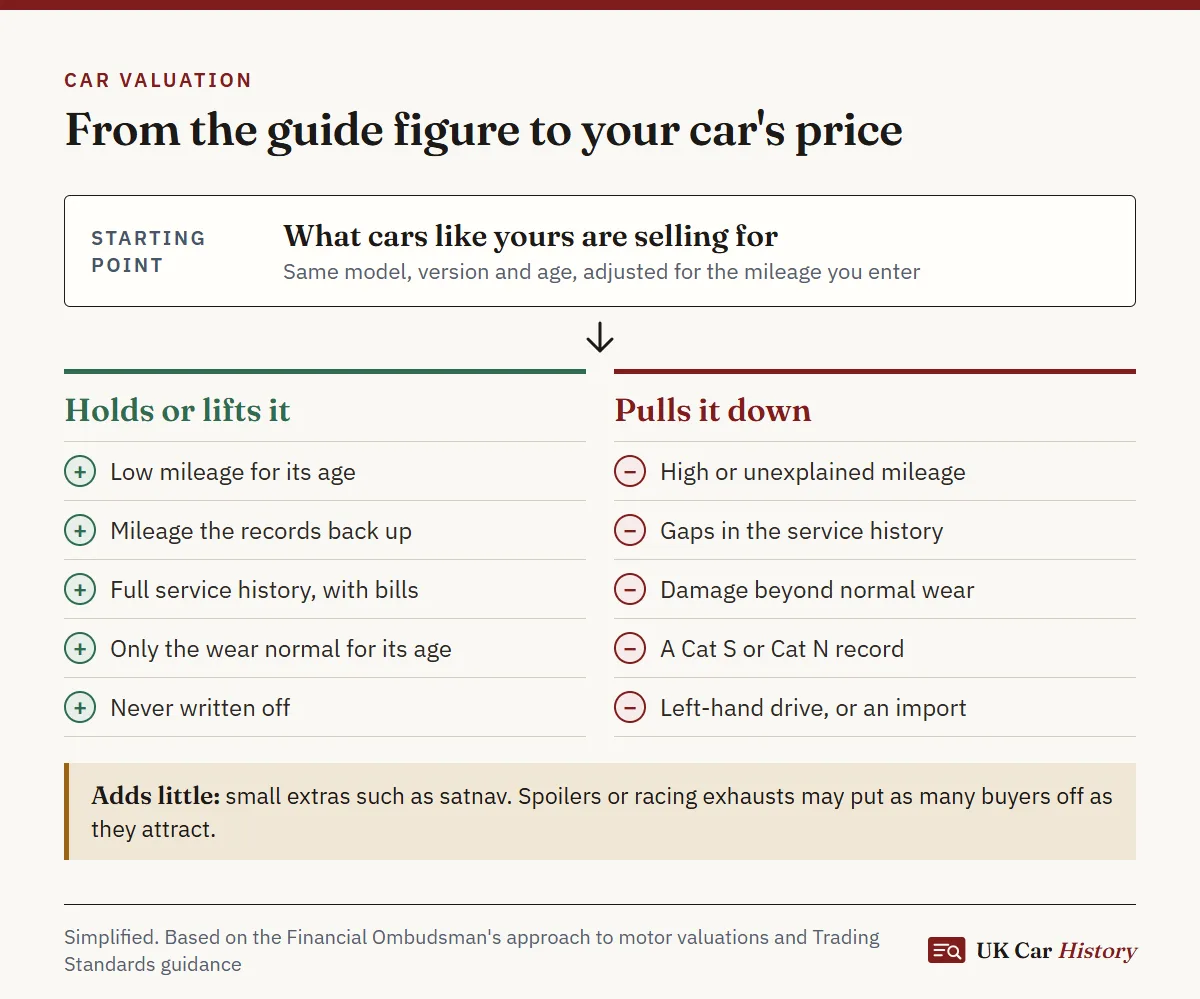
The registration tells the guide which car it is dealing with: the make, model, engine and age. From there it starts with what that version typically sells for and corrects the figure for the mileage you enter.
- It is an estimate. Nobody has paid that sum for your car; it is what a car like yours is likely to fetch.
- It assumes ordinary condition. Wear that is normal for the age and mileage is already built in, but a dent, a slipping clutch or a thick folder of invoices is invisible to the guide. You add or take away for those yourself.
- It goes out of date. Second-hand prices go up as well as down, the Ombudsman acknowledges, and the guides refresh their data regularly to keep up.
Guides do not always agree with one another, and the Ombudsman has said their figures for the same car can vary significantly. When one complaint reached a final decision in 2023, the fair value it settled on was the average of four guides' figures. Averaging two or three sources is a sound habit for your own car too.
Which details push a valuation up or down?
Once the guide has its starting figure, the facts about your particular car decide where it lands. These are the ones that count:
| Detail | What it does to the price |
|---|---|
| Age | Fixed by the date of first registration. The main guides usually stop at around 20 years old, the Financial Ombudsman says, so an older car is priced from other evidence. |
| Mileage | Every guide adjusts for it. Trading Standards expect dealers to verify it, because it is the kind of fact that can decide whether someone buys. |
| Condition | Normal wear for the age is already allowed for. Damage beyond it brings the figure down. |
| Service history | Stamps and invoices show the car was looked after and support its mileage. Missing years make a buyer budget for work that may never have been done. |
| Version and extras | Engine, gearbox, trim and body style all count. Small additions such as satnav add little. |
| Write-off record | Once repaired, a Cat S or Cat N car still sells below an identical car that was never written off. |
| Left-hand drive or import | Usually worth less in the UK, the Ombudsman says, and an imported right-hand-drive car is likely to be affected too. |
Condition is judged against age. Take small scratches: the Ombudsman's view is that they might lower the value of a brand-new car while making no difference on one that has done 15 years. Bolt-on changes get the same scrutiny, since spoilers or racing exhausts may appeal to some buyers but put others off, so on balance they rarely lift the market value.
A mileage figure only tells you something once you set it beside the car's age, and what counts as good mileage for a used car walks through that comparison.
A write-off gap needs pricing with care, and a dealer selling such a car on is expected to tell its buyer about the record. The guide to how much Cat N takes off a car's value shows how to work it out.
How do you make a car valuation by reg as accurate as possible?
- Confirm the car. Hold the result up against your V5C logbook: the make, model, fuel, year and engine size on screen should all match it. If the site asks for trim and gearbox, pick yours, not the nearest one. Wrongly recorded details are a known cause of valuation disputes at the Financial Ombudsman.
- Type in the mileage from the dashboard, to the mile.
- Answer the condition and history questions honestly. A generous answer only produces a number no buyer will match.
- Get a second and a third opinion. An outlier usually has a reason, such as the wrong trim; find it before you use the figure.
- Label each figure as trade, private or retail, so you never compare one kind with another.
- Ask again when you are ready to sell. A figure from a few months back may no longer hold.
To be sure a valuation is for your exact car, the free look-up on our car check home page shows the make, model, colour, fuel, engine size and month of first registration recorded against the registration.
Do adverts for similar cars back up the figure?
Adverts tell you what you are up against: every one is a car a buyer might pick over yours. The Financial Ombudsman has not historically given adverts much weight, but it now says the valuation guides have told it that cars generally sell at or close to their advertised prices. Its warning still applies: compare like-for-like cars only, because small differences change what a car is worth.
- Look for your make and model with the same engine and gearbox, no more than a year or so older or newer.
- Drop any with a very different mileage or a different trim.
- Keep the two kinds of advert apart. Dealers advertise at retail prices; private sellers at private ones.
- Write down at least five asking prices and take the one in the middle.
- Move your figure from there: more miles, missing history or a write-off record push it down; low miles and a full set of invoices push it up.
If the guide figure and the adverts are far apart, check the details you typed into the valuation before you decide which one to trust.
A valuation is no promise that anyone will pay it. On the day, the price comes down to how the car looks and drives, the papers that come with it, and the other cars on sale at the time.
Why is a part-exchange offer below the private price?
A dealer quoting for your car is quoting a trade price, so judge it against the trade figure and nothing else. Once your car is on its forecourt, the dealer carries a trader's duties to whoever buys it next: it must sell a car of satisfactory quality that matches what it said about it. Trading Standards guidance also tells dealers to check a car's MOT history, its service record and its mileage before selling it. That work, and the profit, live in the gap between the trade and retail figures.
Expect the number to change once the dealer has inspected the car and seen its papers. The guide to selling privately or part-exchanging goes through those checks and weighs one route against the other.
What should an insurer pay if your car is written off or stolen?
Insurers usually settle a total loss at market value. In the Financial Ombudsman's words, that is what the car would have fetched at a reputable dealership immediately before the damage or theft, which makes it a retail figure. The FCA, which regulates insurers, found that every firm in its review used retail valuations from one or more trade guides, and it expects an insurer's first offer to be its best estimate of the market value.
A low offer deserves questions: which guides did the insurer consult, and what did it take off, on what grounds? One deduction the FCA singles out as possibly unfair is a cut for ordinary wear and tear, since a guide price already assumes the wear expected at that age and mileage. Should the insurer refuse to budge, put a complaint to it in writing. If you are still unhappy after that, you can take the complaint to the Financial Ombudsman Service, which costs you nothing.
Does a car history report include a valuation?
Yes, as three figures, retail, private sale and trade-in, wherever a valuation is available. It is included in the Basic report, £3.99, as well as the Premium report, £7.99. It is one more estimate, so weigh it with the guides and adverts you have already looked at.
The Premium report sets that valuation beside the records a careful buyer will look at: whether finance is still owed, any write-off or stolen record, the number of previous keepers and any plate changes, with the MOT history and a mileage verdict. The page on car registration history explains the keeper and plate records.
Sellers can use it too. Run the report on your own car and you will know what a buyer's check is going to show before anyone asks.
Questions and answers
Should I value my car at what I paid for it?
No. The Financial Ombudsman has found that people sometimes simply pay more than the guides say a car is worth. Prices also move after you buy, so the purchase price soon stops being a guide.
Will a body kit or a new satnav make my car worth more?
Seldom. In the Financial Ombudsman's view, small extras such as a satnav are unlikely to add much, while changes like a spoiler or a racing exhaust can attract one buyer and put off the next.
Why do two valuation sites give my car different figures?
Each draws on its own research, and the Ombudsman accepts that the guides can be far apart for one car. Average two or three of them and check the result against adverts.
How do I value a car that is more than 20 years old?
Look beyond the guides, which the Financial Ombudsman says do not usually cover cars of that age. The strongest evidence is what sellers ask for the same model in comparable condition; when there is no guide price, the Ombudsman itself asks for things like an engineer's report.
Does left-hand drive lower a car's value here?
In most cases. The Financial Ombudsman describes left-hand-drive cars as usually worth less in the UK and accepts insurers deducting the difference, and being an import is also likely to lower a right-hand-drive car's price.
How often do car valuations change?
Often enough that an old figure can mislead. The Ombudsman acknowledges that second-hand prices rise and fall over time and that the guides update their data regularly, so ask for a fresh figure when you list the car.
Sources
- Financial Ombudsman Service: Motor valuations and write-offs
- Financial Ombudsman Service: decision DRN-4107773 (how trade guides value a car)
- FCA: Findings of multi-firm review into insurers' valuation of vehicles
- Business Companion (Trading Standards): Mileage of used vehicles
- legislation.gov.uk: Sale of Goods Act 1979, section 14 (quality only for business sellers)
This guide is general information for people buying or owning a car in the UK, not legal or financial advice. UK Car History is an independent service, not affiliated with the DVLA, the DVSA or GOV.UK.