The short answer
Expect a Cat N car to cost noticeably less than a clean one, but no rule fixes how much less. The car-buying magazine What Car? puts the Cat N gap at sometimes as much as 20-40%, and the Cat S gap at as much as 50%, depending on the damage. Where one particular car lands inside those ranges comes down to the car itself, what was damaged and the proof of repair.
Below you will find the published figures side by side, the factors that move a discount, a pricing sum you can do with a phone and a handful of adverts, and what happens to the value of a car you already own once it is categorised. Treat it as general information rather than financial advice.
What do the published figures say?
| Who says it | Category | Their words |
|---|---|---|
| What Car? (updated November 2025) | Cat N | "Sometimes as much as 20-40% less" |
| What Car? (updated November 2025) | Cat S | "As much as 50% cheaper", depending on the level of damage |
| GOV.UK guide to buying repaired write-offs | Cat S | "Often slightly cheaper" than similar vehicles |
Read the phrase "as much as" carefully: it describes the steepest cuts seen, on some cars. GOV.UK says even less, and pairs it with a warning for Cat S buyers: a price that looks too good to be true is a reason to be wary.
Insurers decide the letter; buyers decide the price. Every sale is a fresh judgement, so a percentage can open your sums but never close them.
Why does one Cat N car lose more value than another?
The same letter can hide very different cars. These are the things that move the gap one way or the other:
| Factor | Widens the gap | Narrows the gap |
|---|---|---|
| The damage | Flood, fire or electrical faults, which are hard to judge | Bolted-on panels swapped for new ones |
| The evidence | No invoices, no photos, no named bodyshop | A full paper trail you can check |
| The car | A common model with plenty of clean examples for sale | A sought-after model that is hard to find |
| The buyer | A trader, who must resell it with its history | A private buyer who plans to keep it |
| The letter | Cat S: structural damage | Cat N: the structure was spared |
Beware of reading too much into the letter alone. A low-value car can be written off after a fairly small knock, because the repair bill overtakes its worth so quickly, so find out what was actually hit.
How much does Cat S reduce car value compared with Cat N?
Generally by more, for two reasons. A structural repair is harder for the next buyer to judge than a new wing or bumper, and the published Cat S range runs up to half the price of a clean car where the damage was heavy.
The second reason is paperwork. A repaired Cat S car's V5C has the category printed on it, whereas a Cat N car may still have a logbook that never mentions the write-off, so a Cat S history surfaces the moment a buyer opens the documents. Before buying one, the checks in should I buy a Cat S car matter more than the discount.
Can you put a figure on one particular Cat N car?
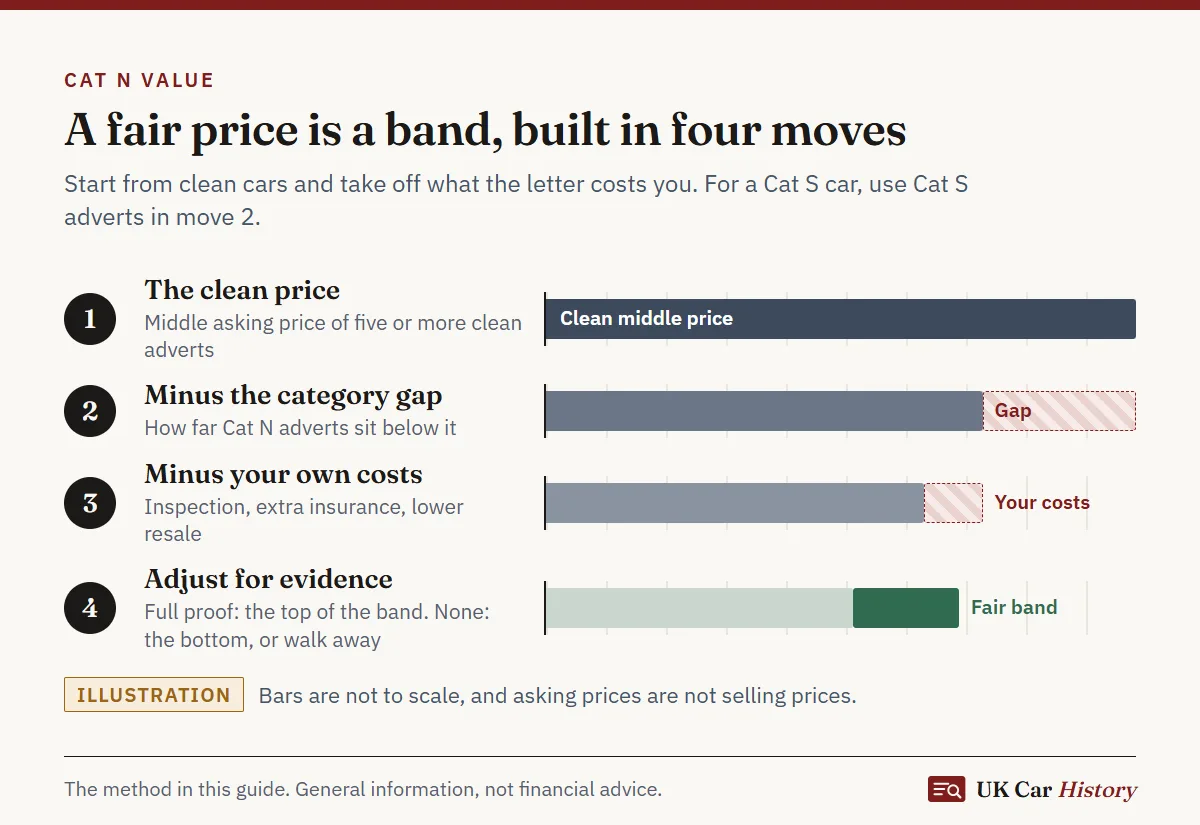
Yes, as a band rather than an exact number. Build it from adverts, in four moves:
- Start from clean cars. Find five or more adverts matching the make, model, engine and trim, of a similar year and mileage, with no write-off history. Take the middle asking price, which one oddly priced car cannot drag up or down.
- Measure the category gap. Search the same model for Cat N adverts (Cat S adverts if that is your letter) and note how far below the clean middle they sit.
- Subtract what the letter will cost you. Budget for an inspection, any rise in your insurance quote and the smaller sum you will get back on resale.
- Let the evidence decide where you land. A full paper trail and a clean inspection put you near the top of the Cat N range; no paperwork puts you at the bottom, or out of the door.
Adverts show what sellers hope for, not what cars sold for, and some sellers stay quiet about write-offs, hence the band. A car priced well below even the Cat N adverts deserves a closer look, not a quick deposit.
What is your own car worth once it is made Cat N?
Your insurer pays what the car was worth just before the loss. In the Financial Ombudsman Service's view, that market value is the price a reputable dealer would have sold the car for immediately before it was damaged or stolen.
Keeping the car is possible: GOV.UK says the insurer pays out and then sells it back to you. You are left with the payout minus the buy-back price, and a car that now carries a Cat N record. To decide, add the repair bill to the buy-back price and compare the total with what the car will fetch as a Cat N car, using the sum above.
Is a repaired Cat N car paid out in full if it is written off again?
Not necessarily. The insurer owes the market value of the car you actually had, write-off record and all. The Ombudsman accepts a deduction where you bought the car knowing it was a repaired write-off, provided the insurer can show how much the earlier write-off lowered the value. Where you had no reasonable way of knowing, it is likely to expect the insurer to pay full market value.
So hold on to the advert and the seller's messages, which prove what you were told. Agreed-value cover is another option: the value is settled when the policy starts, and the Ombudsman expects the insurer to pay that sum on a write-off. Declaring the category when you buy cover is explained in the insurance and finance guide.
What price should you expect when you sell a Cat N car?
Expect the same discount to work against you. The write-off stays on the insurers' records, so a buyer who runs a check will find it even if your advert says nothing; declaring Cat N when selling covers what to tell them.
Dealers will usually offer least, since they take on the job of reselling a categorised car. In a private sale, the strongest thing you can put on the table is the repair paperwork, which settles the question every viewer arrives with and helps you hold your price.
How can the category help you negotiate?
A write-off the seller never mentioned, or a price that ignores one, is a fair reason to offer less. Show the record, your advert sums and your extra costs, make a single offer on that basis, and be prepared to walk. Negotiating a used car price has more on the conversation.
Our Premium report (£7.99) gives you the write-off check and an estimated valuation together; the car category check page explains what is in it. A valuation cannot see the repair, so use it as one input beside your adverts. And when a seller has full evidence and has already priced the letter in, pushing hard can cost you a decent car.
Questions and answers
Will every Cat N car be 20-40% cheaper than a clean one?
No. That range describes how far the discount sometimes goes, not a rule. Some Cat N cars sell much closer to clean prices, others for less, depending on the damage, the evidence and the model.
Does a Cat N car ever catch up with a clean one on value?
No. Because the write-off record is permanent, each new buyer will price the car against clean examples with its history in mind.
Why do dealers offer so little for a Cat N part-exchange?
Because they have to sell the car on with its write-off record, and allow for the time and risk that involves. A private sale usually brings more.
Does a valuation in a report allow for the write-off?
Not necessarily. A valuation estimates a car of that model, age and mileage, so line it up against what Cat N examples are actually advertised for before trusting it.
Can buying a Cat N car save money in the long run?
It can, if the purchase price is low enough and you keep the car for years. The gap works against you again when you sell, so factor the lower resale price in from the start.
Sources
This guide is general information for people buying or owning a car in the UK, not legal or financial advice. UK Car History is an independent service, not affiliated with the DVLA, the DVSA or GOV.UK.