The short answer
Put simply, a Cat N car has been written off by an insurer although its structure came through undamaged. The chassis and frame were sound, yet fixing everything else would have cost the insurer more than the car was worth, so it paid the owner instead. After proper repairs, and once it is roadworthy, the car may lawfully return to the road.
The N refers to the kind of damage: none of it structural. This guide shows where that boundary sits, the kinds of damage it can cover, why a Cat N car's V5C looks like any other, and the checks that reveal the category on a car you are thinking of buying.
Cat N write-off meaning: why does an insurer give up on a repairable car?
A write-off marks the end of a claim, not a finding that the car was beyond repair. Faced with a damaged car, the insurer weighs the repair bill against what the car is worth. GOV.UK's consumer guide calls the result a constructive loss when mending the car would cost more than its replacement value.
Each written-off car is then placed in a category by a qualified assessor, using a salvage code drawn up by the Association of British Insurers. That code defines category N by what is missing: the car is repairable, and its structural framework and chassis escaped damage. On GOV.UK's list of categories, N is the one for repairs after non-structural damage, with the car usable again when roadworthy.
Which parts can be damaged in a Cat N car?
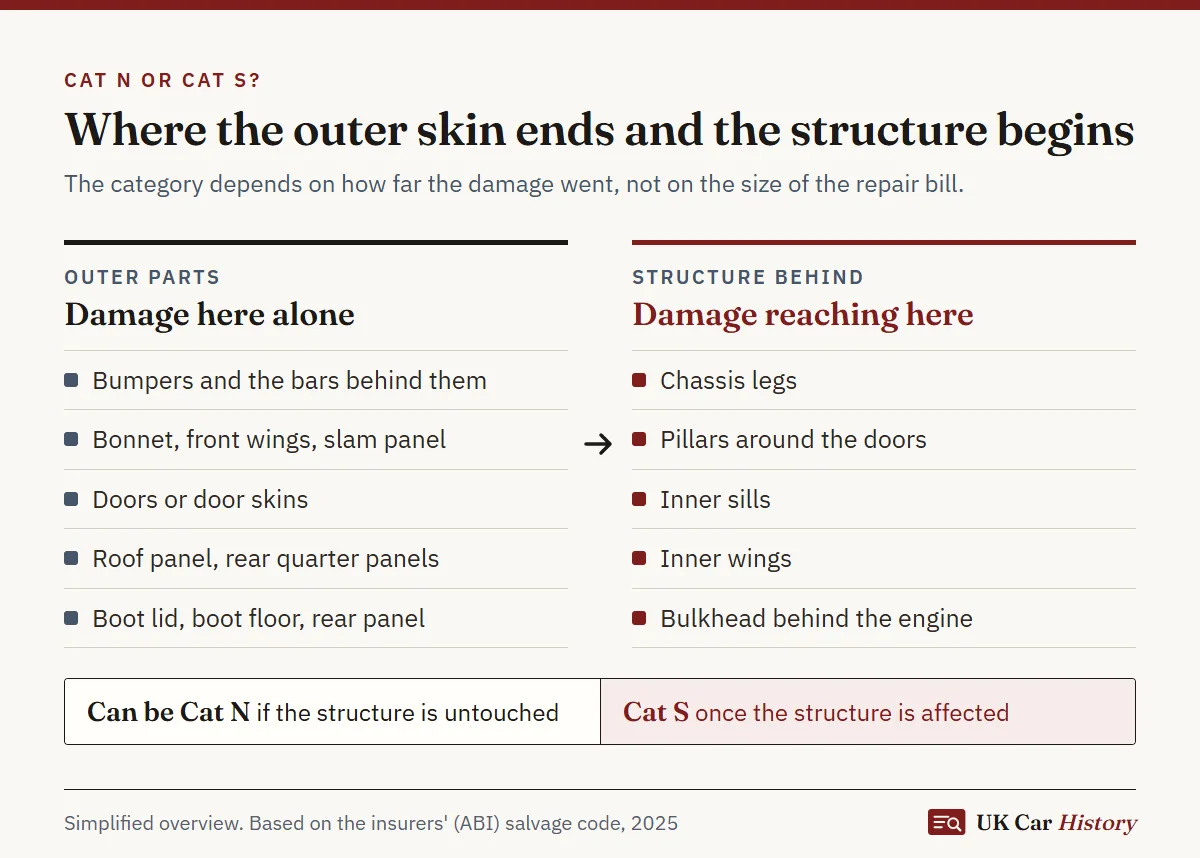
A drawing in the insurers' code marks out which outer parts are not structural. Grouped by area of the car, with the structure each group covers:
| Area | Non-structural: Cat N if only these are hit | Structure behind: Cat S if any is hit |
|---|---|---|
| Front | Bumper and its reinforcing bar, bonnet, front wings, slam panel | Chassis legs, inner wings, bulkhead |
| Sides | Complete doors or door skins, rear quarter panels | Pillars around the doors, inner sills |
| Top | Roof panel | The pillars holding the roof up |
| Rear | Bumper and its bar, boot lid or tailgate, boot floor, outer rear panel | Chassis legs |
When the impact only bent parts in the middle column, the write-off can stay in Cat N. Once anything in the right-hand column needs straightening or replacing, the category becomes S. The code also asks the assessor to rule out a knock that passed through an outer panel into the frame before settling on N.
Is Cat N damage always light?
Not necessarily. Writing as the new categories took effect on 1 October 2017, Thatcham Research warned that a Cat N car might still have needed safety-critical items such as steering and suspension parts, and the insurers' code makes the same point.
Deployed airbags are a case in point. They sit outside the structure, so firing them does not by itself push a car into Cat S. Because the code bars airbags, seat belts and belt pre-tensioners from being re-used or sold from salvage, a correct repair means fresh parts, and you can ask to see proof.
For electric and hybrid cars the code adds a condition: Cat N is possible only where the high-voltage battery is not part of the structure. Even then, it warns, the high-voltage system and its battery may have been harmed.
Think of N as a map of where the damage was. The quality of the repair is a separate question, and it is the one your money rides on.
Crash, theft, fire or flood: which causes end in Cat N?
Collisions are only one route. The salvage code tells assessors to consider how the damage happened, naming theft, collision, impact, fire, electrical faults, flood and contamination. In practice a Cat N history might mean any of these:
- A bump that crumpled a bumper, a wing and a headlamp, on a car worth less than the bill.
- A break-in that left smashed locks, a wrecked ignition or parts missing. If a stolen car is found unharmed, or nearly so, the code does not apply and no category is given.
- Fire or heat that scorched the car without reaching its structure.
- Water. A car whose interior flooded deeply enough to damage its electrics or safety systems should, under the code, never be driven again; lesser water damage can still lead to Cat N.
- An electrical failure the insurer decided was not worth fixing.
The record does not say which story belongs to your car. Put the question to the seller and ask for the paperwork from the repair.
Why does a Cat N car's logbook look completely normal?
Because the category never goes on it. GOV.UK tells someone keeping a Cat N car that they can carry on using their current V5C, and the insurers' code says the category is not written onto it. Cat S works the other way: the whole logbook goes to the insurer, a free duplicate is applied for on form V62, and the DVLA writes the category into it.
So for Cat N, the document a seller hands you is silent by design. The category lives in the insurance industry's write-off register, which every categorised car joins, and the code says that information is shared with firms selling vehicle checks to traders and private buyers alike.
How do categories N, S, C and D compare?
| Letter | Basis | Road use after repair | What the V5C shows |
|---|---|---|---|
| N (from 1 October 2017) | No harm to the structure | Permitted once roadworthy | Nothing: the owner keeps the old logbook |
| S (from 1 October 2017) | Harm to the structure | Permitted once roadworthy | The category, in a duplicate logbook |
| C (before October 2017) | Repair bill above the car's value | Permitted once fixed | Depends on the paperwork you are given |
| D (before October 2017) | Repair bill below the value, yet the insurer paid out | Permitted once fixed | Depends on the paperwork you are given |
People often call N the successor to D. The trouble is that the two letters answer different questions, one about cost and the other about location, so a pre-2017 Cat D car may well have had structural damage, and it keeps its D for good. The old system is set out in our Cat C and Cat D guide.
The structural category has a guide of its own: what Cat S means on a car.
What does Cat N mean in an advert, and how can you confirm it?
Look for "Cat N" or "Category N" in the headline, in the list of specifications or tucked into the description. An advert that never mentions a write-off settles nothing: plenty of sellers do not know their car's past, and some would rather you did not. An unusually low asking price is worth noticing, but only as a prompt to dig further. These steps confirm the position:
- Look up the insurers' records by registration. For Cat N it is the reliable route, since the logbook stays silent. The category car check in our Premium report (£7.99) gives the letter and the date of the loss.
- Tie the record to the car. Compare the VIN on the bodywork with the one in the V5C before you trust any result.
- Study the MOT history around the loss date. Gaps between tests, or advisories that appear soon after, can mark the months off the road and the work that followed. A free car check look-up lists every test.
- Request the repair paperwork. A proper invoice lists the damage found and each part replaced.
- Put the question in writing. Message the seller asking if the car was ever written off, the category and the date, and save the reply.
Has the check confirmed Cat N? Then our guide to buying a Cat N car walks through inspection, price and warning signs.
What will a Cat N history cost you in insurance and resale?
Cover is available for a repaired Cat N car, though not from every insurer, and premiums can be higher. GOV.UK suggests speaking to your insurer before buying a written-off car, and warns that keeping the write-off quiet lets an insurer turn down a claim for non-disclosure. Our guide to Cat S and Cat N insurance and finance covers cover and lending in more depth.
The category also lowers the price, both when you buy and when you come to sell. By how much depends on the model, the damage and the standard of the repair, which our guide to Cat N value explores.
Questions and answers
Is it legal to drive a Cat N car on UK roads?
Yes, provided it has been repaired to a roadworthy condition. It then needs what any car needs: tax, insurance and a valid MOT where one is due.
Does repairing a Cat N car clear the record?
No. Repair does not wipe it. The insurers' code permits a change only to put right a mistake or in exceptional circumstances, so the record follows the car from keeper to keeper.
Why do low-value cars become Cat N so easily?
The deciding sum is the repair bill set against the car's value. On a cheap car that point comes quickly, so damage that would be repaired on a newer model can end in a write-off.
Can a car be Cat N if the airbags were set off?
It can. Airbags are outside the structure, so their firing does not decide the category. Ask to see invoices for the replacement airbag and belt parts, and watch that the airbag warning lamp goes off once the car has started.
Can an electric or hybrid car be written off as Cat N?
Yes, but the code limits it to cars whose high-voltage battery does not form part of the structure, and cautions that the high-voltage system could still be damaged. Have a specialist examine it before buying.
Should I avoid Cat N cars altogether?
Not necessarily. A well repaired Cat N car bought at a fair discount can be a reasonable choice. Weigh the saving against insurance and resale, and get an independent inspection first.
Sources
This guide is general information for people buying or owning a car in the UK, not legal or financial advice. UK Car History is an independent service, not affiliated with the DVLA, the DVSA or GOV.UK.