The short answer
What does Cat S mean? It is the label insurers give a car they have written off after its structure was damaged: the chassis, the frame or the crumple zones built to absorb a crash. Repair is allowed, and once the work leaves it roadworthy, a Cat S car may be driven, taxed, insured and sold again.
The letter arrived with the new categories in October 2017, and it is a warning rather than a ban. Nobody official approves the repair, so this guide covers how such a car returns to the road, how to recognise one, what to inspect, and how the history affects cover and value.
What is a Cat S car, and why was it written off?
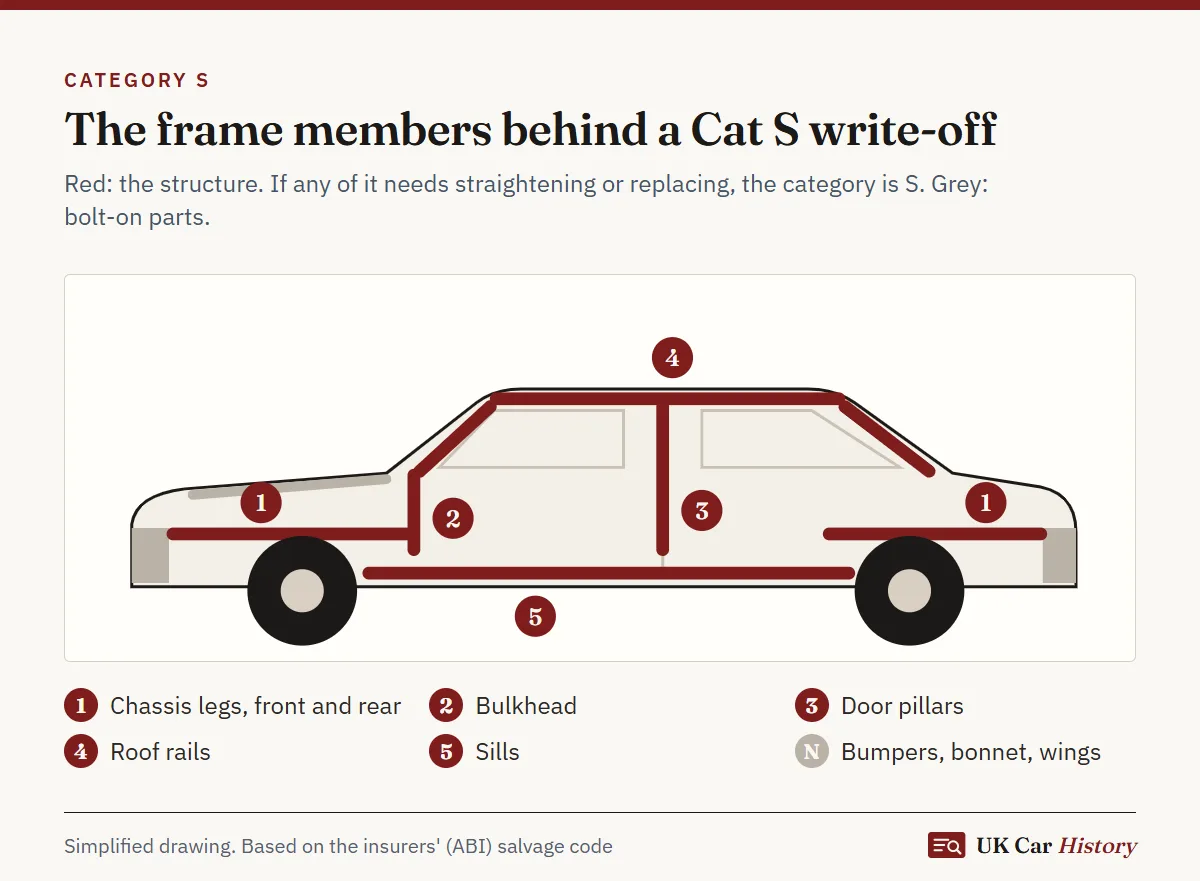
The S refers to structural damage that can be put right. In the accident, the force went beyond the parts that are simply bolted on, such as bumpers, lights and wings, and into the shell that holds the car together: chassis legs, door pillars, sills, roof rails, the bulkhead or the crumple zones. When only bolt-on parts suffer, the result can be Cat N instead.
Being written off is not proof that the car was beyond saving. GOV.UK's guide for buyers describes a constructive loss as one where repairing the vehicle would cost more than its replacement value. Plenty of Cat S cars are everyday models whose repair bill simply outran their worth.
From insurance claim to road: the steps back for a Cat S car
- Once the claim is settled, the car is either sold for salvage or kept by its owner.
- Someone repairs it, whether a body shop, a trader in salvage cars or the owner.
- Before it returns to use, the whole V5C is sent to the insurer and the keeper asks the DVLA for a replacement on form V62, which is free. GOV.UK says the new logbook carries the category.
- Like any other car, it then needs tax, insurance and, if it is old enough, a current MOT before anyone drives it.
Notice what is missing: an official inspection of the structural work. GOV.UK's buyer guide points out that an MOT only shows a car was roadworthy when tested, and suggests paying an independent expert or engineer to look for structural damage. A poor repair can be disguised well enough to get through a test.
Cat S, Cat N, Cat A and Cat B: how do the four categories differ?
All four come from the Association of British Insurers' salvage code. GOV.UK sums them up like this:
| Category | Kind of damage | Repair allowed? | Fate of the car |
|---|---|---|---|
| A | Beyond repair | No | Crushed in its entirety |
| B | Beyond repair | No | Shell crushed; other parts may be salvaged first |
| S | Structural | Yes | Usable again when roadworthy |
| N | Non-structural | Yes | Usable again when roadworthy |
A Cat A or Cat B car sold as something to drive can never lawfully go back on the road. Walk away from it.
Is Cat S just a new name for Cat C or Cat D?
No. The letters used until October 2017 were about money. C went to cars whose repair would have exceeded their value; D to cars that could have been repaired for less, but which the insurer paid out on regardless.
Today's letters describe what was damaged instead, so there is no reliable translation between the two systems: a former Cat D car, for instance, may have had structural damage. Older write-offs keep their original letter, which is why C and D still appear in adverts. Give those cars the same scrutiny.
Three ways to spot a Cat S car before you buy
Sellers do not always volunteer it, so cross-check:
- The insurers' records. A search on the registration finds the write-off category whatever the advert says. It comes, with the date of the loss, in the category car check part of our Premium report (£7.99).
- The V5C. Once a Cat S car is back in use, its logbook should show the category. Compare the VIN printed there with the one on the car itself.
- The seller's own words. Ask outright whether the car was ever written off, and make sure the reply is in writing: a message, the advert or the receipt.
Paperwork can mislead in both directions. Cat N cars never have the category added to their logbook, and a car written off before 2017 may arrive with documents showing an old letter or none. That is why a car check of the insurers' register carries more weight than the papers in a seller's hand.
What should you inspect on a Cat S car?
Everything rests on the repair. A specialist who measures the shell and follows the manufacturer's methods can restore its strength; a rushed, cheap job done to sell the car on may leave it weaker in a future collision. You cannot see the hidden metal, so gather evidence instead:
- Paperwork: the name of the repairer, the invoices and any photographs taken during the work.
- A second opinion: an independent engineer or mechanic to examine the structure, how the panels line up and the airbag system, before you commit.
- Your own eyes: uneven gaps between panels, overspray on rubber seals, and traces of welding or new sealant inside the door frames and the boot.
- Dashboard lamps: the airbag symbol should light up at ignition, then disappear within moments.
- The MOT record: new advisories since the accident, such as tyres wearing on one edge, can hint at a bent suspension mounting.
Our guide on whether a Cat S car is worth buying turns these points into a buying plan.
The seller kept quiet about Cat S: what are your options?
From a dealer, your purchase is covered by the Consumer Rights Act 2015: goods sold by description must match it, and must be of satisfactory quality. A repaired write-off presented as clean may fall short of both. Raise it with the dealer in writing without delay.
Private buyers have narrower rights, though a seller who gave a false answer about write-offs could still face a claim. For your own case, Citizens Advice is the place to start; this guide is not legal advice.
Questions and answers
Does an MOT pass prove a Cat S repair was good?
No. A repaired Cat S car is tested like any other and can pass, but the test checks roadworthiness on the day, not the quality of the structural work.
Should Cat S worry me more than Cat N?
Usually, since S involves the car's structure and N does not. Even so, a careful repair on a Cat S car can be better than a poor one on a Cat N car, so judge the work itself.
Does the Cat S label disappear after repair?
No, repair leaves it in place. The insurers' code permits a category to change only where it was wrong or in exceptional circumstances, and the DVLA writes it into the logbook of a Cat S car that goes back on the road.
Can I get insurance on a Cat S car?
Often, though not from every insurer, and sometimes at a higher price. Get a quote while you are still deciding, and be open with the insurer that the car is a repaired write-off.
Why are repairable cars written off at all?
Insurers compare the repair bill with the car's value. When fixing it would cost more than replacing it, GOV.UK calls it a constructive loss, and the insurer pays out instead.
Sources
- GOV.UK: Insurance write-offs
- GOV.UK: Buying repaired written-off vehicles, a consumer guide
- ABI: Salvage code updated (categories S and N from October 2017)
- Thatcham Research: Revised salvage code of practice comes into play on 1 October (2017)
- legislation.gov.uk: Consumer Rights Act 2015, section 11 (goods to be as described)
This guide is general information for people buying or owning a car in the UK, not legal or financial advice. UK Car History is an independent service, not affiliated with the DVLA, the DVSA or GOV.UK.