The short answer
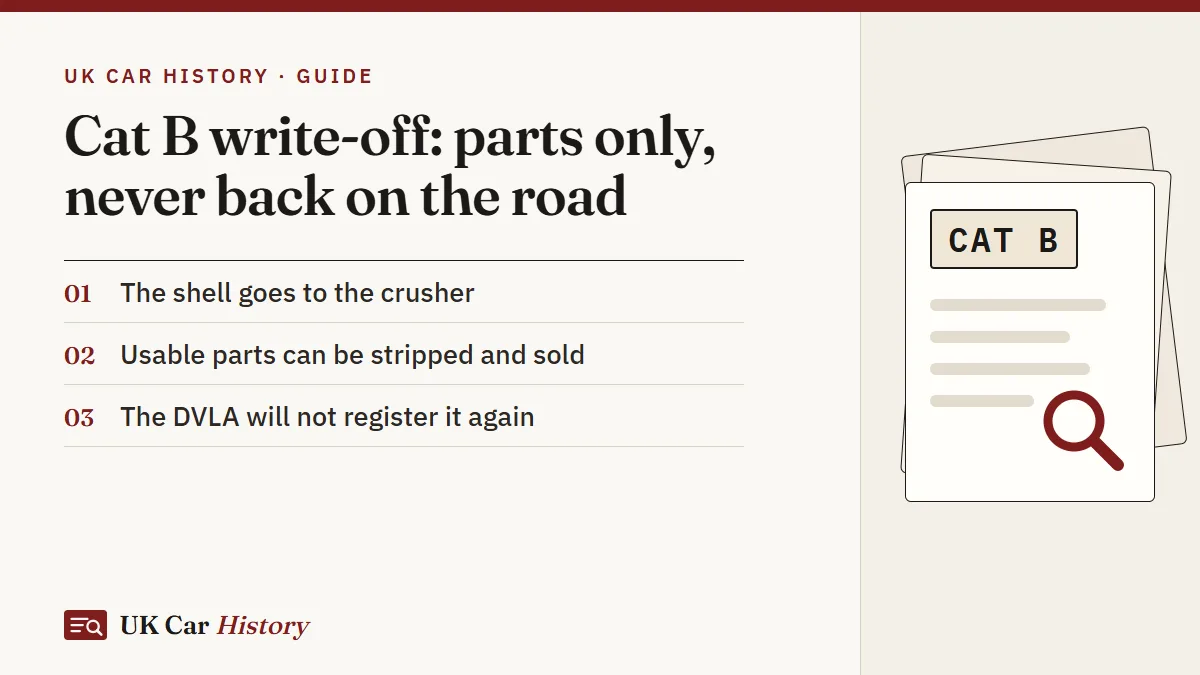
Cat B is the insurers' label for a car that is beyond repair: its usable parts may be stripped and sold, but its body shell must be crushed. So the car itself is finished: the law never lets it back on the road, and the DVLA has not issued a Cat B car a logbook since October 2015.
Read on for where Cat B sits among the categories, the rules that keep it off the road, the crime that makes a Cat B identity valuable, what you get if you buy one as salvage, and how to spot one. The last section is for anyone who searched for a Category B driving licence.
Where does Cat B sit among the write-off categories?
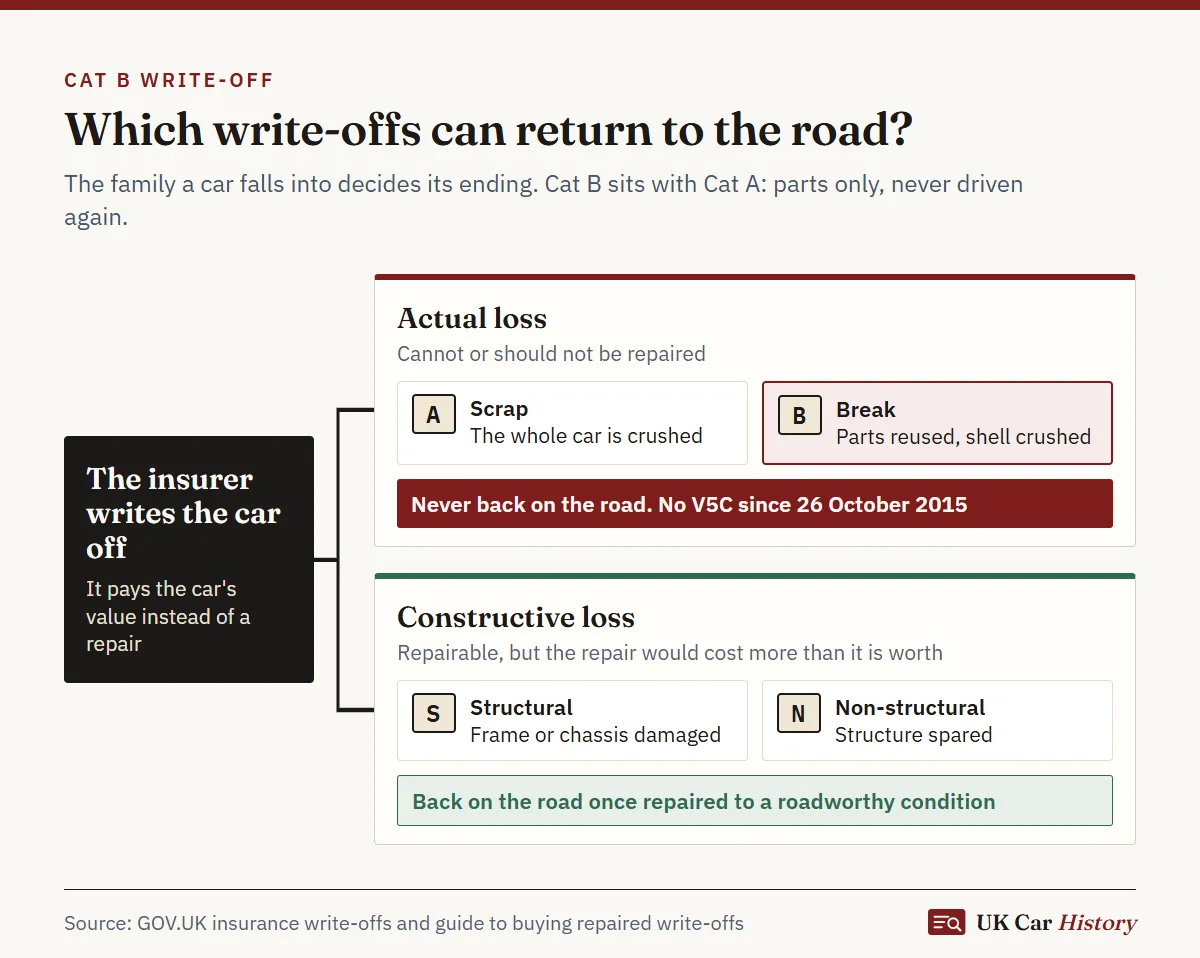
The letters split into two families. GOV.UK's guide for buyers calls Cat A and Cat B an actual loss, where the damage rules out a repair. Cat S and Cat N belong to the other family, the constructive loss, where a repair was possible but would have cost more than the car's replacement value. The Department for Transport once glossed B as "break for spare parts", which is a fair summary.
| Category | Family | What becomes of the car |
|---|---|---|
| A | Actual loss | Crushed whole; nothing is reused |
| B | Actual loss | Stripped of useful parts, then the shell is crushed |
| S | Constructive loss | May be repaired after structural damage |
| N | Constructive loss | May be repaired after damage elsewhere |
When the insurers revised their code in October 2017, only the repairable letters changed: C and D gave way to S and N. A Cat B record from 2012 therefore means exactly what one from this year means.
What stops a Cat B car going back on the road?
Three separate rules close the door, and any one of them would be enough:
- The safety position. GOV.UK's buyer guide says actual-loss vehicles should never return to the road, because the damage they suffered makes them unsafe even when they look repaired.
- The insurer's duty. Schedule 3A of the vehicle registration regulations tells an insurer that has written a car off to destroy any logbook it holds once it has told the DVLA, unless the car is fit for repair without structural damage. A Cat B car is not fit for repair at all.
- No new paperwork. Since 26 October 2015 the DVLA has issued no V5C for a Cat A or Cat B vehicle, and its guide confirms these cars are not re-registered.
Compare a Cat S car: its damage may be serious, yet it can come back legally once mended. A Cat B car cannot, however good the rebuild, because the law treats it as finished.
If a car offered to drive turns out to have a Cat B record, the deal is over, whatever explanation comes with it.
What does it mean if a Cat B car is being driven?
Something has gone wrong, and the buyer usually pays for it. There are two common explanations:
- The shell survived. Someone rebuilt the car instead of crushing the shell. It has no right to a logbook, should not be on the road, and nobody can vouch for the work.
- The identity moved. This is ringing. In a 2012 consultation, the Department for Transport set out how it works: thieves steal a valuable car, buy a similar written-off one cheaply, and transfer its VIN and registration to the stolen car, which can then be sold as if it were genuine.
Criminals like Cat B paperwork for an obvious reason: the original car should have been crushed, so it will never appear on the road to expose the copy. The Vehicle Identity Check was brought in in 2003 to stop ringing, and it ended in 2015. A rung car is stolen property, so the buyer can lose it and be left chasing the seller.
Suspect this? Do not hand over money; call the police on 101. Matching a car to its documents is covered in how to spot a cloned car.
Buying a Cat B write-off as salvage: what are you getting?
A box of parts with a shell attached that has to be destroyed. Before you bid, be clear about each piece:
- The parts. An engine, a gearbox, seats or trim can be removed and used or sold.
- The shell. Destined for the crusher. End-of-life vehicles must go to an authorised treatment facility (ATF), a licensed site, to be scrapped.
- The paperwork. No logbook will follow, so the car can never be registered, taxed or driven.
- The seller's terms. Auctions set their own conditions for Cat B lots. Read them before bidding.
Salvage sales, and how little comeback a bidder has, are explained in buying a car at auction.
Is the car in front of you a Cat B write-off?
A genuine Cat B car has no logbook, and a rung one comes with a logbook belonging to another car, so the paperwork alone will not warn you. The insurers' record will.
- Search the write-off records. Run the registration through a write-off check: the result names the category and the loss date. You get it in the Premium report (£7.99); see our car category check page.
- Read the VIN in more than one place. It should be identical on the car, in each location, and on the V5C; where is the VIN number lists where to look.
- Study the MOT dates. Look for a break in testing that starts near the loss date. If the car then comes back to the MOT record, ask how.
- Get the seller's answer in writing. Ask: was it ever written off, and if so, what category?
A Cat B result on a car being sold to drive is not something to negotiate around. Leave it.
Cat B write-off or Category B licence?
They share a letter and nothing else. Category B on a driving licence is the ordinary car entitlement. GOV.UK's rules for drivers who passed from 1 January 1997 allow up to 8 passenger seats, with a maximum authorised mass of 3,500kg for petrol and diesel vehicles (hybrids included) or 4,250kg for zero-emission electric or hydrogen vehicles.
So "Cat B" in a car advert or a history report is about the car's past. "Cat B" on your licence is about what you may drive.
Questions and answers
Can I rebuild a Cat B car if I do the work myself?
No. Who does the work makes no difference: the shell must be crushed and the car cannot be registered, so a rebuilt Cat B car can never be legally driven.
Why are Cat B cars sold at all?
Their engines, gearboxes and panels can still earn money as spares, so salvage buyers bid on them. You are buying the parts, not a car.
Is Cat B worse than Cat S?
For a buyer who wants a car to drive, yes. A Cat S car can return to the road once it is repaired; a Cat B car never can.
What happens to the logbook when a car becomes Cat B?
The insurer must destroy any logbook it holds once it has told the DVLA, and since October 2015 the DVLA does not issue a new one for Cat A or Cat B cars.
Will a Cat B marker ever disappear from the records?
Rarely. The insurers' code permits a change of category only to put right an error or in exceptional cases, so a correct Cat B record follows the car for good.
Sources
- GOV.UK: Insurance write-offs (scrapping your vehicle and insurance write-offs)
- GOV.UK: Buying repaired written-off vehicles, a consumer guide
- GOV.UK: Scrapping unnecessary checks will save honest motorists around £10 million a year (no V5C for Cat A and B from 26 October 2015)
- legislation.gov.uk: Road Vehicles (Registration and Licensing) Regulations 2002, Schedule 3A
- Department for Transport: Future of the Vehicle Identity Check (VIC) scheme, consultation, July 2012
- GOV.UK: Driving licence categories
This guide is general information for people buying or owning a car in the UK, not legal or financial advice. UK Car History is an independent service, not affiliated with the DVLA, the DVSA or GOV.UK.