The short answer
When a car is declared a total loss, written off or stolen and never recovered, the motor insurer normally pays what it was worth just before the damage or theft. That can be less than the finance still owed on it, or the price you paid. GAP insurance is a separate policy that pays the difference, up to a figure its terms set; dealers and lenders usually sell it, but it is also sold on its own.
Here: the three kinds and their limits, why claims are refused, whether you need cover, what moves the price, the dealer rules, cancelling, and a check worth making on a used car first. We do not sell, arrange or recommend insurance, and nothing here is advice on a particular policy.
Why can a write-off leave you out of pocket?
A total loss, in insurance terms, means the car would cost more to repair than it is worth, or it was stolen and has not been found. Most motor policies then settle at market value: what the car would have been worth immediately before the damage or theft, not what you paid and not what you still owe.
With finance on the car, that settlement can fall short of the balance on the agreement, leaving you a shortfall to pay. It can also be less than the price you paid for the car in the first place. GAP is the separate policy built to cover that difference.
What do the three kinds of vehicle GAP insurance pay?
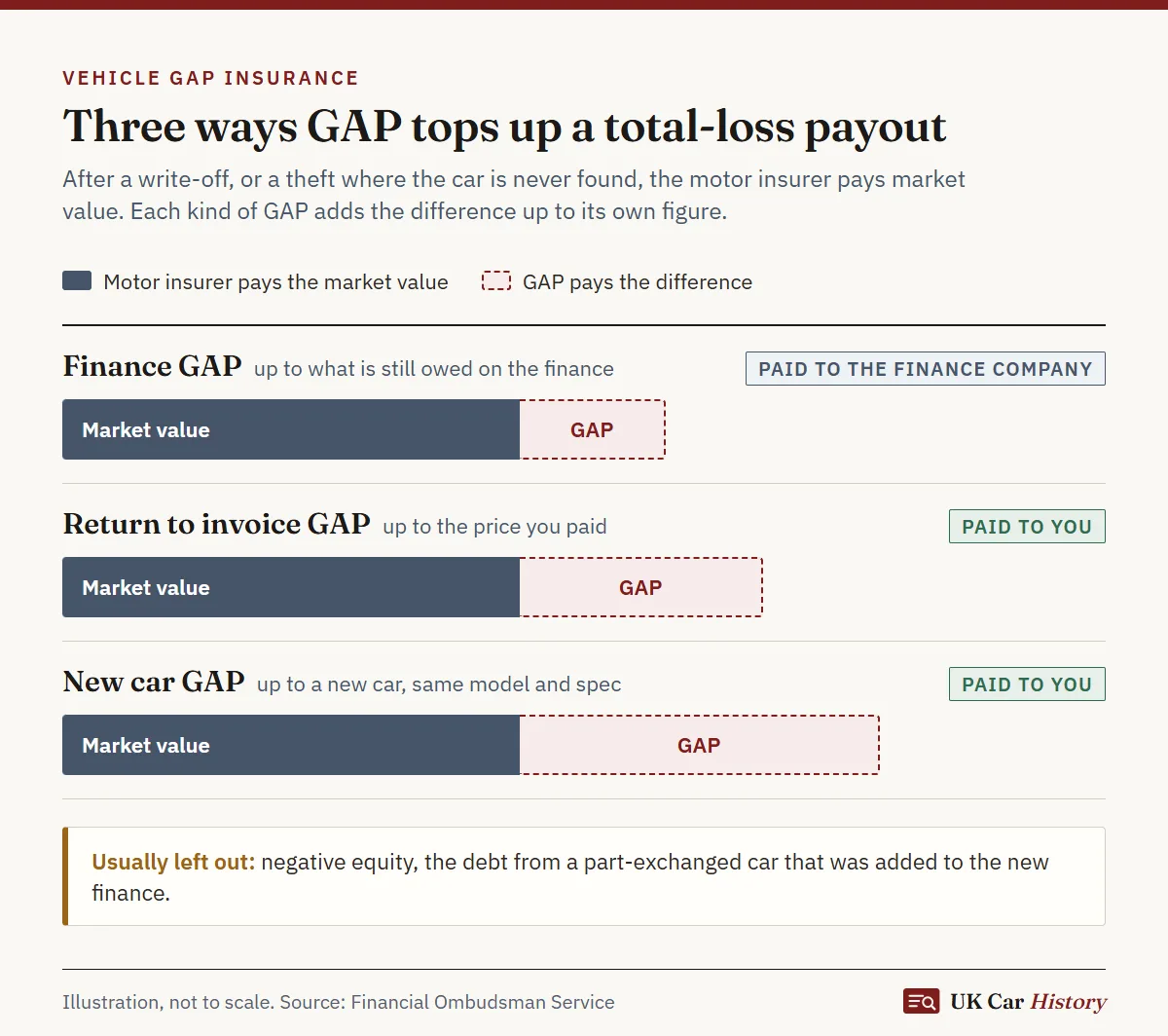
Vehicle GAP insurance comes in three main kinds, according to the Financial Ombudsman Service. Each one builds on the motor insurer's settlement; they differ in the figure they top it up to, and in who receives the money:
| Kind of GAP | Tops the settlement up to | GAP money goes to |
|---|---|---|
| Finance GAP | Whatever is still owed on the finance agreement | The finance company |
| Return to invoice GAP | The purchase price on your invoice | You |
| New car GAP | What a new car of identical model and specification would cost | You |
What does GAP insurance usually leave out?
Read the summary of a policy's limits before buying. Two things GAP often does not cover:
- Negative equity. If your old car was worth less than the finance left on it when you part-exchanged it, and that debt was added to the new agreement, GAP insurers normally exclude it. The Ombudsman usually accepts this where the policy is clear, but finds deductions such as a "negative equity discount" are not always explained, so payouts can disappoint.
- Extras on the same agreement. Some people are wrongly told, or left to assume, that GAP also covers finance for add-on products sold with the car.
Arguments over what the car was worth belong with the motor insurer that valued it. The GAP insurer does not answer for a low valuation, or for an offer below market value that you accepted; the guide to how insurers and valuation guides price a car explains how that figure is reached.
Why do GAP insurance claims get turned down?
These are the reasons for refusal that the Financial Ombudsman often sees:
- the vehicle claimed for was not yours;
- the claim was fraudulent;
- the car had been used for racing;
- you turned down the brand-new car your motor policy would have provided;
- you had no comprehensive motor cover.
The Ombudsman may find a refusal for lack of comprehensive cover unfair, since the GAP insurer can itself work out the motor insurer's likely payout. Where another term is relied on, it checks that the term was relevant, clearly explained and fairly applied.
Four questions to ask before you buy GAP
A seller that recommends GAP has to recommend a suitable policy. The questions the Financial Ombudsman asks when judging that make a good checklist:
- Could you ever claim on it? If there was never any way for you to benefit, the Ombudsman treats the sale as obviously unsuitable.
- Is the car under a year old? Many motor policies replace a car of that age with a new one after a write-off, which often makes GAP pointless for the first year. If the car is on HP or PCP, the finance company owns it and must agree before the insurer supplies a new one.
- Does the type match your deal? Finance GAP covers only the finance balance and never the deposit, so if you put down a big deposit, the finance may never exceed the payout and the policy may never pay.
- Was the price above the car's real value? The Ombudsman asks whether you paid more than the car was really worth, since any insurer will only ever pay its market value.
Where it upholds a mis-selling complaint, the Ombudsman usually has the seller give back the premiums plus interest, unless it decides you would have taken the policy regardless; premiums paid through the finance are factored in.
What has the FCA found about the value of GAP?
Low payouts are an old concern. For 2008 to 2012, the FCA's 2014 market study put the average share of GAP premiums returned as claims at just 10%.
Later data was worse, with only 6% of premiums going back to customers as claims. The FCA then concluded, in February 2024, that some customers were not getting fair value, and insurers covering 80% of the GAP market stopped selling while they reworked their products. Several were allowed to resume from May 2024 after demonstrating fair value, which the Consumer Duty demands.
The most recent figures cover 2025 and came out in July 2026: for stand-alone GAP, claims costs equalled 53% of premiums. The FCA cautions that those figures should still be read with care. Nor does it write GAP off: it has said the product can be useful to customers. What matters for your car is the size of the shortfall you might face, after whatever your motor policy already provides.
What affects the GAP insurance cost?
There is no standard price, and this guide quotes none: each policy is priced on its own. What the FCA's published work does show is what pushes the gap insurance cost up or down:
- Who sells it to you. The dealer is not the only seller. In 2014 the FCA found many people unaware of that, though GAP bought on its own was often cheaper.
- Commission. Some firms were found paying as much as 70% of each premium to the people selling GAP; the firms allowed to resume sales from May 2024 came back with commission materially lower than before.
- What is insured, and who. The FCA's 2018 review of GAP tracked how long policies ran, how much the insured cars were worth and whether they were financed, and noted that how risky the customers are drives part of the cost.
- Paying through the finance. Add the premium to your car finance and you borrow it along with the car.
Before accepting the dealer's policy, find out what an independent seller charges for matching cover.
What must a dealer tell you before selling GAP?
If GAP comes with the car, from the dealer or a business tied to it, and that includes GAP offered with the finance, special FCA rules apply; they took effect on 1 September 2015. Before you buy, you must be given in writing, or another durable form:
- what the premium comes to in total, quoted on its own;
- what the policy does and its key benefits, plus any exclusions or limits that are significant or unusual, with references to the policy wording;
- how long cover runs, and whether taking it is a condition of the deal;
- notice that other firms offer GAP too;
- the earliest point at which the sale can go through, and the date you received all of this.
At least 2 clear days must then pass before the sale is finalised. It may go through the following day only if you take the first step to buy, consent to the shorter wait and confirm you know about the restriction. In practice, as the Ombudsman notes, that rules out a same-day sale of GAP with the car and its loan.
Use the pause to compare. Reviewing its insurance rules, the FCA proposed no change to these in June 2026, wanting more annual data on its 2024 intervention first.
What do you get back if you cancel GAP?
For general insurance, GAP included, FCA rules normally give a 14-day right to cancel, with some exceptions, and the firm must explain that right in good time before the contract is made.
Later on, the policy wording decides what comes back, and some policies refund nothing once the cooling-off period is over, a term the Ombudsman does not always accept. Where a policy ends early, say because you sold the car, its usual approach is a pro-rata refund with a small deduction for administration, though it generally accepts no refund once you have made a claim.
Complaints start with the GAP firm itself. The Financial Ombudsman Service is the free next step once eight weeks have passed without a final answer, or if you reject the answer you get.
Insuring a used car? Check its history first
A past write-off can count against you later. The Financial Ombudsman notes that buyers can be put off by a previous write-off, no matter how good the repair, so after a total loss insurers are likely to put a lower figure on such a car. Where you knew, or should reasonably have known, about the write-off when you bought the car, the Ombudsman may accept a deduction for it; where you could not reasonably have known, it is likely to expect the full market value.
So before you commit to the car, or to any cover on it, run the registration through our category car check, included in the Premium report (£7.99) alongside the finance and stolen checks. It shows any Cat S, Cat N or other write-off category on record.
Tell your motor insurer about any write-off record; our guide to Cat S and Cat N insurance covers how to declare it and how a claim can depend on it.
Questions and answers
Is GAP insurance a legal requirement in the UK?
No. What UK law demands is at least third party motor cover; GAP sits outside that requirement. A dealer offering GAP alongside a car has to say in writing whether you must take it as part of the deal or are free to refuse it.
Do I have to buy GAP from the dealer selling me the car?
No. Other firms sell GAP as a stand-alone policy, and a dealer selling it must tell you so; its wait of at least 2 clear days gives you time for another quote.
Does GAP insurance pay for repairs after an accident?
No. Repair bills are outside GAP. It responds only when repairing the car is not worth the cost, or the car has been stolen and not recovered, and even then it pays only the shortfall.
My GAP payout is taking a long time. What can I do?
Nothing can be paid until the motor claim is settled, because only then is the size of the gap clear. A hold-up at the motor insurer is for that insurer; an unjustified delay by the GAP insurer can lead the Financial Ombudsman to award compensation for the trouble.
Will GAP pay if my car is stolen?
Theft counts once the car is gone for good. Your motor policy settles for its market value, and whatever extra GAP adds depends on the kind of policy and its terms.
Sources
- Financial Ombudsman Service: GAP insurance
- Financial Ombudsman Service: Motor valuations and write-offs
- FCA: GAP insurers agree to suspend sales over fair value (February 2024, updated May 2024)
- FCA: General insurance value measures data 2025 (July 2026)
- FCA: PS15/13, GAP insurance competition remedy (the rules for dealer sales, 2015)
- FCA: CP26/22, Simplifying the insurance rules (June 2026)
This guide is general information for people buying or owning a car in the UK, not legal or financial advice. UK Car History is an independent service, not affiliated with the DVLA, the DVSA or GOV.UK.