The short answer
A car accident check run on a registration looks the car up on the insurers' register of write-offs. It tells you whether the car was ever written off, under which letter and when. Crashes that were mended without a write-off are not on that register, so for those your evidence is the MOT history, the V5C logbook, the seller's paperwork and the car itself.
Accident information in the UK is scattered. This guide starts with what a check can answer, follows an accident through the records it may or may not reach, then gives you a routine for checking any used car.
What can a car accident check tell you?
If the car was written off, three things: that it happened, the category, and the date of the loss. The letter also hints at the damage. S points to the structure, N to other parts, and A or B to a car that should never have been repaired at all.
What it cannot do is list the knocks in between. Each question you might have about a car's past has its own answer in its own place:
| What you want to know | Where the answer is | Can you get it? |
|---|---|---|
| Was it ever written off, and how badly? | The insurers' register, through a write-off check | Yes, paid |
| Did damage show up at a test? | The MOT history | Yes, free |
| Is a category printed on the paperwork? | The V5C logbook, for Cat S | When you view the car |
| What exactly was mended, and by whom? | Paperwork from whoever did the repair | If the seller kept them |
| Was there a claim that ended in a repair? | The insurers' claims database | No |
Where does an accident leave a trace?
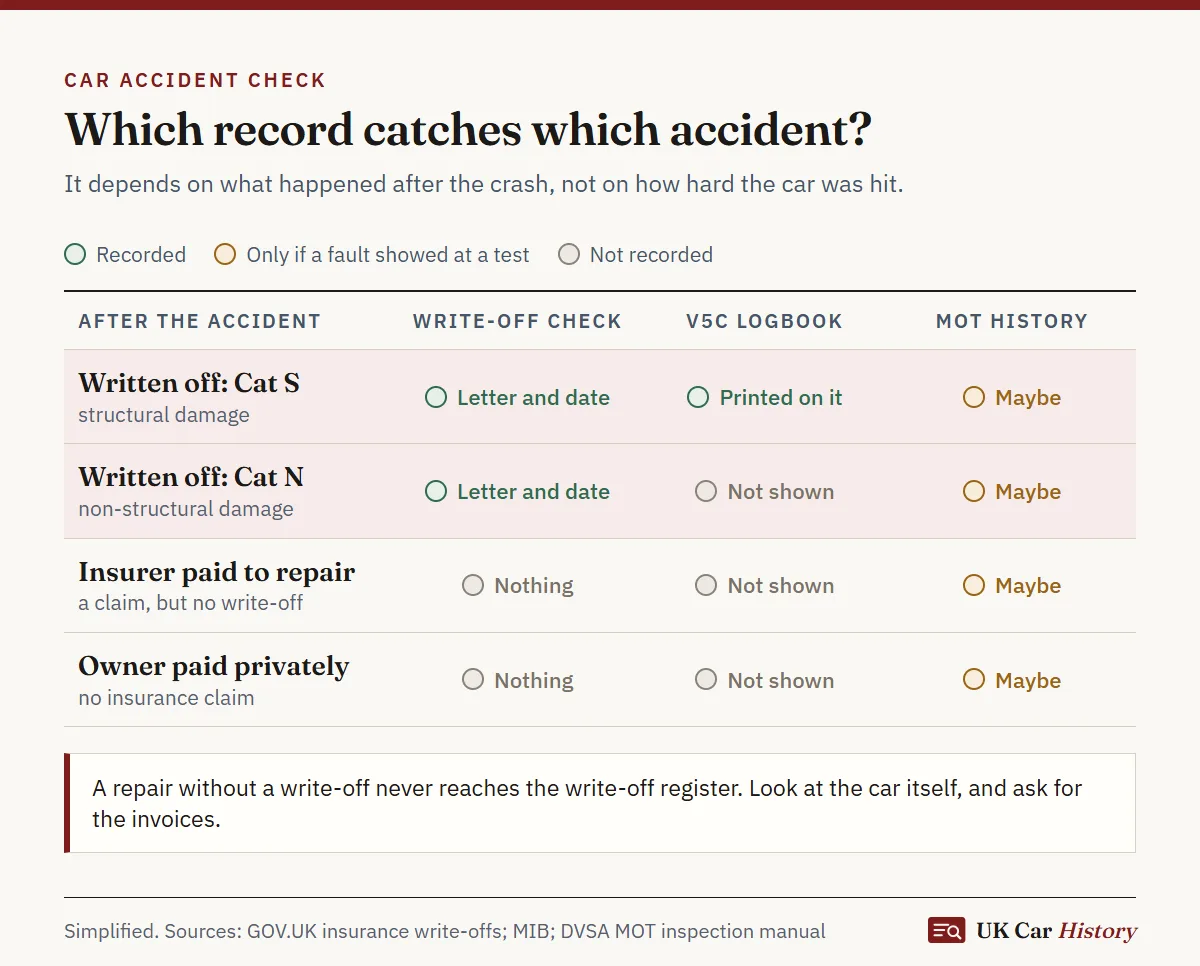
Picture a car hit hard enough for an insurance claim. What gets written down depends on what happens next:
- The insurer writes it off. GOV.UK says it then pays the car's current value, not the repair bill, and the car gets a category. The category is entered on a central register that Thatcham Research called MIAFTR in 2017 and that the Motor Insurers' Bureau (MIB) now holds as Vehicle Salvage and Theft Data, with the vehicle, the claimant and the damage category.
- The insurer pays for the repair. No category is given. The claim is logged on an insurance industry database, the Claims and Underwriting Exchange (CUE). MIB says it holds reported incidents of several kinds, motor among them, even where nobody claimed, and keeps them for six years once closed. Insurers use it; buyers cannot search it.
- The owner pays the bodyshop. Nothing official is recorded. The only proof is whatever invoice the owner kept.
- The police attend. A report exists, but it goes to the people involved and those acting for them, such as an insurer or a solicitor, not to a future buyer.
Only the first path creates something a buyer's check can read. MIB opens its write-off data only to authorised professionals, and names the DVLA and provenance companies, the firms that supply history checks, among those that receive it. Even an owner asking MIB about their own car is not told about markers from before they owned it.
Do MOT records show crash damage?
Sometimes, and only indirectly. A test looks at the car as it is on the day. The DVSA's manual treats two kinds of damage as major defects: a main load-bearing structural member that is cracked, bent or badly mended, leaving the body much less rigid, and a bumper or body panel that is loose or sharp enough to injure someone brushing past.
Anything milder may earn an advisory, at the tester's discretion, or nothing at all. So read the record for patterns:
- a failure or advisory that mentions the structure, a bumper or a body panel
- a sudden crop of new advisories, such as uneven tyre wear, after years of clean passes
- a year or more with no test, which can mean the car was off the road
Car tests in England, Scotland and Wales are online from 2005, with failed parts and minor problems listed; tests in Northern Ireland start in 2017. The guide to what to look for in MOT history shows how to read failures, advisories and gaps.
Will the logbook mention a write-off?
For one category only. When an owner keeps a Cat S car, the old V5C goes to the insurer, the owner applies on form V62 for a free duplicate, and the DVLA adds the category. Thatcham Research gave the wording in 2017: "This vehicle has been salvaged due to structural damage but following a technical evaluation declared suitable for repair."
A Cat N owner simply keeps the existing V5C, so it says nothing. A Cat A or Cat B car should have no V5C at all: the DVLA stopped issuing them on 26 October 2015.
Nor will the DVLA's free vehicle enquiry settle it. It shows tax, MOT expiry, engine, fuel, export status and similar details but no category. It does give the date the latest logbook was issued, a useful cross-check against the V5C the seller shows you.
Why will no vehicle damage history check ever be complete?
A category only exists when the insurer decides not to repair. Where an insurer paid for even a major repair, or the owner paid privately, there is no write-off to find. In 2017 the British Vehicle Salvage Federation put it plainly: "vehicles are structurally repaired by insurers every day."
Thatcham Research also describes the code behind the register as voluntary, so the record is only as complete as insurers make it. Where damage was still there at the next MOT, the test record may hold a clue; where it had been put right, there is nothing to see.
If the write-off search comes back clear, the register holds no write-off for the car. Treat that as one piece of evidence, not as proof that it was never hit.
How do you check a vehicle for accident history, from advert to handover?
- Before you travel, message the seller. Ask in writing about accidents, claims, write-offs and who did any repairs. Keep the replies.
- Look up the MOT record. Our free car check look-up lists every test from the registration. Note bodywork or structure entries and gaps between tests.
- Search the write-off records. The result shows any category on the insurers' register and the date of the loss. It comes in the Premium report (£7.99) with the finance and stolen checks; the car category check page shows what the result contains.
- At the viewing, read the V5C. On a repaired Cat S car, look for the category printed on it. Make sure the VIN on the V5C matches the one on the car.
- Walk round the car slowly. Gaps that differ side to side, a panel a shade off and paint mist on rubber seals are the usual giveaways; how to tell if a car has been in an accident covers each one.
- Ask for proof and, if needed, an expert. Invoices show what was replaced. GOV.UK's guide for buyers of written-off cars goes further: have an engineer or another independent expert look for structural damage before you commit.
What do the results mean for your decision?
| What you found | What it tells you | Your next move |
|---|---|---|
| Cat A or Cat B, but offered as a road car | It should never have returned to the road | Walk away |
| Cat S | The structure was damaged and repaired | Invoices, an engineer's report, then what Cat S means |
| Cat N | Other parts were damaged and repaired | Invoices and an insurance quote before any deposit |
| Bodywork entries at an MOT | Something was hit, or has worn badly | Ask what happened and how it was put right |
| A seller's story that does not fit | You are missing part of the picture | Hold your money until it makes sense |
For any repaired write-off, ring your insurer before you buy. GOV.UK's guide says insurers do not all cover written-off cars, and that leaving the write-off out of your answers can lead to a refused claim. Citizens Advice can help if you learn after the sale that a write-off was kept from you.
Questions and answers
Does a car accident check cost money?
The part that matters most does. The write-off register is open only to authorised organisations, so you reach it through a paid check. The MOT history, which can hint at damage, is free.
Will a car accident check pick up a scrape or a small dent?
Almost never. Small repairs are not write-offs, so they leave nothing on the register, and they rarely cause an MOT fault. Your eyes and the invoices are the check for those.
Can an insurer tell me about claims on a car I want to buy?
No. The claims database is used by insurers for their own customers and is not open to someone buying a car. Ask the seller, and ask to see what was repaired.
Do police crash reports appear in history checks?
No. A collision report goes only to the people involved and to their insurers or solicitors, so no check can show it.
How can I tell when a write-off happened?
The write-off record carries the date of the loss. Set it beside the MOT history: a car that disappears from testing around that date was probably off the road being repaired.
Once I own the car, can I ask the MIB what is on record?
You can ask about a car you own, but the MIB says it cannot share markers recorded before your ownership. That is why the check is worth running before you buy.
Sources
- GOV.UK: Insurance write-offs (scrapping your vehicle and insurance write-offs)
- GOV.UK: Buying repaired written-off vehicles, a consumer guide
- Motor Insurers' Bureau: Resources for data recipients (Vehicle Salvage and Theft Data)
- Motor Insurers' Bureau: Your data and privacy (CUE and Vehicle Salvage and Theft Data)
- DVSA: MOT inspection manual for cars, section 6 (body, structure and attachments)
- Thatcham Research: Revised salvage code of practice comes into play on 1 October (2017)
This guide is general information for people buying or owning a car in the UK, not legal or financial advice. UK Car History is an independent service, not affiliated with the DVLA, the DVSA or GOV.UK.