The short answer
A car category check looks up one car in the insurers' write-off records and reports its letter, if it has one: A, B, S or N for recent write-offs, C or D for those from before October 2017. Those records are closed to the public, so the complete answer comes from a paid check. Free sources can settle part of it, because a Cat S car's logbook carries its category.
This guide gives you a ten-minute free routine, explains why that routine can never clear a car on its own, shows what the paid search adds, and sets out how to act on each result. A table of the letters comes first, in case you need it.
Which letter means what?
The insurer chooses the letter when it settles the claim, and the letter then stays with the car. S and N replaced C and D for cars written off from 1 October 2017; older write-offs keep the letter they were given.
| Letter | Plain meaning | On the road again? |
|---|---|---|
| A | Scrap: the whole car is crushed | No |
| B | Break: some parts may be reused, the shell is crushed | No |
| S | The structure, such as the frame or chassis, was damaged; judged repairable | Yes, when roadworthy |
| N | The damage stopped short of the structure; judged repairable | Yes, when roadworthy |
| C (to 2017) | Mending it would have cost more than the car was worth before the loss | Yes, after repair |
| D (to 2017) | Mending it would have cost no more than that value, yet the insurer paid out | Yes, after repair |
Which free clues can you gather in ten minutes?
- Ask in writing. Message the seller: has this car ever been written off, and if so under which letter and when? A clear written answer is useful whatever it says.
- Look at the V5C. On a Cat S car the DVLA prints a note about structural damage. Thatcham Research gave its wording when Cat S began in 2017: "This vehicle has been salvaged due to structural damage but following a technical evaluation declared suitable for repair."
- Check the logbook date. The DVLA's free vehicle enquiry shows when the latest V5C was issued. If the one the seller holds is older, it has been replaced since, so ask why. Is the V5C genuine? covers the other checks on the document.
- Scan the MOT record. Our free car check look-up shows every test. A long pause in testing followed by new advisories can follow a repair, and is worth a question.
- Walk round the car. Uneven gaps and mismatched paint are covered in how to tell if a car has been in an accident.
Why can a free car category check never clear a car?
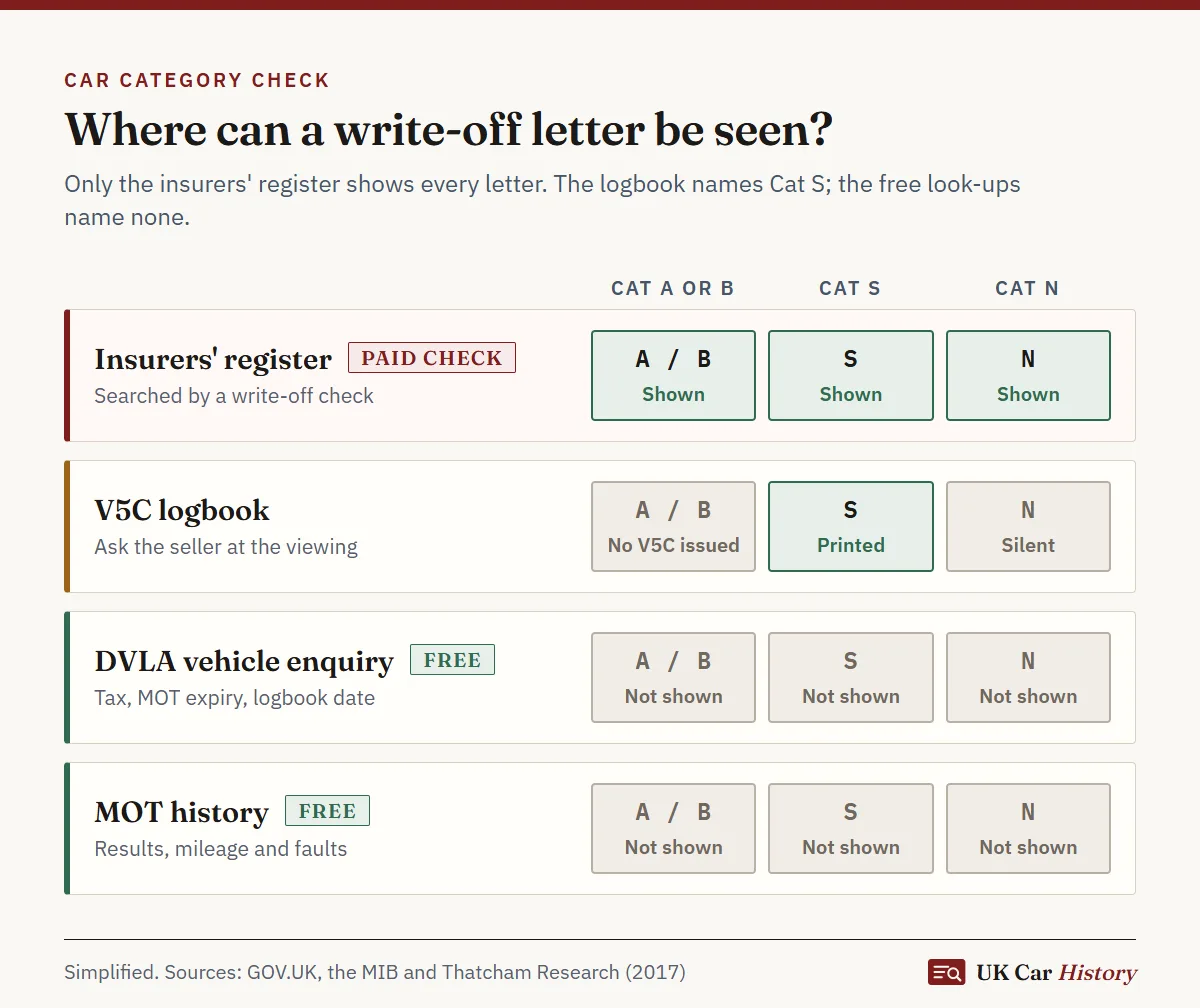
Because the free sources were not built to hold write-offs, and the one that sometimes does, the logbook, only does so for one letter:
- Cat N: the keeper is allowed to hold on to the V5C issued before the write-off, so the logbook stays silent.
- Cat A and Cat B: since 26 October 2015 the DVLA has not issued a V5C for these at all.
- Cat C and Cat D: between April 2003 and 26 October 2015, a Cat C car could not get a new V5C until it had passed a Vehicle Identity Check, and the V5C issued afterwards recorded its write-off. Cat D cars were outside that scheme.
The GOV.UK look-ups do not fill the gap. The DVLA vehicle enquiry covers tax, SORN, MOT expiry, technical details such as engine size, fuel and emissions, export status and the latest logbook date; the MOT history covers results, mileage and faults. Neither has a field for a category, and our free look-up reads the same DVLA and DVSA data.
The insurers' side is closed too. The Motor Insurers' Bureau (MIB) answers members of the public only about a car they own, and will not share markers from before their ownership. GOV.UK's own guide for buyers of written-off cars recommends a private history check for this reason.
Silence on the V5C is not a clean bill of health. A Cat N car, and many older write-offs, carry no mention of it.
Where is the full answer kept?
- On the insurers' register. Thatcham Research called it MIAFTR in 2017; MIB now holds it as Vehicle Salvage and Theft Data, the central record of written-off and stolen vehicles, with each one's damage category. Only authorised professionals get in, and MIB counts the DVLA and provenance companies, which supply vehicle history checks, among the organisations receiving its data.
- At the DVLA, in part. Schedule 3A of the vehicle registration regulations requires the insurer to tell the DVLA whether a written-off car can be repaired and, for notices from 20 February 2018, whether the damage was structural. The keeper must be told the same. The visible result is the Cat S note on the logbook.
What does the paid car category check add?
- Enter the registration on our car category check page. It returns any write-off letter that insurers have filed against the car, with the date of the loss.
- Make sure the make, model and colour in the result are those of the car in front of you.
- Line up the VIN. GOV.UK's buyer guide says the VIN on the car should match the logbook; the Premium report gives the full VIN on record, so you can compare all three.
- Weigh the result against the V5C and the seller's written answer. A Cat S record on a car whose logbook is silent, or a "never written off" that turns out to be wrong, has to be explained before you go on.
You get the search inside the Premium report (£7.99), which also covers outstanding finance and theft records. The Basic report (£3.99) leaves write-offs out.
Does the seller have to mention a category?
A trader should. The Trading Standards guidance for businesses in England, Scotland and Wales, Business Companion, uses this very situation as an example of a misleading omission: a trader not telling a consumer that a car was once an insurance write-off. The law behind it is Part 4, Chapter 1 of the Digital Markets, Competition and Consumers Act 2024.
For a private sale the rule is narrower. Section 13 of the Sale of Goods Act 1979 implies a term that goods sold by description will match it, which is why the words "never written off" in an advert matter. Private seller vs dealer compares your rights in each case.
That is a summary of the law, not advice on your situation. For your own case, contact Citizens Advice.
Does a clear result mean the car was never damaged?
No. The register records write-offs, nothing else. If an insurer paid to put the car right, or an owner paid a bodyshop without claiming, there is no letter to find, however big the repair.
So a clear result narrows the risk rather than removing it. The car accident check guide maps where other damage records sit and which of them you can reach.
How should each result change your plans?
| Result | What to do |
|---|---|
| Clear | Still look over the car and its MOT record: the result covers write-offs only |
| Cat A or Cat B, on a car sold to drive | Walk away: such a car is not meant to be driven again |
| Cat S | Repair invoices and an engineer's inspection; read should you buy a Cat S car |
| Cat N | Repair evidence and an insurance quote; read should you buy a Cat N car |
| Cat C or Cat D | Treat the damage as unknown and have the car inspected |
For any categorised car, get an insurance quote with the letter declared before you pay a deposit: GOV.UK warns that leaving it out can lead to a refused claim. Insurance and finance on Cat S and Cat N cars explains what to tell an insurer and a lender.
GOV.UK says little about price beyond noting that Cat S cars often sell for a bit less than similar cars of the same age and mileage. How much Cat N reduces value gives a method for working out your own figure.
The letter will matter again when you sell. Declaring Cat N when selling covers what buyers should be told.
Questions and answers
Why does my free car check show no write-off category?
Free look-ups read DVLA and DVSA data, and neither includes the insurers' write-off categories. The category is held on the insurers' register, which only a paid check reaches.
Can a category check tell me what the damage was?
Not in detail. It shows the letter and the date of the loss: S means the structure was damaged, N that it was not. For the parts involved, ask the seller for the repair invoices and photos.
Can a seller have a write-off category removed?
No. The insurers' code lets a category be changed only to correct an error or in exceptional cases, so a correct record stays with the car whoever owns it.
Does an old Cat C or Cat D show on a check today?
Yes. A car written off before October 2017 keeps its old letter on the insurers' records, so a write-off check shows C or D rather than S or N.
Is a car category check free on GOV.UK?
No. GOV.UK's vehicle look-ups cover tax, MOT and the car's details, not write-offs, and its guide for buyers points to a private history check for that.
Does a Cat N car always come with a clean-looking logbook?
Usually, yes. The keeper may keep the V5C issued before the write-off, so nothing on it gives the category away. That is why a Cat N only shows up on a check of the insurers' records.
Sources
- GOV.UK: Insurance write-offs (scrapping your vehicle and insurance write-offs)
- GOV.UK: Buying repaired written-off vehicles, a consumer guide
- Thatcham Research: Revised salvage code of practice comes into play on 1 October (2017)
- Motor Insurers' Bureau: Resources for data recipients (Vehicle Salvage and Theft Data)
- legislation.gov.uk: Road Vehicles (Registration and Licensing) Regulations 2002, Schedule 3A
- Business Companion: Selling used vehicles (Trading Standards guidance)
This guide is general information for people buying or owning a car in the UK, not legal or financial advice. UK Car History is an independent service, not affiliated with the DVLA, the DVSA or GOV.UK.