The short answer
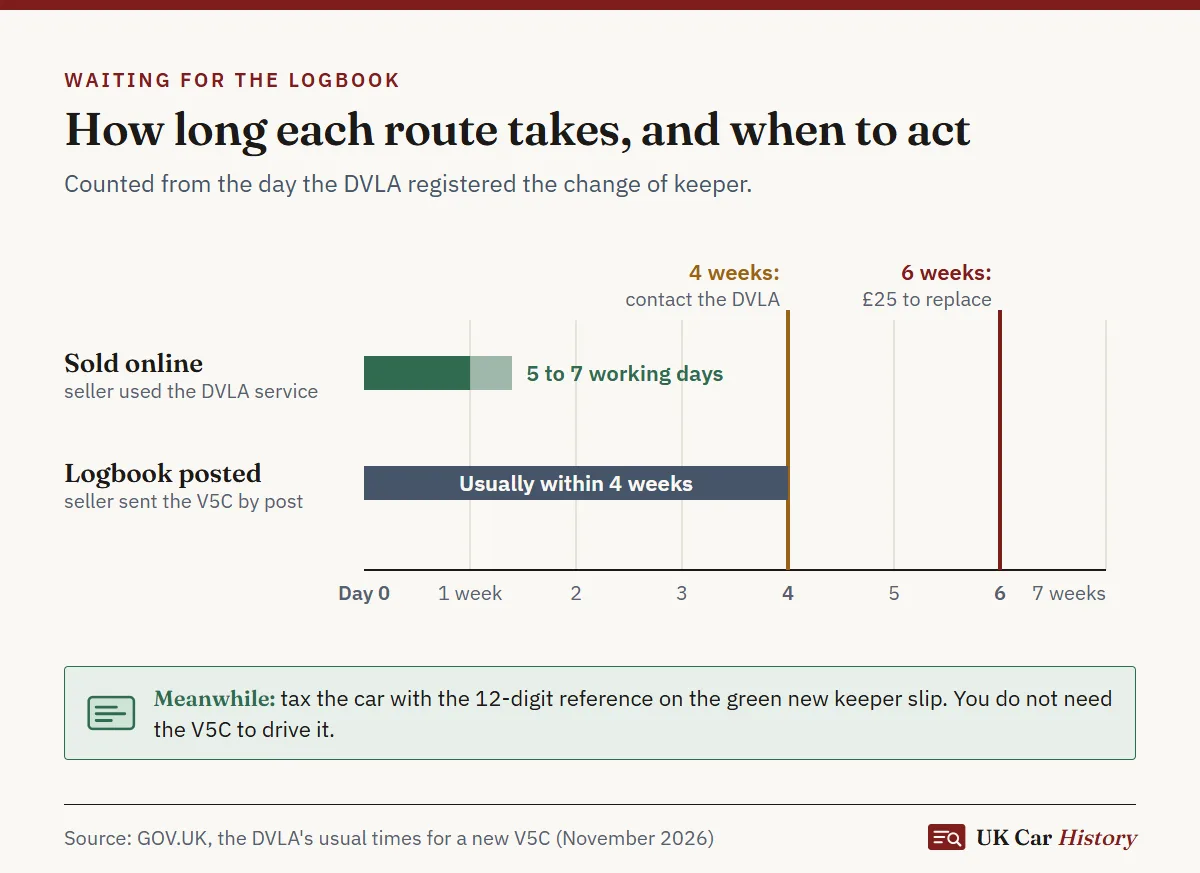
How long a V5C takes depends on how the sale was reported: 5 to 7 working days if the seller told the DVLA online, and usually up to 4 weeks if they posted the logbook. Nothing after 4 weeks? Contact the DVLA straight away, because once 6 weeks pass without you telling them, a replacement costs £25.
None of this stops you using the car. The sections below cover the two main timescales, the order in which to chase a missing logbook, the waits for other kinds of change, what slows things down, driving and taxing while you wait, and what to check when the envelope finally arrives.
Online or by post: when will the new logbook arrive?
Everything hinges on how the seller tells the DVLA about the sale:
- Online. When a used car is registered to you through the DVLA's online service, GOV.UK puts the wait at 5 to 7 working days.
- On paper. A seller who completes the old logbook and posts it means a longer wait: GOV.UK says to expect the V5C within 4 weeks of the change being registered.
At the handover you keep the green new keeper slip. The new logbook goes to the address the seller entered for you, and if they gave the DVLA your email as well, a confirmation lands in your inbox.
Logbook not arrived? When and how to chase it
- Fix the start date. Count from the day the DVLA registered the change; with a posted logbook, that can be some days after you collected the car.
- Ask the seller for their confirmation. Reporting online produces an email for them, if they gave one, plus a letter saying they are no longer the keeper.
- Double-check the address. Your name and address were typed in by the seller, and one wrong character can send the logbook astray.
- See what the DVLA has issued. The vehicle enquiry service shows the date of the latest V5C; a date after your purchase means one has been printed.
- Phone after 4 weeks. Vehicle enquiries: 0300 790 6802, weekdays 8am to 7pm and Saturdays 8am to 2pm. Webchat and an online form are the alternatives.
- Beat the 6-week mark. Leave it longer without telling the DVLA and the replacement costs £25.
Keep the green slip safe until the logbook turns up. Should a posted logbook never produce your V5C, form V62 sent with that slip costs nothing, as long as the slip comes from the most recent logbook; without it, you pay £25.
Which other logbook changes have their own waiting times?
A change of keeper is not the only reason the DVLA prints a logbook. These are GOV.UK's figures for common cases, with its advice on when to get in touch:
| Reason for the new V5C | Expected within | Chase the DVLA after |
|---|---|---|
| Keeper change reported online | 5 to 7 working days | 4 weeks |
| Keeper change reported by post | 4 weeks | 4 weeks |
| Lost, stolen or damaged logbook replaced online or by phone | 5 to 7 working days | 2 weeks |
| V5C applied for on paper, such as on form V62 | 4 weeks of registration | 4 weeks |
| Corrected V5C sent back to the DVLA | 4 weeks | 4 weeks |
| Address change made online | No figure given | 4 weeks |
Across all of them, 6 weeks is the cut-off: a logbook still missing then, with the DVLA not told, means a £25 replacement.
Why do some logbooks arrive late?
- Paper is slower. Expect up to 4 weeks for a posted change, against 5 to 7 working days online.
- The sale was never reported. No notification from the seller, by either route, means nothing to send.
- The letter was incomplete. Sellers without a logbook must write in with specific details, and GOV.UK says notifications with gaps can be turned down.
- A private plate is being removed. That can stretch the wait for a new logbook to 4 to 6 weeks, GOV.UK says.
Can I drive a car without a V5C in my name yet?
You can. Driving does not depend on holding the logbook. It depends on the car being registered with the DVLA, taxed, roadworthy and MOT-tested where required, and on you holding at least third party insurance, which is how GOV.UK sums up a driver's legal obligations.
A police stop does not oblige you to produce the logbook either. Officers can ask for your licence, your certificate of insurance and an MOT certificate where the car needs one, and you may be allowed 7 days to take those to a police station.
The first trip in a newly bought car needs three things settled:
- Tax. It does not carry over from the seller. Use the 12-digit reference on the green slip with GOV.UK's tax service, by phone on 0300 123 4321, or at a Post Office that handles vehicle tax; your own V5C's 11-digit reference replaces it later.
- Insurance. It must be in force before you pull away.
- MOT. Cars generally need one from the third anniversary of registration, and an expired MOT limits the car to a pre-booked test or a garage. Northern Ireland sets its own rules.
Planning to leave the car off the road instead? You will need a SORN of your own, since the previous keeper's cannot pass to you. Paying the tax itself is covered in how to tax a car you just bought.
Once it lands: which details on the V5C should you check?
Checking the new logbook falls to you, GOV.UK says, so compare it with the car rather than filing it unread:
- the spelling of your name and address;
- registration, make, model and colour;
- VIN and engine number, matched against the car, using our VIN locations guide if you cannot find them.
Errors are corrected on the document itself: mark the right details on the V5C and post it to DVLA, Swansea, SA99 1BA, and a corrected logbook should reach you within 4 weeks.
Store the logbook safely and treat its document reference number as private; our guide to the V5C document reference number explains why sellers are warned about sharing it.
No green slip at all: what then?
Without the slip, taxing has to wait until a V5C in your name exists. A buyer left with no part of the logbook applies on form V62, by post, with the £25 fee, and the logbook normally comes within 4 weeks of registration.
Each version of this problem, and what the seller can still do to help, is covered in our guide to a lost new keeper slip.
Still deciding whether to buy? The DVLA advises against buying a car with no V5C, as our guide to buying a car without a V5C explains.
Is the car's tax showing while the paperwork catches up?
Look it up. The free look-up on this page takes the registration and returns the tax status and expiry, or a SORN, together with the MOT status, its expiry date and every past test.
Give it a couple of days after you tax the car: GOV.UK allows up to 2 working days for its records to reflect an approved application.
Questions and answers
Does the seller get proof that they told the DVLA?
Yes. Report online and the DVLA sends a confirmation email, where an address was given, followed by a letter saying the seller is no longer the keeper.
I have just put a private plate on my car. Can I sell it now?
Not yet. GOV.UK says that once a private number has gone on a vehicle, the keeper must not sell it until the new V5C has arrived.
Who do I contact about a logbook that has not arrived?
The DVLA, once 4 weeks have passed: 0300 790 6802, weekdays 8am to 7pm and Saturdays 8am to 2pm, or its webchat and online contact form.
Do the police ever ask to see the V5C?
No. The documents an officer can ask to see are your licence, your certificate of insurance and, for a car that needs one, an MOT certificate, with up to 7 days to produce them.
Will I pay £25 if my V5C is late?
Only if 6 weeks pass without the V5C and without you telling the DVLA. Getting in touch after 4 weeks keeps you outside that rule.
Sources
- GOV.UK: Vehicle registration, new and used vehicles
- GOV.UK: Tell DVLA you've sold, transferred or bought a vehicle
- GOV.UK: Contact DVLA about vehicle registration and V5C log books
- GOV.UK: Get a vehicle log book (V5C)
- GOV.UK: Tax your vehicle without a vehicle tax reminder
- GOV.UK: Legal obligations of drivers and riders
This guide is general information for people buying or owning a car in the UK, not legal or financial advice. UK Car History is an independent service, not affiliated with the DVLA, the DVSA or GOV.UK.