The short answer
A lost new keeper slip does not stop the car becoming yours, but it does stop you taxing it for now. The slip's 12-digit reference is the only way a new keeper can tax a car before their own V5C exists. Everything then hinges on the seller: a sale already reported means a logbook is coming to you anyway, while a sale nobody can report means applying for one yourself, by post on form V62 with a £25 fee.
This guide explains how to find out where the change of keeper stands, the V62 route step by step, exactly what the slip lets you do, what the seller can still do and must do, and how to avoid the problem next time.
Where does the change of keeper stand?
Start with the seller, not the paperwork. It is the seller's report of the sale that leads the DVLA to put you on its record and post you a V5C; the slip in your hand plays no part in that, so losing it changes nothing about the logbook's journey.
A quick message to the seller settles where things are: did they report the sale online or post the logbook, and on what date? Sellers who report online receive the DVLA's confirmation that they are no longer the keeper, which they can forward to you.
| How the sale was reported | What happens next | What you do |
|---|---|---|
| Online | A V5C in your name, normally 5 to 7 working days later | Wait for it, then tax with the 11-digit number it carries |
| Logbook posted to the DVLA | Expect it within 4 weeks of the change being registered | Wait; contact the DVLA if 4 weeks pass with nothing |
| Not reported yet | The DVLA still lists the seller as keeper | Press the seller to report it today, before the logbook goes astray |
Do not let it drift past 6 weeks: from then on, a V5C that went missing costs £25 to replace. For when and how to chase, see how long a V5C takes.
Why you cannot tax a car without the new keeper slip, and the way round it
GOV.UK rules out taxing as a new keeper without the slip, so the only way round it is to become the keeper on paper first, with a V5C made out to you.
If the seller is no help, through a lost logbook or by vanishing, that V5C is yours to apply for:
- Download and print form V62 (it cannot be completed or sent digitally), or collect a copy from a Post Office.
- Complete it and post it with the £25 fee, following the payment and address details printed on the form.
- Hang on to the evidence of the purchase (receipt, advert, messages): the DVLA sometimes inspects a car to confirm its identity, and would contact you to arrange it.
- Give it around 4 weeks, then chase the DVLA if nothing has come.
- Once the logbook lands, its 11-digit reference lets you tax the car.
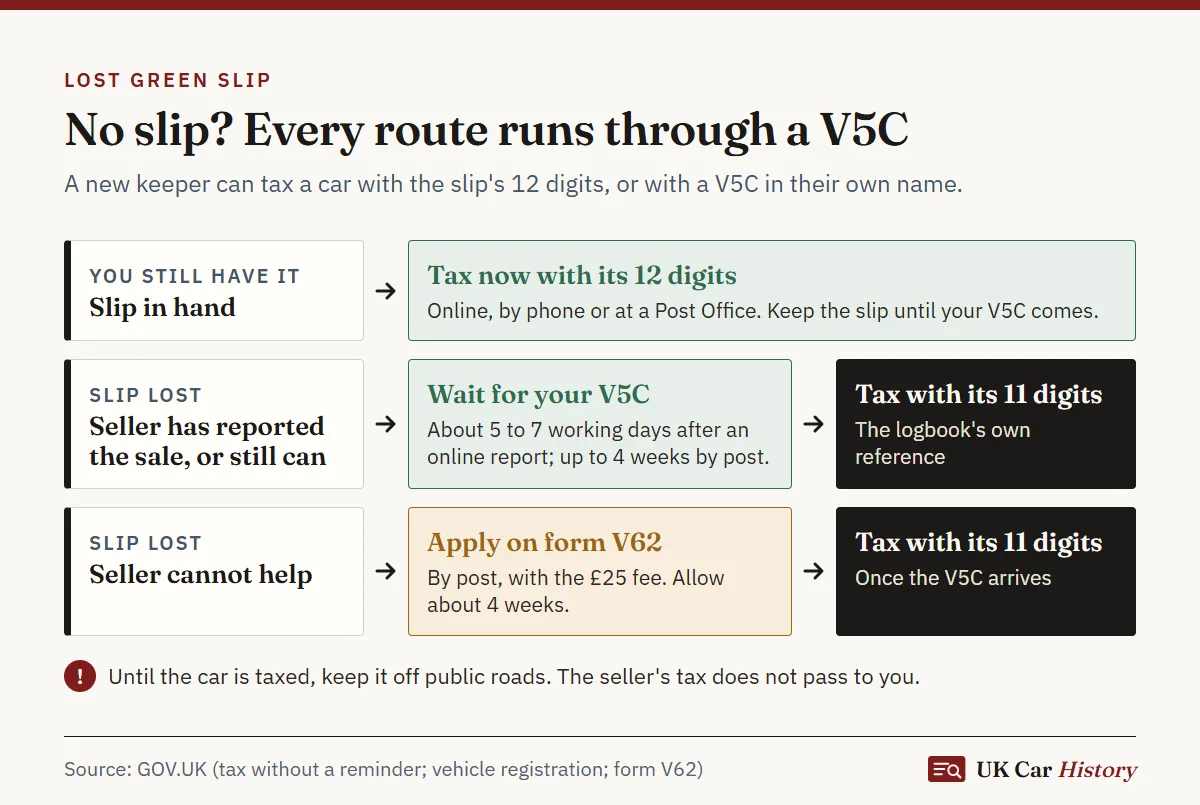
You may read that a V62 can be handed in at a Post Office and the car taxed on the spot. That option is for current keepers replacing their own logbook. A new keeper without a slip waits for the V5C, and the car stays off public roads until then.
What can you do with the slip that you cannot do without it?
| Task | What GOV.UK asks for | If you have no slip and no V5C yet |
|---|---|---|
| Tax the car | The registration and the slip's 12-digit reference (a current keeper uses the logbook's 11 digits) | Cannot be done by a new keeper |
| Make a SORN | Online: the 11-digit logbook number or the 16-digit number on a tax reminder | Form V890 posted with a V62; the new logbook costs £25 |
| Assign a private number | A logbook in your name first (GOV.UK's rule for a car just bought) | Must wait |
| Replace a V5C lost in the post after a change of keeper | Form V62 sent with the slip from the latest V5C, with no £25 fee | V62, paying £25 |
When the V5C arrives, the slip retires and the logbook's own 11-digit number takes over; its position is shown in V5C reference numbers explained.
Can the seller still put things right?
In most cases. The only sellers GOV.UK's online service cannot help are those who have already posted the logbook or never had it; anyone still holding the main part can report the sale online with its 11-digit number, whatever became of the slip.
There is a paper route too: the seller passes you the rest of the logbook, you write your name and address into its new keeper section, and you post it to the DVLA as GOV.UK directs.
Both end the same way, with a V5C posted to you and no V62 needed. Reporting a change of keeper costs nothing; GOV.UK lists no fee for it.
What does the law expect of a seller?
The rules sit in regulation 22 of the Road Vehicles (Registration and Licensing) Regulations 2002. Two duties fall on a seller holding the registration document: deliver the part marked for the new keeper to the buyer, and notify the DVLA forthwith, with the buyer's name and address and the date of sale.
Without a logbook, the seller writes to the DVLA instead. The letter has to identify both parties and the car: the seller's name and address, the registration, make and model, the exact date of sale, and the buyer's name and address.
And when no part of the logbook survives, regulation 22 makes the new keeper the applicant, with a £25 fee, which is the V62 route described above. Citizens Advice can help if a seller digs in and will not cooperate; nothing here is legal advice, only general information about the DVLA's process.
Selling, and the green slip is missing?
A missing slip does not trap you with the car. Report the sale online using the 11-digit reference from your most recent logbook and then destroy the rest of it, or complete the logbook and send it by post. Either way the DVLA issues the buyer their own V5C, usually within 5 to 7 working days of an online report.
Expect the DVLA to ask who bought the car (full name and address) and on what date; file the confirmation it sends. Reporting the sale also cancels your tax, with a refund for any full months that remain. Each method is set out in telling the DVLA you have sold your car.
How to avoid slip problems when you buy
Most slip trouble begins at the handover, and three habits prevent it:
- Look at the complete logbook and make sure the slip belongs to it. A tip from GOV.UK: the date on the slip should be the same as the latest V5C issue date in its free vehicle enquiry.
- Have the seller complete the slip in front of you, and agree who reports the sale and when.
- Store the slip and your receipt together until your logbook comes.
No logbook at all is a different and bigger warning: the DVLA tells buyers not to buy a vehicle that lacks a V5C. The reasons are in buying a car without a V5C.
Once the car is taxed, run its registration through the free look-up at the foot of this page, or our car check home page, to confirm the record has caught up.
Questions and answers
Does a lost slip mean the car is not legally mine?
No. The slip is paperwork for the DVLA, not proof of who owns the car. The DVLA records you as keeper once the seller reports the sale, and your receipt shows the purchase.
How long does a V62 application take?
Allow about 4 weeks for the new V5C to arrive by post, and contact the DVLA if it has not come after 4 weeks.
Is there a fee if the seller reports the sale?
GOV.UK lists none for telling the DVLA about a change of keeper. You only meet the £25 charge in two cases: applying on form V62 without the slip, or failing to chase a missing V5C within 6 weeks.
What if the seller has moved away and cannot be found?
Then the application falls to you: apply on form V62 for a V5C in your name and pay the £25 fee. Keep the advert, the receipt and any messages, as the DVLA may want to confirm the car's identity.
Can I put a private number on the car while I wait?
Not yet. GOV.UK asks buyers of used cars to hold off on assigning a private number until a V5C in their own name has arrived.
Sources
- GOV.UK: Tax your vehicle without a vehicle tax reminder
- GOV.UK: Tell DVLA you've sold, transferred or bought a vehicle
- GOV.UK: Vehicle registration, new and used vehicles
- DVLA: Form V62, application for a vehicle registration certificate
- GOV.UK: Make a SORN
- legislation.gov.uk: Road Vehicles (Registration and Licensing) Regulations 2002, regulation 22
This guide is general information for people buying or owning a car in the UK, not legal or financial advice. UK Car History is an independent service, not affiliated with the DVLA, the DVSA or GOV.UK.