The short answer
Eleven digits printed near the top of the logbook's first page make up the V5C document reference number. They act as a key to the car's record on GOV.UK, letting the keeper tax the car, declare it off the road or update the logbook online, so they are best kept private.
Below: how to pick it out from the other numbers on DVLA paperwork, what a V5C is and what it does not prove, which jobs need the number, why a new logbook brings a new one, and what buyers, sellers and anyone who has lost a logbook should do.
Where on the V5C is the document reference number printed?
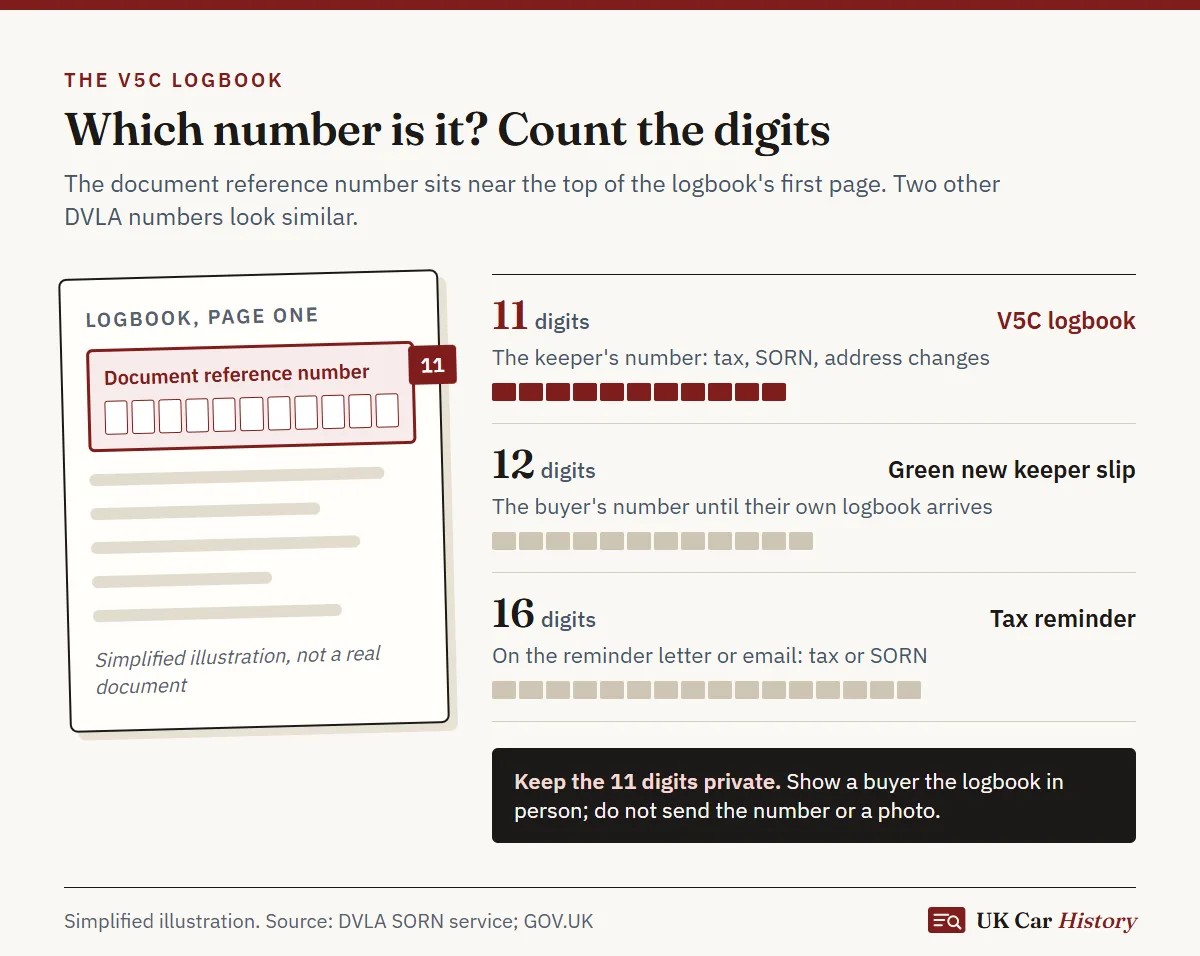
In the upper part of the first page, under a label that names it. The DVLA's online SORN service asks keepers for the 11-digit reference from the front of their registration certificate, and GOV.UK's tax service wants that same number from the V5C.
Before you type anything in, count the digits. Eleven means you have the logbook's own number. Twelve points to the green new keeper slip, and sixteen means the number came from a vehicle tax reminder, whether a letter or an email.
How is it different from the other numbers on DVLA paperwork?
The logbook and the letters that come with keeping a car carry several numbers, and each GOV.UK service wants a particular one. Side by side:
| Number | What it looks like | Where it is printed | What it is for |
|---|---|---|---|
| Document reference number | 11 digits | Top of the logbook's first page | Taxing, SORN and logbook changes online, as the keeper |
| New keeper reference | 12 digits | Front of the green slip (V5C/2) | Taxing or SORN as a buyer, before a logbook in your name arrives |
| Tax reminder reference | 16 digits | Front of the reminder letter or email (V11) | Taxing or SORN straight from a reminder |
| Serial number | Letters and digits | On the logbook | Making sure the logbook is not from a batch of stolen blanks |
| Registration number | As on the number plates | The plates and the V5C | Looking the car up, free tax and MOT checks included |
The serial number is worth its own check when you buy: GOV.UK lists two ranges of serial numbers from stolen blank logbooks, and our guide on whether a V5C is genuine explains what else to look at.
What is a V5C, and does it prove who owns the car?
Officially it is the vehicle registration certificate; in everyday speech, the logbook. The DVLA issues it to put a vehicle on its register, and inside you will find what the car is (make, colour, engine size, when it first went on the register) and who keeps it.
Keeping and owning are not the same thing. DVSA's Safe Driving for Life guide puts it plainly: the keeper is whoever answers for taxing the car, and that may not be the person who legally owns it. When the logbook was redesigned in 2010, the government told Parliament that buyers often wrongly take the V5C as proof of ownership, and that the new certificate would make clear it is not.
It also told buyers to ask the seller for something that does show ownership: a bill of sale, for instance. Whether a lender still has a claim on the car is a separate question, and the finance check is the record that answers it.
Which jobs need the reference number, and which do not?
GOV.UK asks for the 11-digit number when the keeper changes or unlocks something on the car's record:
- Paying the car's vehicle tax online when you are the keeper.
- Declaring it off the road with a SORN, where the 16-digit number from a tax reminder also works.
- Updating your address on the logbook through GOV.UK.
- Telling the DVLA online that the car has been sold: GOV.UK says the online service cannot be used without the logbook.
- Finding out which test centre carried out each MOT, and downloading MOT certificates (for tests in England, Scotland and Wales).
- Seeing the rate of vehicle tax the car pays now, on GOV.UK.
Simply looking a car up needs none of this. The DVLA's tax check and the DVSA's MOT history both start from the registration, and so does the free look-up explained on our mileage history check page, which shows the tax status, the MOT status and the reading taken at every test.
Why does a new logbook come with a new number?
Each printed logbook carries its own reference, and the DVLA prints a fresh one when the record changes: a new keeper, a new address, or a replacement for one that was lost or damaged, for example. The number on an old logbook stops being the one to use.
GOV.UK's address-change guidance reflects this: if the tax runs out within 4 weeks, renew it with the logbook you hold now, and only then report the move. When the new logbook lands on your doormat, its digits replace the old ones.
Should you ever give the number to a buyer?
No. Letting a buyer see the logbook, so they can compare it with the car, is fine; passing on its reference number, or a photo or copy of the logbook, is not. GOV.UK's reason: with those details a fraudster could obtain a copy of your logbook, and the car would then be at greater risk of theft or cloning.
- If someone asks for a photo of the logbook before viewing, offer to show it to them at the viewing instead.
- Check every advert photo for a logbook lying on a seat or the dashboard.
- At the sale, what the buyer needs from you is the green slip, and the report to the DVLA is yours to make.
A buyer never needs your 11-digit number. A request for it, or for a picture of the logbook, before any money has changed hands is a reason to be careful.
Which number does a buyer use, if not the seller's?
A buyer's paperwork starts with the green slip from the seller's logbook, the V5C/2. GOV.UK's tax service asks a new keeper for the 12-digit number on it, and the DVLA's SORN service has a new keeper route that takes the reference from the front of the slip, so you can tax the car or keep it off the road before a logbook in your name exists.
Your own V5C normally reaches you 5 to 7 working days after an online change by the seller, or within about 4 weeks by other routes, and from then on its 11-digit number is the one you use. The guide to how long a V5C takes covers what to do about a delay.
Without the slip, GOV.UK says a new keeper cannot tax the car and must apply for a new V5C by post. The steps are in our lost new keeper slip guide.
Lost the logbook? How to get a number again
Registered keepers whose details are unchanged can replace the logbook online or over the phone, GOV.UK says. Have the registration number ready, with the VIN or chassis number and the name and postcode the logbook is registered to. Expect to pay £25 in most cases and to wait 5 to 7 working days for the post; if you apply online, you can tax the car while you are there.
If the tax or a SORN cannot wait for the post, a recent tax reminder helps: its reference can be used to tax the car, and its 16 digits are accepted for a SORN.
Checking a car you are buying: no reference needed
What a buyer needs from the DVLA and the DVSA starts with the registration. The free look-up on our car check home page shows what the DVLA holds about the car (make, model, colour), whether it is taxed or SORN and until when, its MOT status and every MOT test, so you can hold them up against the logbook in front of you.
To confirm the car is the one on the papers, the Premium report (£7.99) includes the full VIN held for the registration: set it against the VIN in the logbook and on the car. The same report searches finance, write-off and stolen records. The stolen vehicle check page shows where the VIN is usually found on a car.
Questions and answers
Which side of the V5C is the reference number on?
The front, in the upper part of the first page. The DVLA's online services send keepers there for the 11-digit reference.
Is my V5C reference number my car's registration?
No. The registration is the number on the plates and stays with the car unless it is changed. The reference is 11 digits tied to one particular logbook.
Why does the green slip have a 12-digit number?
It is the new keeper reference. A buyer uses it to tax the car, or to declare it off the road, until a V5C in their own name arrives.
Does moving house change my V5C reference number?
Yes, because a change of address brings a new logbook with its own reference. Tax due in the next 4 weeks? Renew it with the logbook you have now, then report the new address.
What could someone do with my V5C reference number?
Obtain a fake copy of your logbook, GOV.UK warns, using the number or a photo or copy of the logbook. That makes the car easier to steal or to clone.
Which numbers work for a SORN online?
The 11-digit number from the front of the V5C, the 16-digit number from a tax reminder or, for a new keeper, the reference on the green slip. GOV.UK also offers a 24-hour phone line and form V890 by post.
Sources
- DVLA SORN service: where the V5C, V5C/2 and reminder numbers are printed
- GOV.UK: Tax your vehicle without a vehicle tax reminder
- GOV.UK: Selling a vehicle (protecting your log book)
- GOV.UK: Written statement on the redesigned V5C, 21 July 2010
- GOV.UK: Get a vehicle log book (V5C)
- GOV.UK: Check the MOT history of a vehicle
This guide is general information for people buying or owning a car in the UK, not legal or financial advice. UK Car History is an independent service, not affiliated with the DVLA, the DVSA or GOV.UK.