The short answer
A free Irish car check starts with the car's papers rather than a database. The Irish plate tells you the year and county of registration, and the NCT certificate prints the car's earlier odometer readings. UK services such as the MOT history and the DVLA enquiry hold nothing on an Irish-registered car until it is registered in the UK, and then only from that date.
This guide is for two kinds of buyer: someone buying a car in the Republic of Ireland to bring to Great Britain or Northern Ireland, and someone looking at a car for sale here that came over from Ireland. It covers what each Irish document proves, what you cannot check for free, and where UK records take over.
What can an Irish number plate tell you?
Quite a lot, once you know the format. Citizens Information, the Irish state's information service, explains that Irish plates carry a three-digit year identifier, with one code for each half of the year: a plate starting 261 was issued in the first six months of 2026, and one starting 262 in the second six months. The letters after it stand for the county or city where the car was registered, so 262-D-111 is a Dublin registration from the second half of 2026. The final number is the car's place in that area's sequence.
The plate must also show the county's name in Irish and, on the left, a blue band with the EU flag and the letters IRL. A plate that breaks those rules is worth asking about, because Revenue, the Irish tax authority, can fine owners whose plates do not comply.
The year identifier is a starting point, not proof. Compare it with the year on the registration certificate and on the NCT certificate. Our guide to a foreign vehicle registration check explains what other European plates can tell you.
Which free checks can you do on an Irish car?
In Ireland, most of the free evidence is on paper, so ask the seller for these before you book a crossing or hand over a deposit:
| Document | What it can tell you | Who has it |
|---|---|---|
| NCT certificate | That the car passed its National Car Test, and the odometer readings from earlier tests | The owner, for cars over 4 years old |
| NCT disc | The most recent NCT odometer reading | On the windscreen |
| Vehicle Registration Certificate (VRC) | Who the registered owner is, so you can match it to the seller | The owner, for cars registered after 1 April 2004 |
| VRT certificate | That Vehicle Registration Tax was paid when the car was brought into Ireland | The owner, only if the car was imported into Ireland |
| Service book and invoices | Where and when the car was serviced, and at what mileage | The owner |
Citizens Information tells buyers to ask for the NCT certificate on any car over four years old and the VRT certificate on an imported one. None of these costs you anything, and together they give you a timeline you can test.
How does the NCT certificate help you check the mileage?
The National Car Test is Ireland's roadworthiness test. A car must first be tested when it is over four years old, then every two years while it is between four and nine years old, and every year once it is ten or older. Each certificate prints the odometer readings recorded at earlier tests, and the disc on the windscreen shows the latest one.
That gives you an Irish equivalent of a mileage history. Citizens Information gives a simple test: if the reading on the disc is higher than the one on the dashboard, the odometer may have been turned back. Also look for readings that fall from one test to the next, or a gap where a test should have been, and ask the seller to explain either.
Use the same unit throughout. If the readings on the certificate and the dashboard are not in the same unit, convert one before you compare them.
How do you check finance, write-offs or theft on an Irish car?
Not from the papers alone. Citizens Information advises private buyers to check a car's history or ownership status before buying, and lists history services in Ireland that do it. If you are buying in Ireland, that is the place to run the check, because those services read Irish records.
Finance matters most. Citizens Information explains that a car paid for through hire purchase or a Personal Contract Plan does not belong to the buyer until the final payment is made, so ask the seller directly whether it was bought that way and get written proof that the agreement is settled.
A UK history check reads UK records, so do not count on it to show an Irish finance agreement, write-off or theft record from before the car came over. Run the Irish check before you pay, while the car is still on Irish plates.
Why can't UK car checks see an Irish-registered car?
Because they are built around UK registrations. The DVLA's enquiry only returns vehicles on its own register, and the DVSA's MOT history only holds tests carried out in Great Britain (since 2005) and Northern Ireland (since 2017). An NCT done in the Republic is not an MOT, so it does not appear there. A car from Northern Ireland is a different case: it is UK-registered, and our Northern Ireland car check guide covers it.
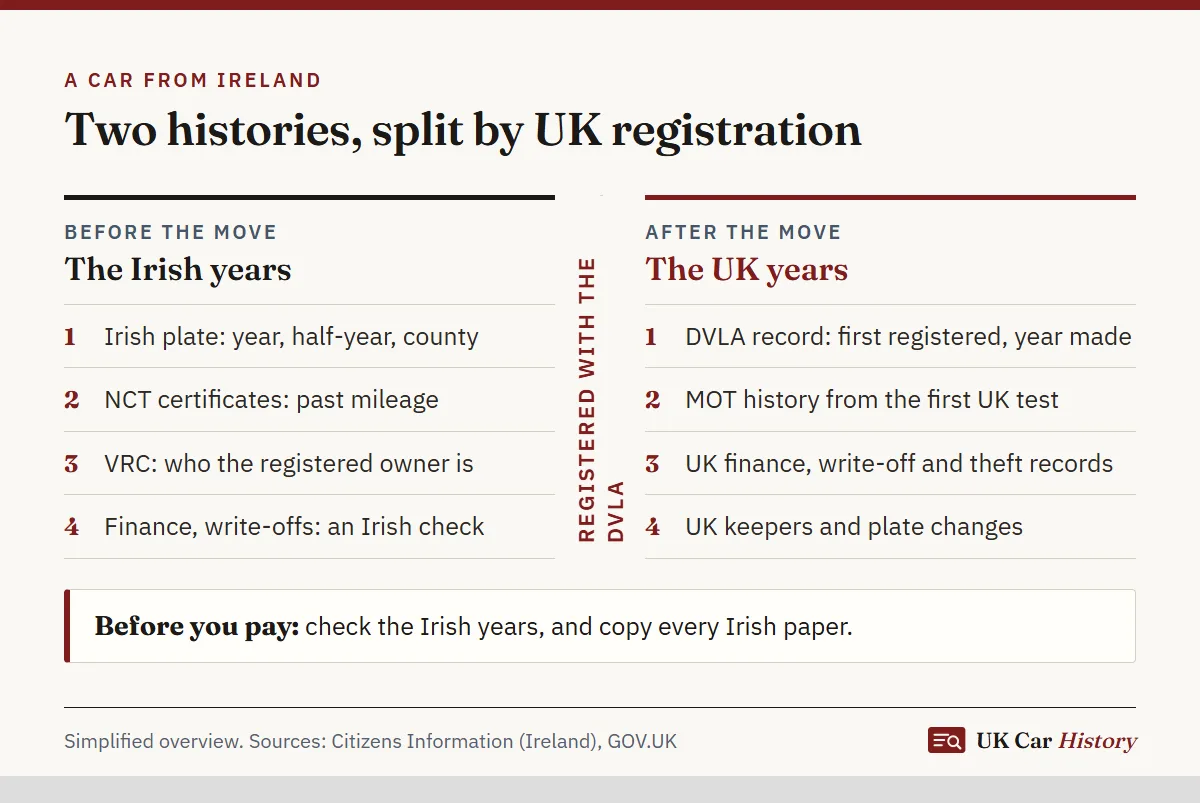
Once the car is registered in the UK, it gets a UK registration number and a UK record. The DVLA asks for the original foreign registration certificate to show when the car was made, and its record then holds the date of first registration and the year of manufacture. From that point, a car check by registration shows the car's UK records, and its MOT history builds up from its first UK test.
What happens when an Irish car is registered in the UK?
The general route, from telling HMRC to receiving a V5C, is set out in our foreign vehicle registration check guide. Three points are specific to a car coming from the Republic:
- Where it goes decides the tax. Into Northern Ireland from the EU, GOV.UK says no import declaration is needed and VAT is usually due only on a new vehicle, meaning one driven less than 6,000 km or used for no more than six months. Into England, Scotland or Wales, VAT and customs duty can apply, and HMRC tells you whether they do.
- Approval comes from the maker. As an EU-registered car, it needs a European Certificate of Conformity, unless it was first registered or built more than ten years ago, when it may need no approval at all.
- The Irish certificate does not come back. The DVLA keeps the original foreign registration certificate. Photograph or copy the VRC, the NCT certificates and the service book before you post anything: they are the only record of the car's Irish years.
What should you ask the seller of a car from Ireland?
- Is the VRC in your name, and does the address match where I am collecting the car?
- Can I see every NCT certificate, and is the current disc on the windscreen?
- Was the car bought on hire purchase or a PCP, and do you have the settlement letter?
- Was the car imported into Ireland? If so, can I see the VRT certificate?
- Has it been in an accident, had an insurance claim or been written off?
- Where has it been serviced, and do you have the invoices and both keys?
Keep the answers in writing, such as messages or emails. If you buy from a private seller in Ireland, Citizens Information notes that you have far fewer rights than when buying from a trader, so the questions you ask before paying matter more.
Is the car for sale here already re-registered from Ireland?
Often it is, and then the checks change. A car that came from Ireland and now wears UK plates has a UK record from its UK registration onwards. Compare the DVLA's date of first registration and the year of manufacture with the first test in its UK MOT history: on an imported car, the gap can be several years.
For the UK part of its life, a history report covers recorded finance, write-offs and theft, and counts the UK keepers and plate changes. For the Irish years, ask for copies of the Irish paperwork, and trace the VIN through UK records to be sure it matches the one on every document.
Questions and answers
What can I check for free on an Irish car?
The car's own paperwork: the NCT certificate and disc, the VRC, the VRT certificate if it was imported into Ireland, and the service book. For finance, write-off and theft records, Citizens Information points private buyers to history services in Ireland.
Can I check an Irish registration on the DVLA website?
No. The DVLA vehicle enquiry and the MOT history only work for vehicles registered in the UK. An Irish-registered car has no UK record until it is registered with the DVLA.
What does 192 mean on an Irish number plate?
The first two digits give the year and the third the half-year, so 192 means the car was registered between July and December 2019. A plate starting 191 was registered between January and June of that year.
Does the NCT certificate show past mileage?
Yes. Citizens Information says previous odometer readings are printed on the NCT certificate and the latest reading is shown on the NCT disc, which lets you compare them with the dashboard.
Will I get the Irish documents back after registering the car in the UK?
Not the registration certificate. GOV.UK says the DVLA keeps the original foreign registration certificate, so copy it and the NCT certificates before you send it.
Can I keep driving a car on Irish plates if I live in the UK?
Only visitors can, for up to six months in a 12-month period, under the temporary import rules. If you live in the UK or stay longer, GOV.UK says you must register and tax the vehicle here.
Sources
This guide is general information for people buying or owning a car in the UK, not legal or financial advice. UK Car History is an independent service, not affiliated with the DVLA, the DVSA or GOV.UK.