The short answer
An MOT is a safety and emissions inspection, so an MOT checklist is mostly about the parts that stop, steer and show the car: brakes, steering, suspension, tyres, lights, the driver's view and the seatbelts, plus the exhaust, fuel system, body structure and number plates. How worn the engine, clutch or gearbox is plays no part in the result.
First comes the tester's own list, grouped by what each part does, then what an MOT ignores. After that: a walk-round for the days before, the reasons a centre can refuse to start, fees and free retests, and what follows a fail. Everything here applies in England, Scotland and Wales; Northern Ireland's tests are run separately by the Driver and Vehicle Agency.
What is checked in an MOT, area by area?
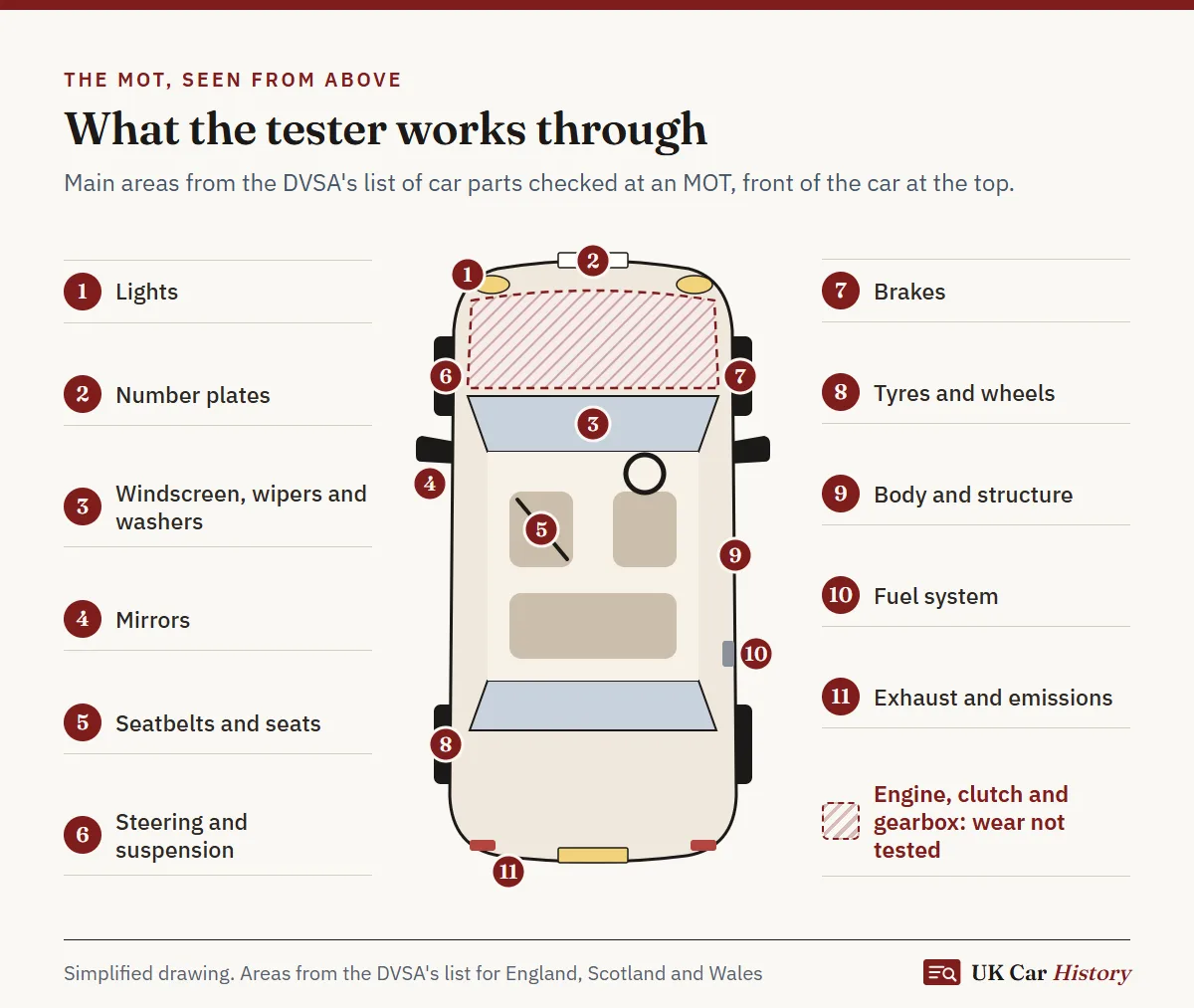
Behind every MOT sits a DVSA list of the parts a tester must examine, backed by an inspection manual that spells out the method and the failure points for each. Sorted by the job each part does:
| Job | Areas | Examples of what the tester looks at |
|---|---|---|
| Stopping | Brakes | How worn they are, how hard they stop on the test equipment, the ABS and stability systems where present, and the related warning lamps |
| Steering and grip | Steering, suspension, tyres and wheels | Play, wear and security, the power steering fluid level, tyre size, type, damage and tread depth, plus the tyre pressure warning lamp on cars first used from 1 January 2012 |
| Seeing and being seen | Lights, windscreen, wipers, washers, mirrors, horn | Every lamp lit and the headlamps pointing the right way, glass undamaged where the driver looks, blades and jets that keep it clear, and a working horn of a suitable type |
| Protecting the occupants | Seatbelts and seats | Each compulsory belt fitted and working, the airbag and belt pretensioner warning lamps, seats that are secure, and a driver's seat that moves |
| Emissions and leaks | Exhaust, emissions, fuel system | An exhaust that is whole, secure and not too loud, the catalyst on cars built with one, emission readings within the limit for the car's age and fuel, and fuel lines and a cap that do not leak |
| Structure and identity | Body, number plates, VIN, towbar | Rust, damage and sharp edges in the areas that matter, doors and bonnet that shut and latch, legal plates fixed firmly, a VIN shown on cars first used from 1 August 1980, and the towbar with its socket |
Two extras complete the list: the speedometer has to work, and the engine has to sit firmly on its mountings.
Which parts does the MOT leave out?
The DVSA draws a firm line between an MOT and a service. Wear in the engine, clutch and gearbox is not assessed at all; those parts only matter to the tester if they leak, smoke too much or have broken mountings. A clutch near the end of its life, or an engine that needs money spending on it, will not stop a pass.
No one looks at the spare wheel or its tyre, and the wheels and trims stay on for the brake test. Nor can the test tell you anything about the car's background: its servicing, its keepers, or an insurance write-off. Our car registration history report counts the keepers and plate changes, and the Premium report adds the finance, write-off and stolen checks.
A certificate is a snapshot of one day. Wear carries on after it, and keeping the car roadworthy until the next test is the keeper's job.
Do not let a new certificate on a car for sale stand in for your own checks. It tells you nothing about the clutch, the service record or what the car has been through.
How do you run your own pre-MOT checks?
Simple faults fail plenty of cars: a dead bulb, a torn wiper, a dry washer bottle. Do your checks a few days before the test so anything you find can still be put right, and take the car in four stages:
- From the driver's seat. Start the engine and watch every warning lamp go out. The engine lamp must not stay lit on a petrol car first used from 1 July 2003 or a diesel first used from 1 July 2008, and testers also look at the lamps for the airbags, ABS, stability control and power steering. Sound the horn, run each seatbelt out to its full length, let it reel back and buckle it, and make sure the seats are solid and the driver's seat slides.
- Walking round the outside. With a helper, work through every light: both beams, side lights, all indicators, hazard lights, fogs, reversing lights, the plate lamp and the brake lights. Look at each mirror and both number plates, which must be secure, clean and readable. Open and close every door, the bonnet, the boot and the fuel cap; front doors should open from both sides, rear ones from outside.
- The glass. A screen fails only when damage seriously affects the driver's view: more than 10mm across in a 290mm-wide band in front of the steering wheel, or more than 40mm elsewhere in the wiper sweep. Clear off stickers or mounts that seriously block that area, then run the wipers with the washers to be sure the glass comes clean.
- Tyres and fluids. Measure the tread: 1.6mm is the legal minimum across the middle three-quarters, all the way round. Any cut or bulge is a problem, and the two tyres sharing an axle must be the same size. Under the bonnet, the brake fluid should sit between its marks; top up the washer bottle, and leave fuel and oil enough for the test.
Lighting faults head the DVSA's failure figures, with suspension, tyres and brakes close behind; our guide to the most common MOT failures has the numbers.
What can make a test centre refuse to test the car?
Centres are allowed to turn a car away when it cannot be tested properly. Most of the grounds in the DVSA's testing guide are within the owner's control:
- a car too dirty, inside or out, to examine without unreasonable difficulty;
- a tank or engine so low on fuel or oil that the car cannot be driven for the test;
- luggage or a load blocking the inspection, unless it is tied down or removed;
- an engine cover, door, tailgate, boot lid or fuel cap that cannot be opened;
- avoidable smoke in large amounts;
- an unpaid fee where the centre wanted it in advance.
The tester may also need the V5C, normally to establish the car's age when it has a private plate or an unclear year, and can refuse without it. Take the logbook, and the key to a locking fuel cap, and the problem does not arise.
Diesels come with one more piece of DVSA advice: arrive with the engine thoroughly warm. Mention at the outset any worry that the smoke test might harm the engine; if the tester believes it might, they will refuse to test the car.
What does an MOT cost, and when is the retest free?
MOT centres cannot charge more than the official maximum, £54.85 for a car with up to 8 passenger seats, and no VAT is due on the fee. Prices below the maximum are allowed, so ask when you book.
Retests depend on where the repair is done and how quickly the car comes back:
- Car stays at the centre for repairs and is retested within 10 working days: no charge for the partial retest.
- Car leaves and returns to the same centre by the end of the next working day, for a retest of simple items such as lamps, mirrors, windscreen glass, wipers and washers, wheels and tyres, seatbelts, the horn or plates: no charge either.
- Car repaired elsewhere and back within 10 working days: a partial retest, possibly with a fee.
- Any other case: a full test again, at the full price.
What happens when a car fails its MOT?
One dangerous or major item is enough for a fail; minor items and advisories leave the car with a pass and a to-do list. Each grade, and the stock phrases testers use, is explained in our guide to MOT advisories.
Driving away is allowed only when the previous certificate has not yet run out and the fail lists no dangerous item; in every other case the repair comes first. The penalty for ignoring a dangerous fail can reach £2,500, with a driving ban and 3 penalty points.
Nothing is wiped afterwards. Passes and fails alike go into the MOT database, and any future buyer can read the fail alongside the retest that cleared it.
How do past MOT results help with your checklist?
For your next MOT, or for a car you are thinking of buying, the earlier tests make the best checklist of all. The free look-up on this page shows each one, with its failures, advisories and mileage, and the recall status reported by the DVSA.
Start with the two most recent tests. Anything advised then has had another year of wear, and parts that failed once, tyres and brake pads especially, wear out again on the same schedule. The rest of the record is explained in what to look for in MOT history.
Questions and answers
Does the MOT test the engine?
Only indirectly. Emissions, fluid leaks and the security of the engine mountings are checked, but the wear and condition of the engine, clutch and gearbox are not.
Can I stay and watch the MOT?
Yes, from the test centre's viewing area, as long as you do not interrupt the tester while they work.
How do I spot an approved MOT centre?
Look for the blue sign with 3 white triangles. Only approved test centres are allowed to carry out MOTs.
Will a dashboard warning light fail the MOT?
Some do. An engine lamp that will not go out is a fail on petrol cars first used from 1 July 2003 and diesels first used from 1 July 2008, and the airbag, ABS and stability control lamps are checked too.
Do I need to take the V5C to the MOT?
Usually not, but the tester can ask for it to confirm the car's age, for example when it has a private plate. Taking it avoids a refused test.
Can a full boot stop my MOT?
It can. A centre may refuse to test a car whose load or loose belongings get in the tester's way, so clear the boot before you go.
Sources
This guide is general information for people buying or owning a car in the UK, not legal or financial advice. UK Car History is an independent service, not affiliated with the DVLA, the DVSA or GOV.UK.