The short answer
There is no set scrap car value. Each authorised treatment facility (ATF) prices a car for itself, mostly from its weight, the going rate for scrap metal and any parts worth reselling, and it may add a charge when essential parts are missing. In Great Britain the yard has to pay by bank transfer or cheque rather than in cash, and a separate refund for whole months of unused tax comes from the DVLA.
Below: when selling beats scrapping, what moves an offer, checking a yard, the payment and ID rules in each nation, the handover, and cars with finance, a late keeper or an insurance write-off. What a scrapped record means to a later buyer is in the buyer's guide to scrapped and exported records.
Scrap my car: how much will I get?
Nobody publishes an official rate, so there is no standard figure to look up. GOV.UK says only that the ATF pays you the scrap value; each business makes its own offer, and two quotes for one car may not match.
The money you end up with has three parts:
| Part | Who pays or charges it | Effect on what you get |
|---|---|---|
| The offer for the car | The ATF or scrap dealer that takes it | Adds to it |
| A fee for missing parts | The ATF, if the engine, gearbox, wheels or bodywork were removed; otherwise scrapping there is usually free | Takes from it |
| A tax refund | The DVLA, by cheque, for each whole month of tax still to run | Adds to it, separately |
A car worth nothing on the market need not cost you anything to get rid of. Every maker or importer must offer free take-back for its brands, through ATFs that belong to its collection system. From 1 January 2007, the 2005 producer responsibility regulations for end-of-life vehicles have stopped such a system from charging the final owner for a car that has no market value, except where essential parts have gone or rubbish has been added to the car.
To see how many months of tax could come back, type the registration into the free look-up on our car check page: it shows when the tax expires.
Could the car be worth more sold than scrapped?
Possibly, when someone values it as a car rather than as metal. Three alternatives are worth pricing before you book a yard:
- Sell it as it stands. Someone able to repair the car, or break it for parts, may pay more than its metal is worth. Say plainly in the advert that it does not run or is sold for spares, because selling an unroadworthy vehicle is an offence in Great Britain under the Road Traffic Act 1988 (section 75), though a seller with reasonable cause for believing it would stay off the road until fixed has a defence.
- Strip parts first. GOV.UK lets you take parts off to repair another vehicle of yours, as long as the car is declared off the road with a SORN, kept off it, and its oil and other fluids are kept out of the ground and the drains. A car that reaches the yard without its essential parts can then be charged for.
- Ask the ATF what it plans. Some cars are repaired and resold by the ATF rather than destroyed, so if yours still runs, ask whether that would change the offer.
Still driving, with MOT left to run? Then a buyer who wants to use the car may pay more than a yard that will weigh it. Selling a car quickly compares the faster routes and the price each one costs.
What pushes a scrap offer up or down?
Every yard does its own sums, but the same things come up in each:
- Metal, by weight. In England and Wales the law makes a dealer record the type and weight of all the scrap metal it receives, and a bigger, heavier car simply holds more of it.
- The day's market. Scrap metal prices go up and down, so find out how many days a quote is good for.
- Parts someone will buy. Recovering parts for reuse or sale is part of a motor salvage operator's trade, as the 2013 Act describes it, so wanted parts can lift what the car is worth to that buyer.
- What has been taken off. If the car's original catalytic converter has gone, or the engine or another essential part, the yard can charge, and the free take-back promise no longer applies.
- Getting it to the yard. A car that will not start has to be transported, so ask if the offer includes collection.
Which yards can you use? Checking the ATF and its licence
Only an ATF may scrap a car; GOV.UK calls doing it anywhere else illegal. Before you book, find the business on the register for the nation where the car is:
| Nation | Register | Kept by |
|---|---|---|
| England | The ATF register of end-of-life vehicle sites, in its public registers | Environment Agency |
| Wales | End of life vehicles treatment facilities public register | Natural Resources Wales |
| Scotland | Register of authorised ATFs, a spreadsheet last updated in March 2026 | SEPA |
| Northern Ireland | ATF Public Register, usually updated every month (latest: 4 November 2026) | DAERA |
The "Find a vehicle scrapyard" search on GOV.UK covers England and points to the other lists. In England and Wales an ATF works under an environmental permit; in Scotland, SEPA authorises each site.
The buyer needs a licence as well. Any business buying scrap metal in England and Wales, motor salvage operators included, must hold a scrap metal licence issued by the local council. Natural Resources Wales and the Environment Agency keep registers of them, and a copy must be on show at each licensed site, or readable from outside a collector's vehicle. In Scotland, the Civic Government (Scotland) Act 1982 requires a metal dealer's licence.
Getting quotes, and holding the yard to them
Until a yard has seen the car, its figure is only as good as your description, so mention an engine that will not start, wheels that will not turn, damage, missing parts or an awkward spot to load from. Then ask each yard:
- Will my car go to an ATF, and will that ATF send me a certificate of destruction?
- Can you give me your licence and permit details to check against the registers?
- Is collection free, and will anything else be deducted?
- How many days is this price good for, and what could change it when you see the car?
- How and when will the money reach my account?
A lower offer on the day can be fair if the car is not what you described, but you are free to turn it down and keep the car. Get the agreed figure and the payment date confirmed in a text or an email before the car goes.
Consumer law works for you even though you are the seller. The 2024 Digital Markets, Competition and Consumers Act treats a trader's dealings over a product supplied by a consumer as commercial practices, so a yard must not mislead you or use harassment, coercion or undue influence to get the car. Ignoring a request to leave your home, or not to return, is unfair in all circumstances under the Act, unless the trader is enforcing a contract.
How will the yard pay you, and what ID will it want?
The rules differ between the nations of the UK:
| Nation | Where the rule comes from | How the dealer may pay |
|---|---|---|
| England or Wales | Scrap Metal Dealers Act 2013, s.12 | A non-transferable cheque, or an electronic transfer of funds; a dealer who pays any other way, cash included, commits an offence |
| Scotland | Civic Government (Scotland) Act 1982, s.33A | Only a non-transferable cheque or an electronic payment to a building society or bank account held in your name (since 1 September 2016) |
| Northern Ireland | Not covered by either Act (England and Wales: 2013; Scotland: 1982) | No payment rule from those Acts; asking for a transfer still gives you a record of the sale |
Identity checks sit alongside the payment rules. Before accepting a car in England and Wales, a dealer has to confirm your full name and address from reliable documents, and a 2013 regulation lists two ways to pass: a photo document that shows your address, a photocard driving licence for instance, or a passport or other listed photo ID plus a bank, card, council tax or utility statement or bill from the last three months, though not a mobile phone bill. The dealer keeps a copy of the document, with a copy of the cheque or the record of the transfer, for three years. A Scottish metal dealer has to note the seller's name and address and the way it verified them.
GOV.UK notes a case where cash is allowed: a car the ATF chooses to fix and sell on, rather than scrap, may be paid for in any way, and comes with no certificate of destruction.
Collection day: the plate, the papers and the DVLA
Keeping a private number? Deal with it while the car still runs. Taking a number off costs £80, and among the conditions are that the car moves under its own power and is taxed or has a SORN. GOV.UK warns that you need both the new logbook and the V778 retention document in your hands before the car is scrapped, or the right to the number is lost.
- Give the yard the car, its keys and the logbook (V5C), but tear off and keep the yellow section for selling to the motor trade.
- Show the ID it asks for, and check that the payment, or the written promise of it, matches what you agreed.
- The same day, report the car as scrapped on GOV.UK's "sold, transferred or bought" service, with the 11-digit reference number from your most recent V5C; the yard goes in as the trader you sold to, even when no money changed hands.
- Cancel the insurance, or move it to your next car.
The fine for not telling the DVLA can be £1,000. Your tax refund is worked out from the day the DVLA receives your report, so reporting late can make it smaller.
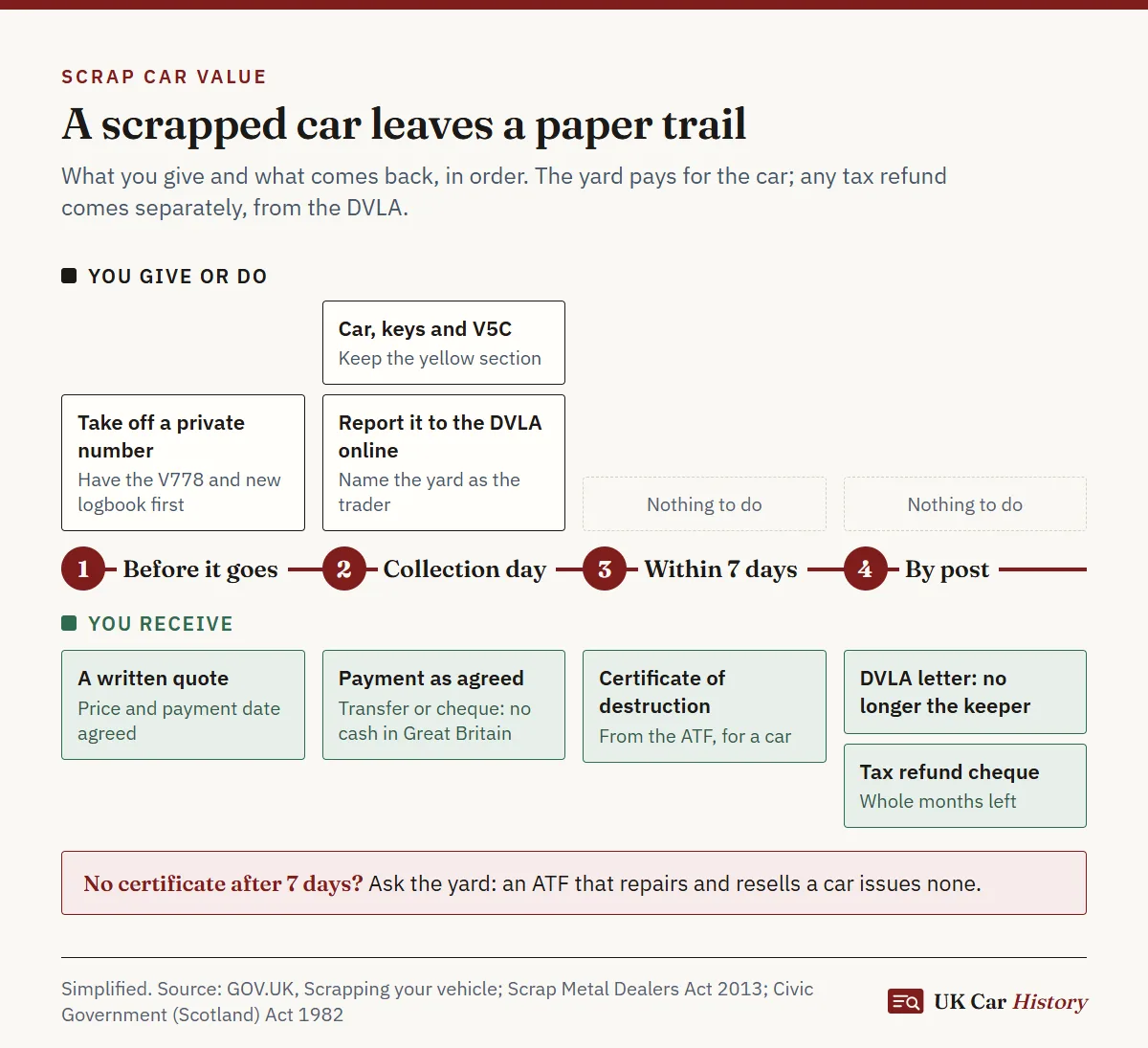
No certificate of destruction a week after collection? Ask the yard why, then see checking that your car has been scrapped for what to do next.
Car on finance, inherited or left on your land?
A car you are still paying for is not yours to scrap. Under hire purchase, ownership stays with the finance company until the final payment, and Citizens Advice warns that selling or disposing of goods on HP without the lender's permission is a criminal offence. For PCP deals, leases and logbook loans, read the paperwork and talk to the lender first.
Request a settlement figure: the lender has 7 working days to send it, calculated for a settlement date that falls 28 days after your request arrives. Then either clear the balance before the car goes or agree with the lender what happens to the yard's payment, because scrapping a car does nothing to the debt. Selling a car that still has finance explains settlement figures in more depth.
Bought the car used and unsure an earlier keeper's finance was ever cleared? Our finance check looks for any agreement recorded against it, as part of the Premium report (£7.99).
- A car inherited from someone who has died. Take any private number off before the car is sold, as GOV.UK's guidance on telling the DVLA after a death asks; the same guidance lists what to send whether you sell the car or keep it.
- An abandoned car on your property. You cannot scrap it yourself. Tell the council: it must take abandoned vehicles away from open-air land, private land included, without charging you as the landowner. It has to give you 15 days' notice first, and cannot remove the car if you object during that time.
Written off by your insurer? Then scrap prices do not apply
An insurance write-off is a different deal. GOV.UK explains that the insurer pays the car's current value rather than the cost of repairs, and usually arranges the scrapping itself. Weigh that payout against what the car was worth on the market, not against a scrap quote; how cars are valued covers the way insurers reach their figure and how to dispute a low offer.
- Keeping a private number? Apply to take it off first.
- The insurer gets the V5C; the yellow section stays with you.
- Report the write-off to the DVLA online, putting the insurer's name and postcode in the trader details. GOV.UK treats a write-off as selling the car to your insurer, and the same £1,000 fine applies if you do not report it.
- Want to keep it? With Cat N or Cat S, the insurer settles the claim and then sells you the car back; repair is not an option for Cat A or Cat B.
Questions and answers
Is it free to scrap a car?
Normally, yes. GOV.UK describes scrapping at an ATF as usually free, and each maker has to provide a free take-back route for its own brands. A yard can charge when the car comes without key parts, the engine or wheels for example.
Why did two yards quote such different prices?
There is no official rate, so each yard prices the car its own way, from the metal in it, the parts it could sell and the cost of fetching it. Compare offers on the same footing, with collection and any deductions included.
Does the scrapyard pay my tax refund?
No. The DVLA does, once you report that the car has gone: a cheque made out to the keeper named in the logbook and sent to the address it shows, for each whole month of tax remaining after your report arrives.
What if the yard offers less when it turns up?
You can refuse and keep the car. A lower figure can be fair when the car turns out different from your description, but the law forbids a trader from misleading you or using aggressive pressure to make you accept.
My car failed its MOT. Should I scrap it?
Only after doing the sums. Set a scrap offer against two other figures: the repair bill, and the price the car would fetch once fixed. A cheap repair can make the car worth more on the road than at the yard.
Sources
- GOV.UK: Scrapping your vehicle and insurance write-offs
- legislation.gov.uk: Scrap Metal Dealers Act 2013
- legislation.gov.uk: Civic Government (Scotland) Act 1982, section 33A (payment for metal)
- legislation.gov.uk: End-of-Life Vehicles (Producer Responsibility) Regulations 2005, regulation 10
- GOV.UK: Find a vehicle scrapyard (with the lists for Scotland, Wales and Northern Ireland)
- Citizens Advice: Hire purchase and conditional sale
This guide is general information for people buying or owning a car in the UK, not legal or financial advice. UK Car History is an independent service, not affiliated with the DVLA, the DVSA or GOV.UK.