The short answer
Selling to a motor trader is usually your quickest way to sell a car: a car-buying service, a dealer buying outright, or the dealership supplying your next car, as a part exchange. One trade buyer saves you advertising, showing the car to strangers and sitting in on test drives, but it pays a trade price, usually less than a private buyer would.
Three things can stall even a willing buyer: money still owed on finance, no logbook, or an MOT that has run out. Each can be sorted before the car is advertised. Below: the routes side by side, what speed costs, the jobs to start weeks or days ahead, a faster private sale, the scams that feed on a hurry, sale-day paperwork, refunds if a buyer cheats you, and the law in brief.
Sell my car quickly: which kind of buyer is fastest?
Each route has its own bottleneck:
| Route | Before you are paid | What decides the timing | The catch |
|---|---|---|---|
| Car-buying service | A quote online, an inspection of the car and a firm offer, then the money and collection | When it can inspect the car, and when its payment goes out | A trade price, and the inspection can lower it |
| Dealer buying outright | The dealer appraises the car and names its price | Getting the car to the dealer, and how the dealer pays | A trade price |
| Part exchange | The dealer values your car against the one you are buying | When your next car is ready to collect | A trade price, taken off what you pay for the replacement |
| Private sale | Adverts, messages and calls, then viewings, test drives and finally the payment | Whether a buyer appears who will pay your price | More of your time, usually for more money |
No route has a fixed timescale. Ask a trade buyer, before you agree to anything, on which day it would inspect the car and on which day the money would land; a private sale finishes only when the right buyer turns up. If the car has little life left, its scrap value may be the better yardstick.
What does a quick sale cost you?
Some money, in most cases. Behind every trade offer sits the cost of checking, preparing and reselling the car, plus a margin, none of which a private buyer has to cover. The size of that gap varies from car to car, so work it out for yours:
- Know your numbers. Find a trade value and a private value for the car and test them against real adverts for the same model; how car valuations work explains which figure belongs with which kind of offer.
- Collect several trade offers close together, so speed does not leave you with a single bid.
- Pin each buyer down on four points: whether the figure is fixed, what an inspection could take off it, any deductions or fees, and the day you are paid.
- Write down your walk-away price before the first viewing or inspection.
Selling privately, your quickest lever is the asking price: pitch it against what comparable cars are listed for, and buyers have less reason to keep looking. Where the trade-private gap comes from is covered in part exchange or private sale.
Which jobs take weeks, and should come first?
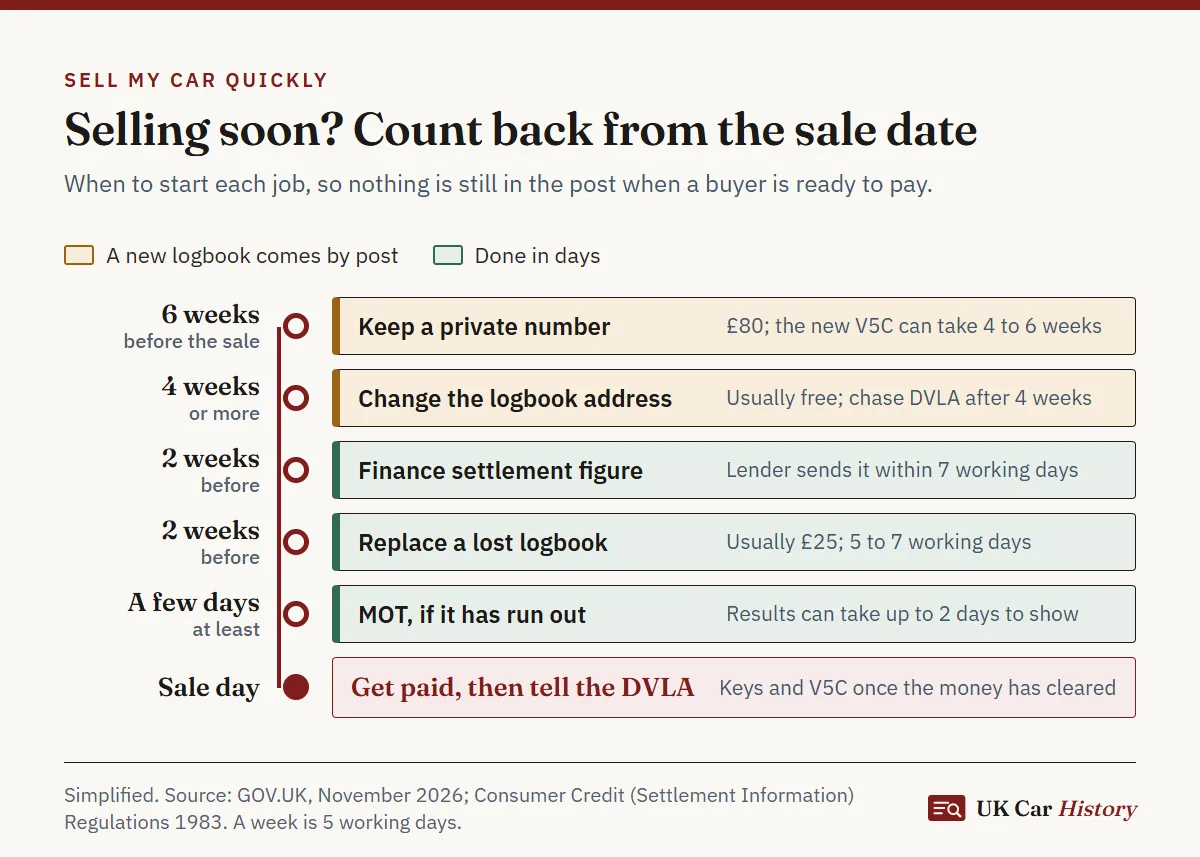
Two jobs end with a new logbook arriving by post, so start them as soon as a sale is on the cards:
- Keeping a private number. Taking the number off costs £80 and must be done before the sale. GOV.UK allows 4 to 6 weeks for the replacement logbook to arrive, and you need it, with the V778 retention document, before you sell, or the number is lost.
- An out-of-date address. GOV.UK warns that you may not get your tax refund if the logbook details are wrong. Updating the address online is usually free, and a new logbook comes by post; after 4 weeks with nothing in the post, chase the DVLA. Wait for it, because reporting the sale online asks for the reference number from the latest one.
Which hold-ups can be cleared in days?
- Finance still owed. Request a settlement figure from the lender. It must send one within 7 working days, and the figure is calculated as at 28 days after your request reaches it, so ask once a sale looks likely. Clear the balance yourself, or let a trade buyer pay it off out of the price; selling with finance outstanding covers paying the lender from the buyer's money on the day.
- No logbook. If nothing on it needs changing, a replacement V5C, usually £25, can be ordered by phone or online, and normally reaches you in 5 to 7 working days.
- MOT expired, or close to it. Testing as much as a month (less a day) before the expiry date keeps the same renewal date. GOV.UK warns that MOT records can take up to 2 days to update, which may delay taxing the car. A buyer cannot tax a car with no valid MOT, and may only drive it to a booked test or to be repaired.
Can a private sale be quick too?
It can be quicker than you might expect if buyers have nothing left to check when they arrive. Four ways to get there:
- Check the car's history before buyers do. The MOT history is public: every test result, advisory and mileage reading can be looked up by registration. Look yours up first with the free check on our mileage history check page, so an advisory that costs little to fix is fixed before the advert goes live.
- Put the number plate and your known faults in the advert. A buyer who has already looked the car up and read about its flaws arrives ready to decide.
- Keep the paperwork in one folder: the V5C, the service record, the spare key and, if there was finance, the lender's letter confirming it was settled.
- Agree the payment method by message beforehand, and ask the buyer to make sure their bank will let the whole sum through on the day.
The full private route, from photos to paperwork, is in selling privately, step by step.
Is a buyer in a hurry a warning sign?
Not usually: plenty of genuine buyers want a car quickly. But fraudsters lean on urgency too. Stop! Think Fraud, the government's anti-fraud campaign, warns that criminals create false urgency so that people act before they have time to stop and think.
Trading Standards at Warwickshire County Council described one trick in July 2026: groups of three or more pose as buyers, and while one keeps the seller talking, another opens the bonnet and tampers with the wiring or pours oil over the engine or into the cooling system. The gang then claims the car has serious faults and haggles hard for a much smaller sum there and then. The council's tips for sellers:
- Hold viewings at your home or at a busy spot you know well, ideally with a second person there.
- Let nobody test drive the car until you know they are insured for it, and never let them go alone.
- Accept a bank transfer and nothing else (no cash), and do not part with the car, its keys or any document until your bank shows the full price has cleared.
- Walk away if something feels wrong.
Other moves should make you stop and think:
| If the buyer | Why it matters |
|---|---|
| Wants to drive off now and pay later | You could be left with neither the car nor the money |
| Offers a screenshot or an email as evidence it has paid | Only your own bank can confirm the money has arrived |
| Pays too much, then asks you to send back the difference | Check with your bank before sending a penny |
| Wants the V5C's document reference, or a photo of the logbook | GOV.UK warns these can help a criminal obtain a fraudulent copy of the logbook, and so expose the car to theft or cloning |
Even honest buyers' payments can stall. Since 30 October 2024, a buyer's bank that has reasonable grounds to suspect the payment was set up as a result of fraud or dishonesty by someone else may hold it back for up to four business days after it receives the payment order. Wait it out; the car stays put until the money is there.
The only proof of payment that counts is your own bank: log in yourself or phone it on a number you trust. Until then, keep hold of the car, its keys and the V5C.
Sale day: which papers go where?
Most of it takes minutes, and the DVLA's online service is open 7am to 9pm Monday to Friday and 7am to 8pm at weekends, so it can be done before the buyer leaves.
- Split the logbook correctly. Someone buying privately gets just the green new keeper slip. Selling to the motor trade, car-buying services included (GOV.UK counts them as motor traders), you hand over the whole logbook, green slip and all, keep back the yellow section and destroy it once the DVLA knows.
- Tell the DVLA online straight away. You need the newest V5C's 11-digit document reference, and you pick the private-buyer or the trade answer. The DVLA then posts a letter saying you are no longer the registered keeper.
- Do nothing about the tax yourself. Once the DVLA knows, it cancels the tax, stops any Direct Debit and sends a refund for the whole months remaining to the logbook address. The buyer must tax the car before it goes on the road.
- Check the buyer is insured before they drive off, then end your own policy or transfer it to the car you drive next.
- No SORN. That is for cars kept off the road; once a car has been sold, GOV.UK says, reporting the sale is enough.
Selling without the logbook, or reporting by post? See reporting a sale to the DVLA.
Scammed by a buyer? What the refund rules cover
Only money you sent. Authorised push payment (APP) fraud refunds are for transfers you were deceived into making, such as returning a fake overpayment. If you parted with the car and the payment never came, no money left your account, so these rules do not apply: that is a matter for the police.
| Rule | Position in November 2026 |
|---|---|
| Which payments | UK-to-UK transfers over Faster Payments or CHAPS sent on 7 October 2024 or later |
| Who can claim | Individuals, microenterprises and charities |
| Most you can claim | £85,000, unless the firm decides to refund more |
| Excess | Up to £100 if the firm applies one; never for vulnerable customers |
| Deadline to report | 13 months from the date of the payment |
| Decision | Normally 5 business days, stretching to 35 at most where the firm has to gather more information |
| Not covered | Card, cash and cheque payments (which have other protections), civil disputes with a genuine buyer or seller, and anyone found complicit or grossly negligent |
The Payment Systems Regulator set these rules. A Financial Services and Markets Bill, before Parliament since May 2026, would pass the regulator's functions to the FCA, and the regulator has announced a formal consultation for December 2026; its page will carry any changes.
Suspect a scam? Ring your bank immediately, using the number on its website or the back of your card, or dial 159. Report Fraud, the national reporting centre for fraud and cyber crime, takes reports online and on 0300 123 2040; in Scotland, Police Scotland takes them on 101.
Does selling fast change your legal duties?
Your obligations are the same at any speed; a rush just makes mistakes likelier. The main points, in general terms:
- Describe it accurately. Section 13 of the 1979 Sale of Goods Act implies a term that goods sold by description correspond with it. Compare the advert's make, model, engine size and mileage with the V5C before publishing it.
- Quality is a dealer's promise, not yours. Satisfactory quality is implied only into business sales (section 14). Even so, every statement you make about the car should be true.
- Roadworthiness still matters. In Great Britain it is an offence to supply a vehicle in an unroadworthy condition (Road Traffic Act 1988, section 75); a seller who had reasonable cause for believing the car would be kept off the road until repaired has a defence.
- Selling to a business? Consumer law protects you. The 2024 Digital Markets, Competition and Consumers Act covers a trader that acquires a consumer's product, and a trader must leave your home when you ask, unless it is there to enforce a contract. The Act also bans a trader from falsely presenting itself as a consumer, so anyone dealing in cars as a business is a trader, however the advert is worded.
A summary of the law in general terms; Citizens Advice can advise on your own circumstances.
Questions and answers
Is a same-day sale realistic?
It can be with a trade buyer, provided your documents are in order and the full payment has reached your account before the car leaves. Finance still owed, a missing V5C or an expired MOT are the hold-ups to clear first.
Can a car with finance on it still be sold quickly?
It can, once the lender is paid. Ask for the settlement figure first (the law allows the lender up to 7 working days to send it); a trade buyer can then clear the balance from what it pays you, with the lender's agreement.
Can I sell a car with no MOT?
Nothing stops the sale itself. The catch is on the buyer's side: no tax until the car passes, and no driving except to a pre-booked test or a repair, which narrows the field of buyers who can take it away that day.
A buyer opened the bonnet and now says the engine is faulty. What should I do?
Turn the new offer down for now and stay with your car. Have a mechanic you choose look at it before you decide anything: a fault that appears during a viewing is exactly the trick Trading Standards in Warwickshire warned sellers about.
Does the DVLA treat a car-buying website as a trader?
Yes. GOV.UK lists car buying services among motor traders, so the whole V5C goes to the business with its green slip, you keep and then destroy the yellow section, and the online report goes through the motor trade route.
Sources
- GOV.UK: Tell DVLA you've sold, transferred or bought a vehicle
- GOV.UK: Getting an MOT
- GOV.UK: Take a private number off a vehicle
- legislation.gov.uk: Consumer Credit (Settlement Information) Regulations 1983
- Payment Systems Regulator: APP fraud reimbursement protections
- Warwickshire County Council: Trading Standards warns of car buyer scam targeting private sellers (14 July 2026)
This guide is general information for people buying or owning a car in the UK, not legal or financial advice. UK Car History is an independent service, not affiliated with the DVLA, the DVSA or GOV.UK.