The short answer
On MOT evidence, the Renault Clio common problems are coil springs that have broken or weakened, joints worn in the suspension and steering, lamps that are dead or badly aimed, and washers that do not work. Clios also fail often: in October 2025 the share failing first time was 45.6%, where all cars and light vans managed 28.6%, and no model in our 14-car comparison did worse.
The figures are our own analysis of the DVSA's anonymised MOT data, 29,118 Clio tests in that month. A high rate can simply reflect old cars, so this guide checks the Clio against cars of its own age and mileage first, then explains each frequent failure and advisory, and finishes with what to look at when buying a used Renault Clio.
Which faults fail Renault Clios at the MOT?
A failed test lists every fault it found, including any the test centre fixed on the spot, and these failure items are what the table counts. The Clio's twelve most frequent, each as a share of all its failure items:
| Failure item | Share of Clio fails | What the tester found |
|---|---|---|
| Coil spring | 8.5% | Snapped, or eaten away by rust or wear until seriously weak |
| Suspension ball joint | 7.0% | Excessively worn |
| Headlamp aim | 6.3% | A beam outside the limits on the beam-setting equipment |
| Position lamp | 5.4% | A front or rear position lamp out, or over half its light sources dark |
| Windscreen washers | 4.3% | Dry or faulty, leaving the wipers unable to clear the screen |
| Drive shaft CV joint boot | 4.2% | Missing, split or insecure, so dirt can reach the joint |
| Track rod end | 4.0% | Excessive wear or free play in this steering ball joint |
| Stop lamp | 3.4% | A brake light out, or more than half of its light sources |
| Tread depth | 3.3% | Less than 1.6mm in the central three-quarters, graded dangerous |
| Tyre seriously damaged | 2.7% | A cut reaching the cords, or a bulge, lump or tear |
| Headlamp | 2.6% | Missing, dead, or more than half out on an LED lamp |
| Metal brake pipe | 2.4% | Damaged or excessively corroded |
Coil springs led by a clear margin, with 3,127 recorded in the month. Lamps fill four places, joints two and tyres two. Almost everything here is a part that wears or rusts and can be replaced, which matters when you come to judge a particular car.
Are old cars the reason so many Clios fail?
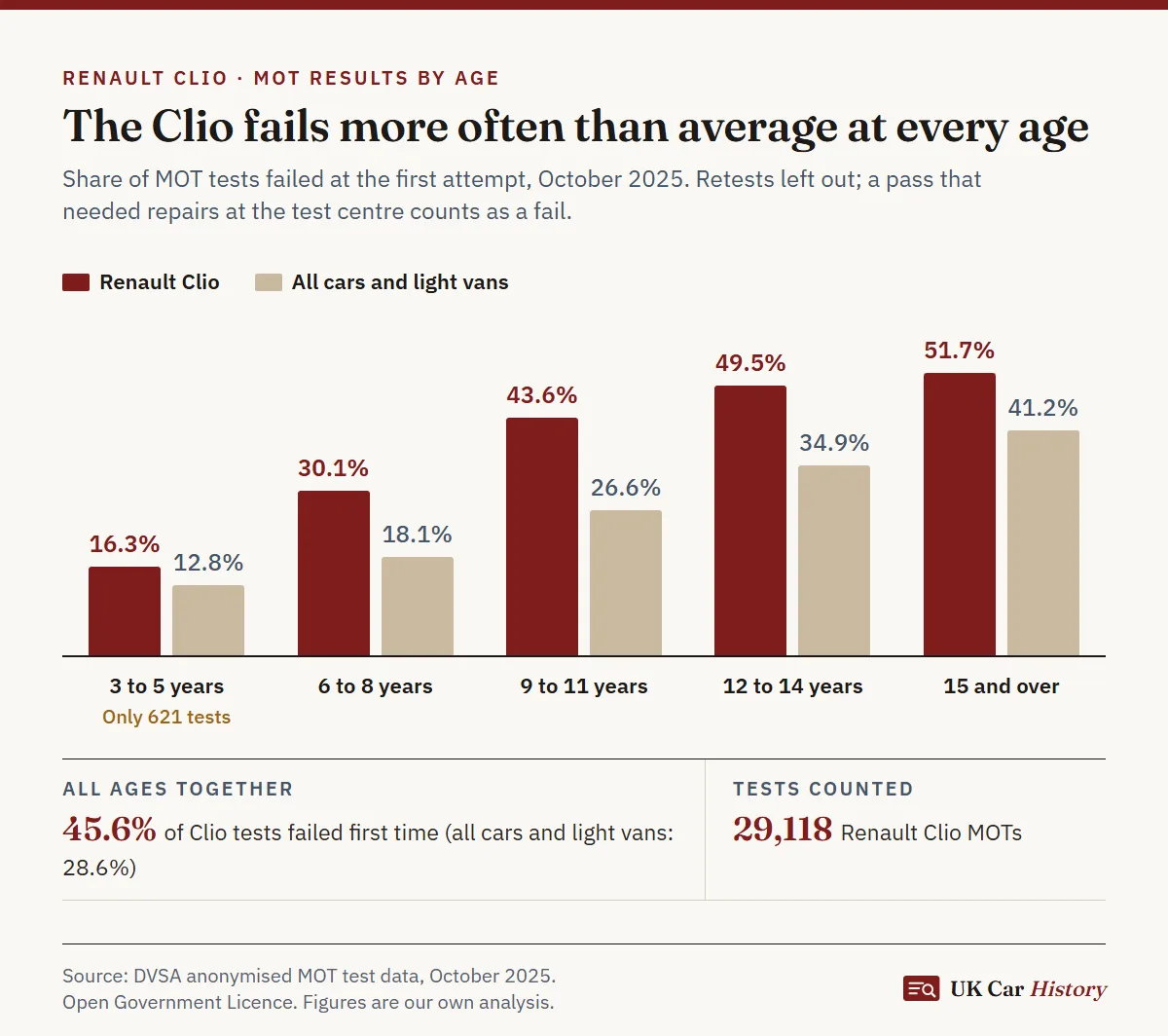
Partly, but not fully. The Clios tested were old on average: 11,706 of the 29,118 tests, more than in any other band, were on cars of 15 or more. Yet compared only with cars of the same age, the Clio still failed more often in every band.
Among Clios aged 3 to 5, 16.3% failed first time, where all cars and light vans of that age managed 12.8%; that group is small, at 621 tests, so treat its figure with the most caution. At 6 to 8 years the Clio rate was 30.1% (national: 18.1%), from 3,743 tests. The biggest gap came at 9 to 11, with 43.6% of 6,915 Clios failing against 26.6% nationally. At 12 to 14 the figures were 49.5% from 6,023 tests (34.9%), and at 15 and over 51.7% (41.2%).
Two rules shape every figure here: only first attempts count, with retests set aside, and a car that passed only after repairs at the test centre is treated the same as one that failed. Our guide to the most common MOT failures gives the method in full and compares all 14 models.
Is high mileage behind the Clio's record?
No: the Clios tested had covered fewer miles than average at every age, so hard use is not the reason.
- Aged 3 to 5: 33,950 miles on average for a Clio, against 38,187 for all cars and light vans.
- Aged 6 to 8: 46,907, against 55,582.
- Aged 9 to 11: 66,932, against 76,786.
- Aged 12 to 14: 82,143, against 93,592.
- Aged 15 and over: 88,941, against 108,155.
Petrol cars made up 78.6% of the Clio tests and diesels 21.4%. The oldest Clio tested dated from 1992 and the newest from 2023; 2014 was the commonest year of first registration, ahead of 2015 and 2010. Cars the data records as a Clio Iconic TCe or a Clio RS Line TCe count too.
MOT results describe how each car was on the day of its test, after years of use and maintenance by many owners. They show how often Clios failed, not why, and they are no verdict on how the car was built.
Where on a Clio do the failures come from?
Sorted by area, the Clio's failure items look much like any car's, with a few differences (all cars and light vans in brackets):
- Above the average: lights, reflectors and electrics 26.9% (24.9%), suspension 23.9% (21.4%) and steering 5.4% (3.7%).
- About level: brakes 14.9% (14.8%), visibility 7.6% (7.3%), and body, chassis and structure 6.4% (6.4%).
- Below the average: tyres 9.1% (12.6%), and noise, emissions and leaks 3.3% (5.9%).
What marks the Clio out, then, is the rate rather than the type of fault. Its list reads like any car's, only it fills up faster.
What should a Clio buyer know about coil springs?
They carry the car's weight at each corner, and a failed one is the Clio's most frequent item, 8.5% of all its failure items. In the DVSA's list of defects, the item covers a spring that has snapped and one that rust or wear has seriously weakened. Both are major defects, so either fails the test.
Rust often shows first as an advisory. "Coil spring: corroded" was the Clio's fifth most frequent advisory, 4.2% of the total, and it is the stage before a spring weakened by rust fails outright.
You cannot always spot a snapped spring from outside the car. Clues are a corner that sits lower than its neighbours, or a knock from that corner over bumps. Where a Clio's record mentions a spring, either as an advisory or a fail, find out which springs were changed and when, and ask to see the bill.
How do Clio joints, lamps and boots fail the test?
- Joints. Excessive wear fails a suspension ball joint (7.0%). Each front wheel is steered through a track rod end (4.0%), a ball joint at the outer end of the linkage; wear or free play there fails too, and from the driver's seat it can feel like a knock or a vague, wandering steer.
- Headlamp aim (6.3%). Testers set beam-setting equipment in front of each headlamp. They may correct the aim slightly as part of the test, but they may not carry out repairs.
- Lamps that do not light. Position lamps (5.4%), stop lamps (3.4%) and headlamps (2.6%) fail when missing or dead, and a lamp built from several light sources fails once more than half are out. A single brake light out is a major defect; every brake light out is dangerous.
- Washers (4.3%). They must supply enough fluid for the wipers to clear the screen, so even an empty reservoir can lead to a major defect.
- Drive shaft boots (4.2%). The rubber cover over the constant velocity joint at each end of a drive shaft fails when it is missing, split or loose enough to let dirt in.
- Brake pipes (2.4%). The manual accepts that a metal pipe whose wall has lost a third of its thickness to corrosion or damage is bad enough to fail.
Which advisories should worry a Clio buyer?
An advisory records a part that passed while showing wear or rust. The table lists the Clio's most frequent next to the fail each one can turn into:
| Advisory | Share of Clio advisories | What it can become |
|---|---|---|
| Tread close to the limit, or worn on one edge | 16.5% | Tread under 1.6mm, graded dangerous |
| Tyre slightly damaged, cracking or perishing | 10.1% | A seriously damaged tyre |
| Brake pipes corroded, or hidden under grease or other material | 8.8% | A pipe damaged or excessively corroded, a major defect |
| Discs with wear, pitting or scoring | 8.4% | A disc significantly and obviously worn |
| Coil spring corroded | 4.2% | A spring seriously weakened, the Clio's top fail |
| Engine oil leak, not excessive | 4.0% | A fail once it leaves a pool over 75mm across within five minutes |
| Brake pads wearing thin | 3.4% | A pad under 1.5mm, a dangerous defect |
| Road wheel slightly distorted | 3.0% | A badly distorted wheel, a major defect |
| Ball joint with slight play | 2.9% | An excessively worn joint |
| Suspension pin or bush worn, without excessive movement | 2.4% | Excessive wear |
| Brake binding, not excessively | 2.3% | A binding brake, a major defect |
| Track rod end with slight play | 2.1% | Excessive wear or free play |
The ones to press the seller on are the springs, the brake pipes and the joints, because each is also among the model's most frequent fails. An advisory that turns up at test after test has usually been left alone. For the difference between an advisory and a minor, major or dangerous defect, see our guide to MOT advisories.
How should you view a used Renault Clio?
- Before the viewing, read the car's full MOT history; the free look-up at the foot of this page brings up every test from the registration alone. Underline each entry for the springs, the steering and suspension joints, the brake pipes and the lamps, and see which advisories repeat from one year to the next.
- When you get there, walk round the parked car on a flat surface and compare how high each corner sits: if one is lower, suspect a spring.
- Kneel by each wheel with a torch. Look up at the coil spring for a break or heavy rust, then behind the front wheels at the drive shaft boots for splits or flung grease.
- Turn the steering from lock to lock, then drive slowly on full lock, listening for knocks or clicks from worn steering or drive shaft joints.
- Ask a helper to watch from outside as you switch on each lamp in turn, front and rear, then press the brake pedal and work the indicators.
- Test the wipers with a squirt of washer fluid. Then go round the tyres, checking the tread across the full width and the sidewalls for cracks, cuts and bulges.
- If the history advises on corroded brake pipes, ask whether they have been renewed; the pipes run underneath and are hard to judge without a ramp, so an inspection may be worth paying for.
Before you settle on a price, ask about any spring, joint or brake pipe advisory in the history: those parts also sit high on the Clio's list of failures.
For the full viewing routine, paperwork and interior included, use our used car checklist.
The test drive checklist lists what else to listen and feel for once you are moving.
What will the MOT history not show about a Clio?
Recalls run separately from the MOT. The manufacturer carries out the work, and GOV.UK says owners do not usually pay for the repairs or parts. On the free look-up the recall line reads Outstanding, All fixed, None found or Not available, as reported by the DVSA, and GOV.UK offers a recall check of its own. Settle any outstanding recall with the seller before money changes hands.
The MOT also leaves the engine, clutch and gearbox unexamined, as GOV.UK makes clear, so a test drive and the service record still matter. Nor does an MOT history mention finance owed on the car, an insurance write-off or a stolen marker. A full car check by registration covers them.
Should a high fail rate put you off a Clio?
Not on its own, but it means checking closely. No other model of the 14 had a higher overall rate, and in no age band did the Clio do as well as the average. Those results reflect wear, corrosion and upkeep on the day of each test, so take them as a reason to read the history line by line, not as a verdict on the design.
Springs, joints, lamps and washers can all be replaced, and you can ask about every one of them. A Clio whose recent tests show those parts dealt with, and no advisory carried from year to year, is a very different buy from one that collects the same warnings at every test.
Questions and answers
Does the Clio have the worst MOT record of the models compared?
Yes, among the 14 models we compared: 45.6% of Clio tests in October 2025 failed at the first attempt, against 28.6% for all cars and light vans. The age of the cars is part of the reason, but not all of it.
Are young Clios also above average?
Yes. Of Clios aged 3 to 5, 16.3% failed first time, while the rate for all cars and light vans that age was 12.8%. With only 621 tests behind it, that is the shakiest of the five figures.
What does a coil spring failure mean on a Clio?
The tester found a spring that had broken, or one so weakened by rust or wear that it no longer does its job safely. That is a major defect, and it made up 8.5% of all Clio failure items.
What is a drive shaft boot, and when does it fail?
It is the flexible rubber cover over the constant velocity joint at the end of a drive shaft. The MOT fails it when it is missing, split or insecure enough to let dirt in; a merely perished boot is a minor defect.
Do petrol and diesel Clios both count in these figures?
Yes, every Clio recorded in the data is included, whatever its fuel. Petrol cars made up 78.6% of the tests and diesels 21.4%.
Where can I see one Clio's MOT failures?
Look it up by registration. Our free look-up and the government's MOT history service both list each test with the failures, advisories and mileage the tester recorded.
Sources
- DVSA open data: anonymised MOT tests and results
- GOV.UK (DVSA): MOT inspection manual for cars and passenger vehicles
- GOV.UK (DVSA): MOT inspection manual, section 5 (springs and suspension joints)
- GOV.UK (DVSA): MOT inspection manual, section 4 (lamps)
- GOV.UK: Getting an MOT (what the test does not cover)
- GOV.UK: Check if a vehicle, part or accessory has been recalled
This guide is general information for people buying or owning a car in the UK, not legal or financial advice. UK Car History is an independent service, not affiliated with the DVLA, the DVSA or GOV.UK.