The short answer
The Vauxhall Corsa common problems that testers record most are coil springs that have snapped or weakened, rubber gaiters and joint covers on the steering that no longer keep dirt out, headlamps aimed wrongly and other lamp faults, and washers that do not work. In October 2025, 38.0% of Corsas failed first time against 28.6% of all cars and light vans, and they did worse than average at every age.
Those figures come from our analysis of the DVSA's anonymised MOT data for that month, 80,279 Corsa tests. They describe each car's condition on the day it was tested, not breakdowns. This guide takes the faults one area at a time, sets the Corsa against cars of its own age and mileage, and ends with the checks worth making when buying a used Vauxhall Corsa.
Which items fail Corsas most often?
A failed test can carry several failure items, and those put right at the test centre during the test count too. The Corsa's twelve most frequent, with the number recorded in the month and their share of all its failure items:
| Failure item | Times recorded | Share of Corsa fails |
|---|---|---|
| Coil spring broken or badly weakened | 5,995 | 8.3% |
| Gaiter or dust cover on the steering split or missing | 5,338 | 7.3% |
| Headlamp aimed outside the limits | 4,280 | 5.9% |
| Washers dry or not working | 3,472 | 4.8% |
| Brake light not working | 3,242 | 4.5% |
| Not enough tread | 2,441 | 3.4% |
| Tyre badly damaged | 2,435 | 3.4% |
| Engine management light reporting a fault | 2,381 | 3.3% |
| Front sidelight or rear light out | 2,378 | 3.3% |
| Headlamp not working | 2,375 | 3.3% |
| Shock absorber failed or leaking heavily | 2,204 | 3.0% |
| Wiper blade worn out or missing | 2,080 | 2.9% |
About one Corsa failure item in twelve is a spring. Lamps of one kind or another fill four places, the wipers and washers two, and tyres two. Most of the list is routine wear, which is why the history of the car you are viewing matters more than the model's headline rate.
Is a Corsa worse at the MOT than other cars its age?
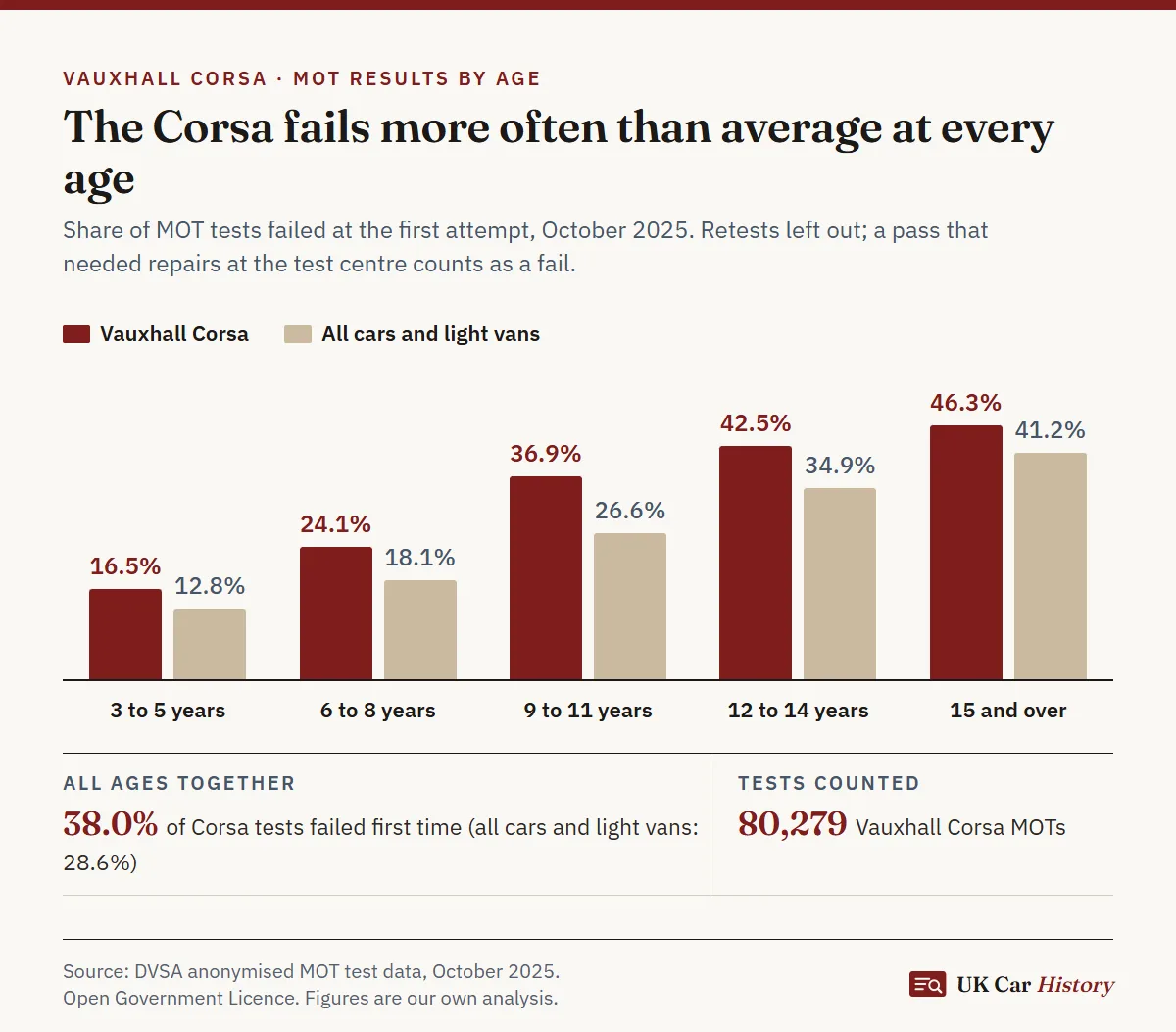
Yes, in every age band, from the first MOTs on. At 3 to 5 years, 16.5% of Corsas failed first time against 12.8% of all vehicles that age; at 6 to 8, the Corsa's 24.1% compared with 18.1%.
The gap was widest in the 9 to 11 band: 36.9% of Corsas there failed first time, where the national rate was 26.6%. It stayed open after that, with 42.5% against 34.9% at 12 to 14 and 46.3% against 41.2% at 15 and over.
Most of the tests were on older cars. Corsas of 15 or more accounted for 23,202 of the 80,279 tests and those of 9 to 11 for 21,890; cars first registered in 2015 were the most numerous, then 2014 and 2016.
How we counted: retests were dropped, so each MOT appears once at its first attempt, and a Corsa that only passed once the test centre had repaired it was scored as a fail. The full method, with the Corsa beside 13 other popular models, is in our guide to the most common MOT failures.
Why does steering take so much of the Corsa's failures?
The answer is rubber. A concertina-shaped gaiter protects each end of the steering rack, and every steering ball joint wears a small dust cover; both are there to keep grit and water away from moving parts. When testers found one missing or no longer sealing, the car failed, 5,338 times in the month, second only to springs. A gaiter that is merely cracked or perished goes down as a minor defect, which does not fail.
That single item lifts steering to 9.3% of all Corsa failure items, compared with 3.7% for cars and light vans as a whole. The other areas, with the national share in brackets: lamps, reflectors and electrics 25.9% (24.9%), suspension 21.3% (21.4%), brakes 11.4% (14.8%), tyres 9.5% (12.6%), visibility 8.1% (7.3%), noise, emissions and leaks 7.1% (5.9%), and body, chassis and structure 5.6% (6.4%).
A share describes the mix within the Corsa's own failures. Brakes and tyres look modest at 11.4% and 9.5%, but that does not make a Corsa's brakes or tyres more durable than anyone else's.
What should you know about Corsa springs and shock absorbers?
Springs head the Corsa's list at 8.3% of its failure items. A spring counts as a major defect once it has snapped or been seriously weakened. There is a second check while the car is on the jack: as it comes down, each spring should seat itself properly, or it is failed for being insecurely attached. Breaks are not always visible from outside, although a corner sitting lower than the others is one possible clue.
Rust on a spring does not fail it on its own, but it is the warning to notice: "Coil spring: corroded" was recorded 6,531 times, 5.1% of Corsa advisories.
Testers fail a shock absorber when it has stopped working or leaks heavily, and on Corsas that happened 2,204 times, eleventh on the list. A damper that is merely misted with oil passes: the manual tells testers not to reject slight seepage, even where it leaves a film of fluid. Misting was noted 7,476 times (5.8% of advisories), an early warning rather than a fail.
Advisories point to wear and rust elsewhere in the suspension too: worn pins and bushes that do not yet move too much (5,853, 4.5%), and rust that has not seriously weakened the sub-frame (5,130, 4.0%) or the suspension arms (3,162, 2.5%).
Which lamp, washer and wiper faults catch Corsas out?
Taken together, lamps are where Corsas fail most. Four items share the total:
- Headlamp aim: 4,280 fails, 5.9% of all Corsa failure items.
- Brake lights: 3,242 (4.5%).
- Sidelights and rear lights: 2,378 (3.3%).
- Headlamps not lit: 2,375 (3.3%).
The tester measures aim with beam-setting equipment, may nudge it during the test, and fails a beam that lands outside the limits as a major defect. Dazzling lights also break the Highway Code, which says they must be properly adjusted. Since 1971, cars have had to carry two brake lights, one per side: losing one is a major defect, losing all of them is dangerous.
Washers came fourth on the list, with 3,472 fails (4.8%), and wiper blades a little lower, with 2,080 (2.9%). The washers have to supply the wipers with enough fluid to clear the glass, so a dry reservoir alone can fail the car.
Does a Corsa fail on its engine light, oil or exhaust?
Sometimes. The engine malfunction indicator lamp, the engine management light, was found showing a fault 2,381 times (3.3% of failure items). The tester turns on the ignition and expects the lamp to light and then go out; on some models it stays lit until the engine is running. A lamp that stays on, or never comes on, is a major defect, checked on petrol cars from 1 July 2003 and diesels from 1 July 2008, by date of first use.
GOV.UK points out that the MOT does not look at the condition of the engine, clutch or gearbox. Where a Corsa's history includes an engine lamp fail, ask the seller what had caused it and what was done.
Oil leaks were the Corsa's third most frequent advisory, a leak "but not excessive" noted 9,553 times (7.4%). The manual judges a leak with the engine idling and fails it only when it leaves a pool wider than 75mm within five minutes. Exhausts with a small leak drew 4,184 advisories (3.3%).
What do Corsa tyre advisories tell you?
That the tyres need watching. Tread "worn close to legal limit/worn on edge" made up 15.7% of all Corsa advisories, the largest share, and "slightly damaged/cracking or perishing" 12.7%.
When the tyres do fail, the two causes are almost level: tread below the legal limit, the sixth most frequent item (2,441, 3.4%), and a tyre seriously damaged (2,435, 3.4%). In the manual, a cut deep enough to expose the cords is major, while a bulge, lump or tear caused by the carcass failing is dangerous.
Are Corsas high-mileage cars?
Far from it. At every age the Corsas tested had covered fewer miles than the average car or light van, and the shortfall grew with age:
| Age at the test | Corsa average | All cars and light vans |
|---|---|---|
| 3 to 5 years | 33,001 | 38,187 |
| 6 to 8 years | 44,708 | 55,582 |
| 9 to 11 years | 65,273 | 76,786 |
| 12 to 14 years | 78,818 | 93,592 |
| 15 years and over | 86,641 | 108,155 |
Hard use, then, is not behind the Corsa's record: it fails more often at every age while covering less ground. Petrol cars made up 92.7% of the Corsas tested and diesels 7.3%. For one car's own readings, test by test, see how our mileage history check page reads them.
How to check a used Vauxhall Corsa before you buy
- Start with the record. The free look-up at the foot of this page brings up each test's fails and advisories; list every mention of springs, gaiters, shock absorbers, the engine lamp, oil and tyres.
- At the viewing, park on the flat and look at the car's stance: it should sit square, with no corner lower than the rest.
- Lock the steering fully one way and use a torch on the rubber gaiters at the rack ends and the boots on the drive shafts. A torn or missing one would fail the next MOT.
- Do the bounce test: push down firmly on one corner at a time and let go. According to the Highway Code, a car that goes on bouncing has worn shock absorbers.
- Switch on the ignition before starting. The engine lamp ought to light briefly and switch off once the engine is running; ask about any lamp that stays on before you discuss a price.
- Inspect the tyres for tread depth across their width and for cracking in the sidewalls, the two tyre advisories that appear most on Corsas.
- Check the ground under the engine for fresh drips, then have a helper watch the lamps as you work them, and try the wipers and washers.
The rest of the viewing, paperwork included, is laid out in our used car checklist.
For the drive itself, use the test drive checklist.
Should a used Corsa be on your list?
The numbers are not kind to the Corsa. It trails the average in every age band, the youngest included, and does so while covering fewer miles than other cars.
Look at what fails, though, and it is mostly maintenance: worn springs and dampers, perished rubber, blown bulbs, lamp aim, washer fluid and wiper blades. If a Corsa's record shows such faults being fixed quickly, the model's average need not put you off. Give the service book and the test drive equal weight with the MOT record, and when something leaves you unsure, have the car inspected independently before you buy.
A safety recall is the manufacturer's job, and GOV.UK says owners will not usually pay for the repair or parts. The free look-up shows the DVSA's recall status for the car, and GOV.UK has its own recall checker; if a recall is still open, get it done before the money changes hands. Finally, finance still owed, a write-off and a theft record never appear in an MOT history, so run a full car check on the registration as well.
Questions and answers
Which part fails most on a Vauxhall Corsa?
The coil springs. In October 2025, testers failed 5,995 Corsa springs as fractured or seriously weakened, 8.3% of all its failure items, and noted corrosion on springs in another 6,531 advisories.
Why would a split gaiter fail a Corsa's MOT?
The gaiter keeps dirt out of the steering joint inside it. Once it is missing or no longer seals, the manual treats it as a major defect, which fails; a gaiter that is only cracked or perished is a minor defect. Corsas failed on this 5,338 times in the month.
Does the engine management light have to be off for a Corsa to pass?
It must not be reporting a fault on a car the check covers, meaning petrol Corsas first used since July 2003 and diesels since July 2008. A lamp that never lights up at all is also a major defect.
Are young Corsas any better at the MOT?
Better than old Corsas, but still worse than average. Of Corsas aged 3 to 5, 16.5% failed first time in October 2025, when the rate for all vehicles of that age was 12.8%.
Do Corsas usually have low mileage?
Yes, for their age. Those aged 12 to 14, for example, showed an average of 78,818 miles at their October 2025 test, while the figure for every car and light van of that age was 93,592.
Can a shock absorber with oil misting pass the MOT?
Yes. Slight seepage is accepted, so misting is written down as an advisory and the car passes. The damper fails only once it stops working or shows severe leakage.
Sources
This guide is general information for people buying or owning a car in the UK, not legal or financial advice. UK Car History is an independent service, not affiliated with the DVLA, the DVSA or GOV.UK.