The short answer
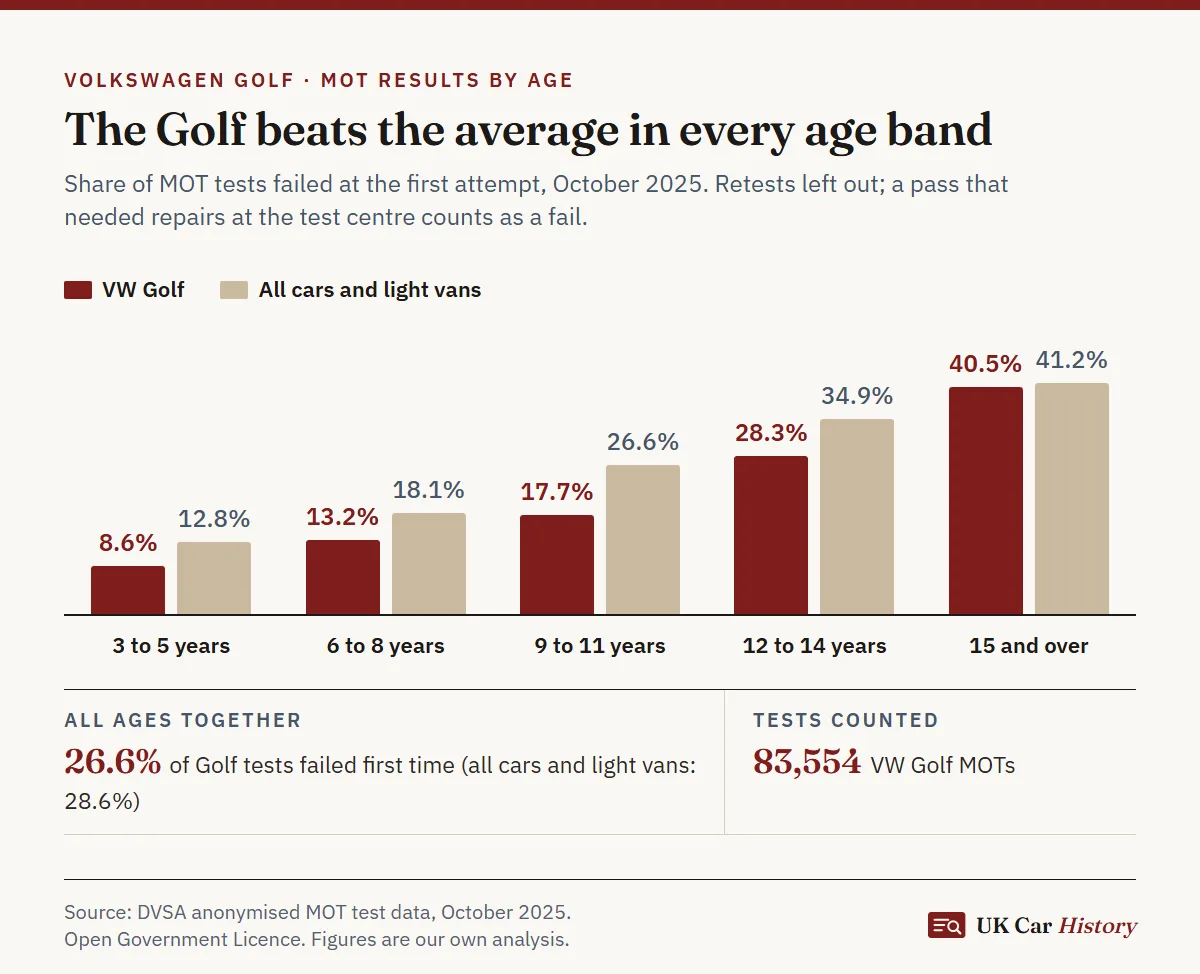
In the MOT results for Golfs, the suspension supplies most of the VW Golf common problems: springs that snap, dampers that give up and rubber covers on the joints that split, with tired or damaged tyres next. Headlamp aim is the single most frequent fail. Golfs still beat the average: 26.6% failed first time in October 2025 against 28.6% of all cars and light vans, and the Golf was ahead in every age band.
We took those figures from the DVSA's own anonymised test results, 83,554 Golf MOTs, not from owners' stories. Trims the data names separately, such as Golf Life and Golf Style, are included; the Golf Plus and Golf SV are not. Read on for the faults and how testers judge them, what age and mileage do to the picture, and how to judge a car when buying a used VW Golf.
Which faults fail VW Golfs most often?
A failed MOT records each fault as a failure item, faults fixed at the test centre during the test included. By part of the car, the Golf's ten most frequent items were (each as a share of all its failure items):
- Lamps: headlamp aim outside the limits, 6.2%, the top single item.
- Suspension: a coil spring snapped or badly weakened, 5.7%; a shock absorber that no longer works or leaks severely, 4.3%; a split or missing dust cover on an anti-roll bar link joint, 3.6%.
- Tyres: too little tread, 5.0%; serious damage, 4.4%; cords showing or damaged, 3.3%.
- Transmission: a constant velocity joint boot on a drive or prop shaft missing, split or insecure, 3.4%.
- Engine: the engine warning light on and showing a fault, 3.1%.
- Brakes: a pad worn below 1.5mm, 3.0%.
Worn suspension pins and bushes missed the ten narrowly, at 2.8%. Put the springs, dampers, covers and boots together and the parts that carry and steer the car dominate the list; add three tyre items and you have most of what a Golf buyer needs to look at.
How does a Golf compare with cars of the same age?
It does better in every band. At 3 to 5 years old, 8.6% of Golfs failed first time; the national figure was 12.8%. At 6 to 8 it was 13.2% against 18.1%, and the widest lead came at 9 to 11, where 17.7% of Golfs failed while 26.6% of all cars and light vans did.
The lead shrinks with age. At 12 to 14 the Golf managed 28.3% against 34.9%, and by 15 and over the two were almost level, at 40.5% and 41.2%. Old Golfs are plentiful, too: of the 83,554 tests, 29,458 were on cars of 15 or more. Golfs first registered in 2017 were the most numerous, ahead of 2015 and 2014.
Each MOT counts once, at its first attempt, so the figures show cars as they arrived; a Golf that only passed after the test centre fixed it is scored as a fail. For the method, and the same figures for 13 other models, see our guide to the most common MOT failures.
Golfs cover big miles: does that matter?
Less than you might think. Young Golfs are close to the average: 36,626 miles at 3 to 5 years against 38,187 for all cars and light vans, and 55,449 against 55,582 at 6 to 8. From nine years they pull ahead, with 79,632 against 76,786 at 9 to 11, then clearly at 12 to 14 (103,635 against 93,592) and at 15 and over (124,566 against 108,155).
Yet in each of those bands the Golf failed less often than average. A high reading on an older Golf is therefore normal rather than a red flag by itself. What counts is the trail: readings that climb steadily from one test to the next, matched by a service record. Our mileage history check page sets out how to read such a trail.
Petrol and diesel Golfs were tested in almost equal numbers, 50.2% and 47.1%; hybrids made up 2.6% and electric Golfs 0.1%.
Where on a Golf do the failures come from?
For cars and light vans in general, lamps produce the most failures. On the Golf the suspension takes that place, and by a clear margin. Rows go from the biggest gap above the average to the biggest gap below it:
| Area of the car | Golf | All cars and light vans | Golf share is |
|---|---|---|---|
| Suspension | 26.2% | 21.4% | Well above |
| Tyres | 13.8% | 12.6% | Above |
| Body, chassis, structure | 7.5% | 6.4% | Above |
| Noise, emissions and leaks | 6.7% | 5.9% | Above |
| Seat belts and other restraint systems | 2.2% | 1.5% | Above |
| Brakes | 14.9% | 14.8% | Level |
| Visibility | 5.7% | 7.3% | Below |
| Steering | 1.8% | 3.7% | Below |
| Lights, reflectors and electrics | 19.6% | 24.9% | Well below |
The shares describe what a Golf fails on when it fails, faults put right at the test centre included, not how often. Golfs fail less often overall, so the big suspension slice is a large part of a smaller whole.
How do testers judge Golf springs, dampers and rubber covers?
Coil springs, failed 3,051 times in the month, were the Golf's leading suspension item and second only to headlamp aim overall. A spring fails when it has broken, or when wear or rust has left it seriously weakened.
A shock absorber fails when it is damaged so that it does not work, leaks severely or shows negligible damping. Slight seepage that leaves a film of fluid is not a reason to fail, which explains why "has light misting of oil" is so common on Golfs: 10.4% of all their advisories, behind only tyre tread.
The ball joints of the suspension, those on the anti-roll bar links among them, and the constant velocity joints on the drive shafts all sit inside rubber covers and boots. A cover that has badly perished is a minor defect; once it is missing, split or no longer keeps dirt out, the defect is major and the car fails.
Excessive wear fails a pin or bush. Some rubber bushes are designed to give, so a tester only rejects one when the rubber or its bond has seriously deteriorated. Bushes worn short of that point were the Golf's third most frequent advisory, 8.4%.
How are headlamp aim and the engine light tested?
Headlamp aim heads the Golf's list at 6.2%. The tester sets aiming equipment against each dipped-beam headlamp. On a European-type lamp the beam has a sharp horizontal top edge, and that edge must fall between two lines a little below the horizontal. Too high, and the lamp dazzles oncoming drivers, which the Highway Code forbids; too low, and less of the road is lit. Testers may correct the aim slightly during the test, and an aim fault fixed that way is counted in these figures.
For the engine warning light, which made up 3.1% of failure items, the tester switches the ignition on and watches the lamp light up and then go out, in some cars once the engine is running. If it stays lit with a fault, or never works at all, the car fails, provided it is a petrol model first used in July 2003 or later, or a diesel first used in July 2008 or later.
Which Golf advisories point to a future fail?
An advisory flags a part that passed today but is heading towards a fail. Beyond the shock absorber misting and worn bushes above, the Golf's list runs as follows (shares of all its advisories):
| Advisory | Share of Golf advisories |
|---|---|
| Tread close to the legal limit, or worn on one edge | 17.4% |
| Tyre with slight damage, cracks or perished rubber | 8.3% |
| Discs worn, pitted or scored, short of seriously weakened | 8.1% |
| Brake pads wearing thin | 5.5% |
| Suspension arm corroded, not seriously weakened | 4.7% |
| Coil spring corroded | 3.8% |
| Sub-frame corroded, not seriously weakened | 3.5% |
The rust entries deserve attention. Section 5.3.3 of the inspection manual warns that some cars use thin pressed steel for highly stressed suspension parts, and that their hollow box sections and upward-facing surfaces can trap road dirt and salt, causing severe local corrosion. A suspension part fails once its damage or corrosion is excessive, so a corrosion advisory on a Golf is a reason to look underneath before you buy.
Our guide to MOT advisories explains how advisories relate to minor, major and dangerous defects.
Checklist for a used VW Golf
- Before you travel, bring up the car's MOT history with the free look-up at the foot of this page and note every suspension, tyre, brake or lamp entry in the last few tests.
- Flag any spring, damper, bush or anti-roll bar link entry from past tests. In person, check the car stands level; on the road, it should take bumps quietly and without a clunk.
- With a torch behind each front wheel, look for split rubber covers. Grease sprayed inside a wheel arch can mean a CV boot has torn.
- Read every tyre from edge to edge for tread depth, cuts and bulges. If one edge is far more worn than the other, ask about the suspension and the alignment.
- Rust advisories on the arms or sub-frames call for a look underneath, by you or a garage, before any price is agreed.
- Treat disc and pad advisories from the last test as costs to deduct from your offer.
- Finish with the lights: every lamp working, and an engine lamp that glows when the ignition goes on and then goes out.
The rest of the viewing, starting with the V5C logbook, is covered by our used car checklist.
Our test drive checklist covers the noises to listen for, from knocks over bumps to clicks on full lock.
What is the verdict on a used VW Golf?
A good one, as averages go. The data shows Golfs failing less often than the average car of every age, even though from nine years on they had done more miles. But a figure built from 83,554 tests cannot tell you how one particular Golf has been treated.
An MOT also has blind spots. It checks things like the brakes, tyres, suspension, lamps and emissions on the day, but GOV.UK says it does not cover the condition of the engine, clutch or gearbox. So the servicing record and a thorough drive deserve as much weight as the test results.
With an older Golf, plan for suspension work. That is the Golf's biggest failure area, so a car with fresh bills for springs, dampers, bushes or covers is worth more than one whose history still advises on them.
Safety recalls are handled outside the MOT altogether. GOV.UK says the manufacturer writes to the keeper about a serious safety defect, and that owners will not usually pay for the repair. Check the recall status on the free look-up, or with GOV.UK's checker, and ask the seller to have any open recall done before the sale. Finance still owed, a write-off and a stolen record will not show up in the MOT history or on a test drive: a full car check by registration looks for them in the Premium report, £7.99.
Questions and answers
Which single fault fails VW Golfs most?
Headlamp aim: 6.2% of all Golf failure items in October 2025, aim corrected at the test centre included. A broken or seriously weakened coil spring was next at 5.7%, then tread below the legal limit at 5.0%, while the suspension as a whole made up 26.2%.
Are Golfs better than average at the MOT?
They are, according to the October 2025 figures. Whatever the age band, a smaller share of Golfs failed first time than of all cars and light vans; the margin was greatest at 9 to 11 years and smallest at 15 and over.
What does light misting of oil on a shock absorber mean?
It is an advisory, and the car passes: oil has seeped onto the damper in a thin film, which the manual does not treat as a reason to fail. The damper fails only when it leaks severely, has been damaged so badly it no longer works, or barely damps at all.
What happens to a split CV boot at the MOT?
It fails. The boot is the rubber cover over a constant velocity joint on a drive or prop shaft, and if it is missing, split or insecure so that dirt can get in, the car fails; a boot that is badly perished but intact counts only as a minor defect.
Should I avoid a Golf with a high mileage?
Not on that alone. From nine years old the Golfs tested had more miles than the average car, yet in no age band did they fail more often than average. Its own history, servicing and condition tell you far more than the odometer.
Sources
- DVSA open data: anonymised MOT tests and results
- GOV.UK (DVSA): MOT inspection manual, section 5: axles, wheels, tyres and suspension
- GOV.UK (DVSA): MOT inspection manual, section 6: body, structure and attachments (transmission)
- GOV.UK (DVSA): MOT inspection manual, section 4: lamps, reflectors and electrical equipment
- GOV.UK: Getting an MOT (what the test covers)
- GOV.UK: Check if a vehicle, part or accessory has been recalled
This guide is general information for people buying or owning a car in the UK, not legal or financial advice. UK Car History is an independent service, not affiliated with the DVLA, the DVSA or GOV.UK.