The short answer
Most Honda Jazz common problems found at the MOT are small: a sidelight or rear light that has stopped working, a headlamp aimed wrongly, a tired wiper blade, worn brake pads and rust in the metal around the suspension mountings. The Jazz also does well at the test itself: up to 14 years old, it fails far less often than the average car of the same age.
These are the faults found on test day, not breakdowns or owners' complaints, and every figure comes from our own analysis of the DVSA's anonymised MOT results for October 2025, 31,950 Jazz tests in all. This guide reads them for a buyer: what fails, how age changes the picture, which advisories hint at the next bill, and the checks to make on the car you are about to see.
What fails most often on a Honda Jazz at the MOT?
Every fault that fails a car is logged as a failure item, faults fixed at the test centre during the test included, and one failed MOT can hold several. These twelve came up most on the Jazz, each shown as a share of all its failure items:
| Failure item | Share of Jazz failure items | What makes it a fail |
|---|---|---|
| Position lamp (front sidelight or rear light) | 8.6% | The lamp is missing or dark, or over half of its light sources are out |
| Headlamp aim | 6.9% | A dipped beam falls outside the limits on the aiming equipment |
| Wiper blade | 5.0% | Missing, or plainly not clearing the screen |
| Metal near a suspension mounting | 4.8% | Load-bearing structure within 30cm of a mounting weakened by rust, damage or a crack, or poorly repaired |
| Brake pad under 1.5mm | 4.1% | Graded dangerous in the inspection manual |
| Tyre seriously damaged | 3.9% | A cut down to the ply or cords, or a lump, bulge or tear |
| Windscreen washers | 3.5% | Dead, or squirting too little for the wipers to do their job |
| Handbrake efficiency | 3.2% | Below the minimum on the brake tester, 16% for most cars |
| Tread depth | 2.9% | Under 1.6mm across the central three-quarters of the tread |
| Dust cover on a linkage ball joint | 2.6% | Missing, or no longer keeping dirt out of the joint |
| Suspension pins and bushes | 2.4% | Worn past what the manual accepts |
| Number plate lamp | 2.3% | Out where it is the only lamp; with two or more, all of them must be out |
The sidelights and rear lights alone were failed 1,924 times in the month. Four items on the list, those lamps, the wiper blades, the washers and the number plate lamp, are things you can try for yourself in a minute at a viewing. The brakes, the tyres and the metal underneath need a closer look, and they are covered below.
Is a Honda Jazz less likely to fail than other cars its age?
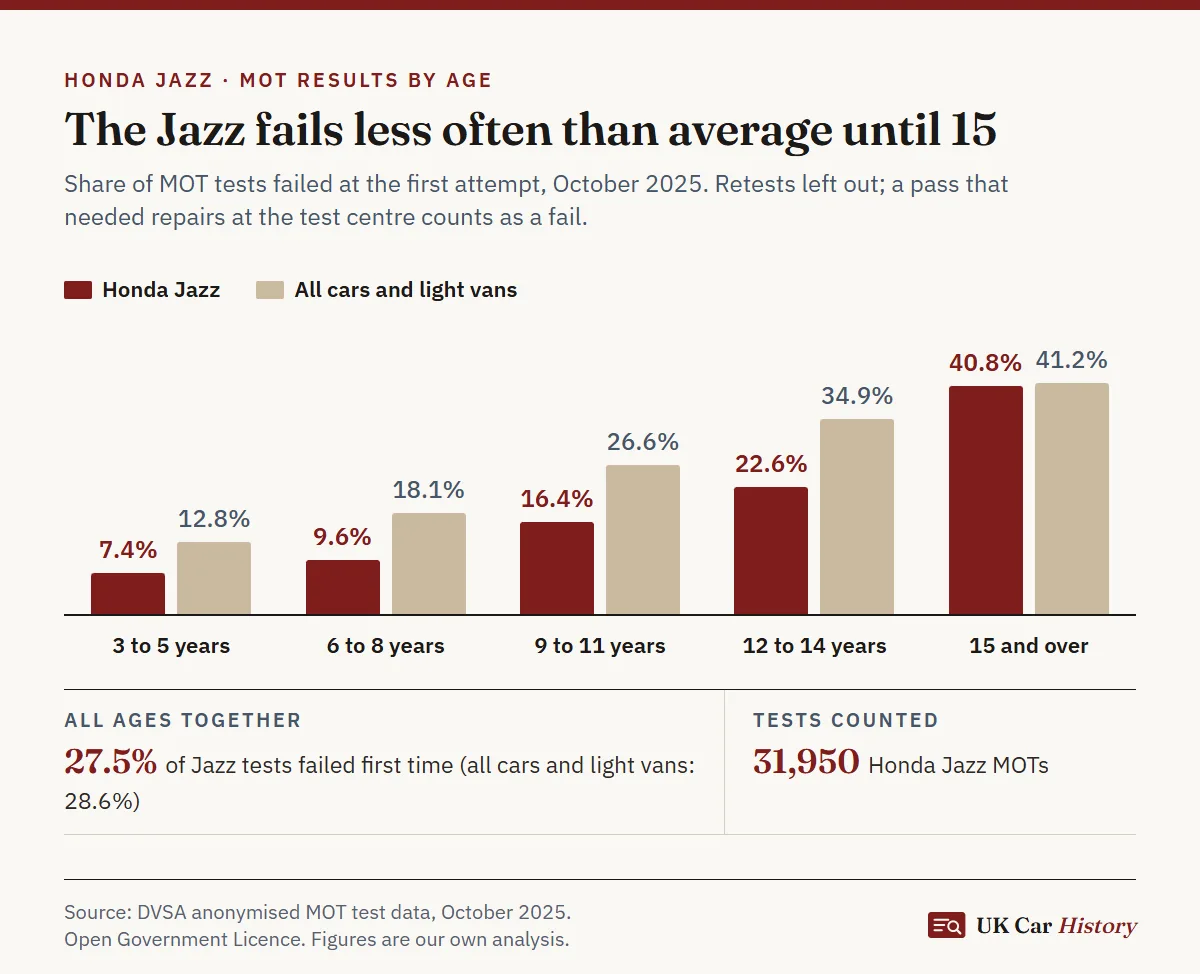
Yes, until it reaches 15. Set each Jazz against cars of the same age and its lead is wide: at 9 to 11 years old, 16.4% of Jazzes failed first time while 26.6% of all cars and light vans did, and at 12 to 14 the figures were 22.6% and 34.9%. The youngest group, at 3 to 5 years, failed 7.4% of the time against 12.8%, and those aged 6 to 8 managed 9.6% against 18.1%.
In the oldest band the two rates meet. Of the Jazzes aged 15 or over, 40.8% failed first time, against 41.2% for every car and light van that age.
How the rates were worked out: each MOT counts once, at its first attempt, with retests left aside, and a car that only passed once the test centre had repaired it is counted as a fail, since it arrived with a fault. Our guide to the most common MOT failures sets out the same method and puts 14 popular models side by side.
Why does the Jazz look only average across all ages?
Put every age together and most of the Jazz's advantage disappears: 27.5% of its tests failed first time, against 28.6% for all cars and light vans. The cause is the age of the cars in the test bays. Of the 31,950 Jazz MOTs, 14,888, nearly half, were on cars aged 15 or older, the band in which every model fails most, and the commonest years of first registration were 2009, 2011 and 2010.
Mileage tells a similar story. At each age the Jazzes tested had covered far fewer miles than the average car or light van:
| Age at the test | Average Jazz mileage | National average |
|---|---|---|
| 3 to 5 years | 23,542 | 38,187 |
| 6 to 8 years | 33,808 | 55,582 |
| 9 to 11 years | 46,826 | 76,786 |
| 12 to 14 years | 66,499 | 93,592 |
| 15 years and over | 88,281 | 108,155 |
A car that covers less ground puts less wear on its tyres, brakes and joints, and that may be one reason the Jazz scores well. Mileage does nothing to stop rust, though, and rust is where an old Jazz catches up. For the car you are viewing, its own trail of readings matters more than any average: our mileage history check page explains how to read them.
Where on the car do Jazz MOT failures come from?
Sort the failure items by area of the car and the Jazz departs from the average in a few clear places. The rows run from the area where the Jazz's share is furthest above the national one to the area where it is furthest below:
| Area of the car | Jazz | All cars and light vans | Jazz share is |
|---|---|---|---|
| Lamps, reflectors and electrics | 29.6% | 24.9% | Higher |
| Brakes | 19.1% | 14.8% | Higher |
| Visibility (mostly wipers and washers) | 9.0% | 7.3% | Higher |
| Noise, emissions and leaks | 5.5% | 5.9% | Slightly lower |
| Body, chassis and structure | 5.1% | 6.4% | Lower |
| Steering | 1.9% | 3.7% | Lower |
| Suspension | 18.3% | 21.4% | Lower |
| Tyres | 8.9% | 12.6% | Lower |
Shares describe the mix, not the frequency. They add up to one whole, so when lamps and brakes take bigger slices, tyres and suspension are left with smaller ones. A big brake slice on a car that fails less often overall means brakes are a larger part of what goes wrong when a Jazz does fail, not that its brakes give out more often than another car's.
Are brakes a Jazz weak point at the MOT?
They are the area where the Jazz stands furthest from the average after lamps, at 19.1% of its failure items against 14.8%. Two faults account for most of it:
- Pads under 1.5mm, 4.1% of failure items. The inspection manual counts this as a dangerous defect. A pad worn only as far as its wear indicator is already a major one, and where the indicator is a metal tab it squeals against the disc as a warning.
- A weak handbrake, 3.2%. On the brake tester, the parking brake of most cars has to reach an efficiency of at least 16%. Anything under that is graded major, and under half of it, dangerous.
The advisories show the brake work building up. Pads wearing thin made up 7.8% of the Jazz's advisories and discs worn, pitted or scored 7.5%. Metal brake pipes noted as corroded, or coated in grease or other material, accounted for 6.4%, slight corrosion on the metal end fittings of the flexible hoses, called ferrules, for 2.5%, and brakes binding slightly for 2.3%. Binding means the tester measured some braking effort at a wheel while the brake was off.
Of these, the pipe advisory is the one to chase. The manual lets a tester reject a metal brake pipe once chafing, corrosion or damage has taken about a third off its wall thickness, and the pipes run under the car, out of sight at an ordinary viewing.
What does rust under an older Jazz mean at the test?
The Jazz's fourth most frequent failure item, logged 1,085 times in the month (4.8%), is not a component but the metal around one. The manual calls this zone a prescribed area. On the suspension it takes in every piece of load-bearing structure up to 30cm from a sub-frame, spring or suspension mounting, and it fails when rust, damage or a fracture has seriously cut its strength, or when an earlier repair is not good enough.
Testers judge it by eye, then with finger and thumb pressure, and if needed by scraping or tapping lightly with a corrosion assessment tool. Rust that has made a hole, metal that does not feel firm, or a tool that goes through it all mean a fail.
The suspension parts themselves add two more items: a joint whose rubber dust cover has split or gone, letting dirt in (2.6%), and pins or bushes worn beyond the limit (2.4%). Rust that has begun without yet failing shows in the advisories, where testers noted corrosion on the coil springs (3.6%) and on the suspension arms (2.8%).
Which tyre and lamp advisories matter on a Jazz?
Low mileage does not protect tyres from damage. Serious damage to a tyre came sixth in the Jazz's list of failures, with 3.9% of the total; tread under the legal minimum came lower, with 2.9%. Under the manual, a cut that goes down to the ply or cords is a major defect, and a lump, bulge or tear where the tyre's structure is coming apart is a dangerous one.
On the advisory side, tread worn close to the limit made up 13.2% of the Jazz's advisories and slight damage, cracking or perishing 12.1%, the two largest entries. Lighting has two of its own. Some 3.7% of advisories were for a film or product on a headlamp lens that had not yet cut its output seriously, and 2.6% for number plates showing wear but still legible. A film that obviously dims the beam, or turns its light a colour other than white or yellow, is a fail.
An advisory passes, but it is the tester's note of what may fail next year. Our guide to MOT advisories explains how they sit beside minor, major and dangerous defects.
How should you check a used Honda Jazz before buying?
- Before you travel, type the registration into the free look-up at the foot of this page and read the last three or four MOT tests for the items above: lamps, wipers, brakes, brake pipes, corrosion near the suspension and tyres.
- At the car, switch on the sidelights, dipped beams and hazard lights and walk all the way round, number plate lamp included. Then run the wipers and the washers.
- Check both headlamp lenses: a cloudy coating, a film or a crack all count against the light.
- With a torch, follow the metal brake pipes along the underside, look for flaking rust around the sills, sub-frames and suspension mountings, and compare what you see with any corrosion advisories.
- Ask the seller when the pads were renewed, and peer through the wheel spokes at the brake discs.
- Run a tread gauge across every tyre, inner edge to outer, then check the sidewalls for splits, bulges and perished rubber.
- During the drive, pull up on a hill, release the footbrake and see whether the handbrake keeps the car still on its own.
A handbrake that cannot hold the car on a slope is worth a garage's opinion before you agree a price: a parking brake below the required efficiency is one of the Jazz's regular MOT failures.
For the paperwork, the bodywork and the rest of a viewing, work through our used car checklist.
The test drive checklist takes the brakes, steering and suspension one at a time once you are on the road.
Most Jazzes tested ran on petrol (90.1%) and 9.7% were hybrids, which this data does not give a fail rate of their own. A hybrid brings its own questions about the battery and the servicing, and our guide to buying a used hybrid goes through them.
What about recalls, and the records an MOT never shows?
Safety recalls are a separate matter from the MOT: the manufacturer runs them, and GOV.UK says owners will not usually have to pay for the repairs or parts. The free look-up shows the DVSA's recall status for the car beside its tests, and GOV.UK's recall checker works from the registration too, or from the make, model and year of manufacture. Ask for an open recall to be done by a Honda dealer before any money changes hands.
Some records never appear in an MOT history at all: finance still owed on the car, an insurance write-off and a theft report. A full car check by registration looks for all three, with the keepers and plate changes, in the Premium report (£7.99).
Should you buy a used Honda Jazz?
Judged on its MOT results, the Jazz gives a buyer little to worry about until it is old: up to 14 years it failed far less often than the average car of its age, and from 15 it was level. Some of that may come from its low mileage, and an MOT measures condition on the day, not reliability; GOV.UK points out that the test does not cover the engine, clutch or gearbox.
For a younger Jazz the numbers are firmly on your side. With an older car, use them as a map of what to inspect: every lamp and the wipers, the pads, discs and handbrake, the brake pipes underneath, and the metal that carries the suspension. Put a price on anything the advisories point to, and make your offer with it in mind.
Questions and answers
Which fault fails a Honda Jazz most often?
Lighting. The item testers logged most was a position lamp, meaning a front sidelight or a rear light, missing or not working. It made up 8.6% of everything the Jazz failed on that month, and a headlamp aimed outside the limits came next, at 6.9%.
Is the Honda Jazz good at passing its MOT?
For cars under 15, yes. In every age band to that point, far fewer Jazzes failed first time than cars and light vans in general, for example 16.4% against 26.6% at 9 to 11 years. From 15 years the Jazz and the average were level.
Should a weak handbrake on a Jazz worry me?
Get it looked at before you agree a price. A parking brake that falls short of the minimum efficiency is a major defect at the MOT, and it made up 3.2% of the Jazz's failure items.
Are hybrid Jazzes counted in these figures?
They are: 9.7% of the Jazz tests were on hybrids and 90.1% on petrol cars. The data has no separate fail rate for each fuel, so it cannot say whether the hybrids fail more or less often.
Does low mileage keep a Jazz free of rust?
No. Fewer miles mean less wear on tyres, brakes and joints, but they do not stop corrosion, and in the oldest band, 15 years and over, Jazzes failed about as often as the average car. Look underneath whatever the odometer reads.
How old were the Jazzes in these figures?
Mostly old. Of the 31,950 tests, 14,888 were on Jazzes aged 15 or more, and the years of first registration seen most often were 2009, 2011 and 2010.
Sources
- DVSA: Anonymised MOT tests and results (data.gov.uk, Open Government Licence)
- GOV.UK (DVSA): MOT inspection manual for cars and passenger vehicles
- GOV.UK (DVSA): MOT inspection manual, section 1: brakes
- GOV.UK (DVSA): MOT inspection manual, Appendix A: structural integrity and corrosion
- GOV.UK: Check if a vehicle, part or accessory has been recalled
- GOV.UK: Getting an MOT (what the test does not cover)
This guide is general information for people buying or owning a car in the UK, not legal or financial advice. UK Car History is an independent service, not affiliated with the DVLA, the DVSA or GOV.UK.