The short answer
Judging by what testers write down, the Toyota Yaris common problems are a dead sidelight or rear light, a headlamp pointing the wrong way, a broken coil spring, and wipers or washers that leave the screen smeared. Age for age it does well, beating the average car in every band up to 14; its all-ages rate, 29.1% against 28.6% for every car, is lifted by the many old Yarises still on the road.
The figures come from our analysis of the DVSA's anonymised MOT results for October 2025, 44,013 Yaris tests, and they show what testers found, not breakdowns. They do not include the Yaris Cross, which the data treats as a separate model. This guide covers the faults behind most fails, the age effect, the rust advisories on older cars, mileage and fuel, and what to look at when buying a used Toyota Yaris.
What do MOT testers fail on a Toyota Yaris?
Every fault that fails a test is a separate failure item, and those put right at the test centre during the test count as well. Here is the Yaris's top twelve in order, with each item's share of all its failure items:
| Failure item | Share of Yaris fails | When it fails |
|---|---|---|
| Position lamp | 7.2% | Front sidelight or rear light missing or dead, or over half of a multi-source lamp out |
| Headlamp aim | 6.4% | The beam lands outside the limits on the aiming screen |
| Coil spring | 5.2% | Fractured or seriously weakened |
| Wiper blade | 4.5% | Missing, or obviously leaving the screen uncleared |
| Windscreen washers | 4.1% | Not working, or unable to feed the wipers enough fluid |
| Tread depth | 4.0% | Any point of the central three-quarters under 1.6mm: dangerous |
| Stop lamp | 3.5% | One brake light dark is major; none working is dangerous |
| Number plate lamp | 3.4% | The only lamp out; where there are two or more, all of them out |
| Tyre seriously damaged | 3.3% | A cut to the ply or cords, or a bulge, lump or tear |
| Headlamp | 2.9% | Missing or dead, or an LED lamp with more than half its light sources out |
| Structure near a suspension mounting | 2.5% | Rust, damage or a fracture within 30cm of a mounting that seriously cuts its strength, or a poor repair |
| Suspension pins and bushes | 2.5% | Worn past the limit; a rubber bush only when the rubber or its bond has seriously deteriorated |
Position lamps alone were failed 2,192 times in the month. Five of the twelve concern lamps, and two more the wipers and washers, so a quick walk round with the lights on and a squirt of washer fluid covers much of the list before you even look underneath.
How does the Yaris do, age band by age band?
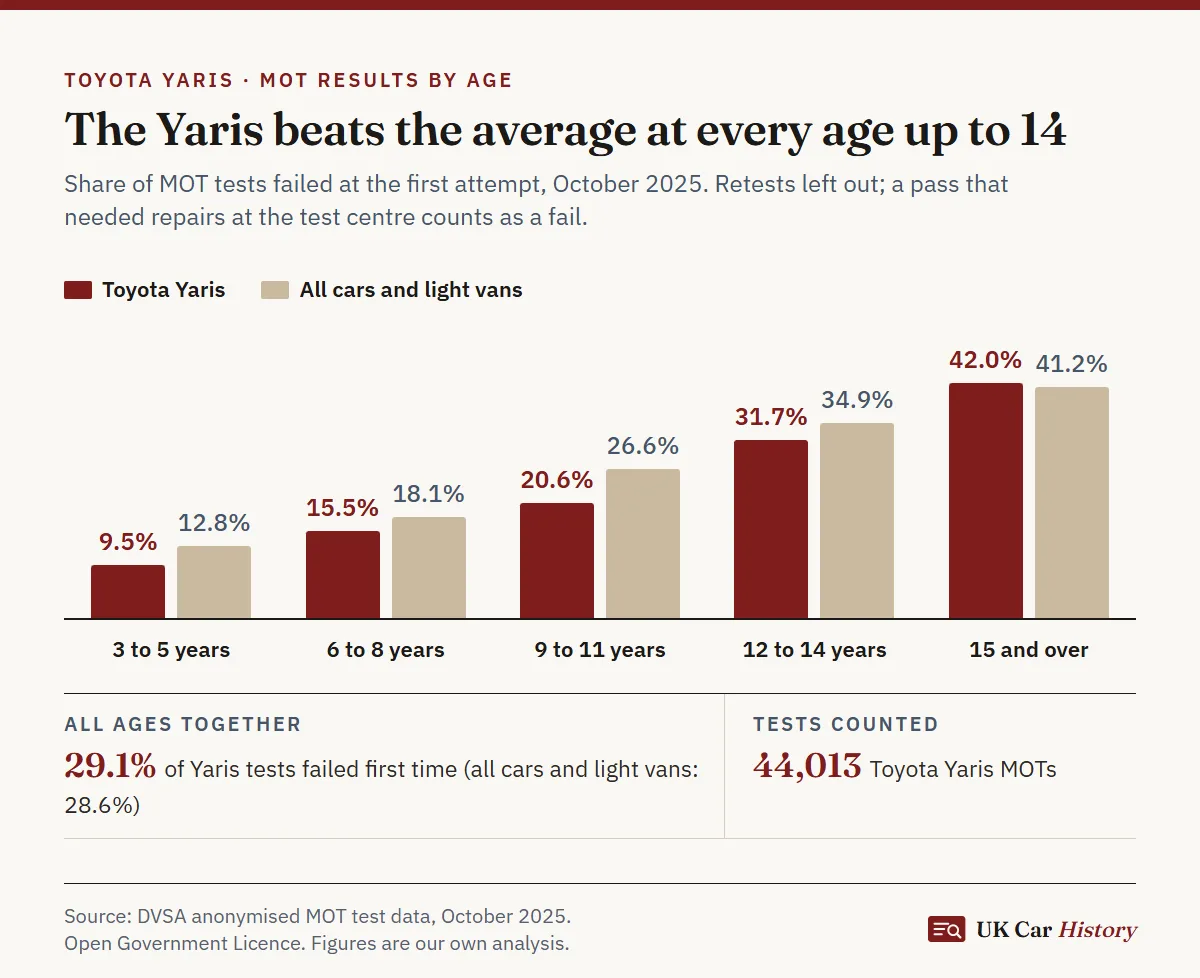
Favourably. Up to 14 years old the Yaris's first-time fail rate was lower in every band than the figure for all cars and light vans. At 3 to 5 years it was 9.5%, the national figure 12.8%; at 6 to 8, 15.5% and 18.1%. The gap peaked at 9 to 11 years, where 20.6% of Yarises failed against 26.6% of cars generally, and narrowed at 12 to 14, with 31.7% against 34.9%.
Only past 15 do the two come together, and even then the difference is tiny: 42.0% for the Yaris, 41.2% nationally.
We counted each MOT once, at its first attempt, leaving retests out, and treated a pass that needed repairs at the test centre as a fail. The same method across 14 models is set out in our guide to the most common MOT failures.
If the Yaris does so well, why is its overall rate 29.1%?
The answer lies in the age of the cars that came for testing. The largest single group, 16,917 of the 44,013 tests, was on Yarises aged 15 or more, the age at which every model fails most. A model with lots of old cars on the road carries a heavier headline rate than its age-for-age record deserves. Cars from 2015 were the most common, then 2013 and 2014.
For a buyer, the age-band figures are the ones to use. Set a Yaris beside other cars of the same age and it comes out ahead until its very oldest examples.
What does the lamp-heavy failure list mean for a Yaris?
Grouped by area, a third of the Yaris's failure items concern lamps and electrics. The shares, largest first, with all cars and light vans alongside:
| Area of the car | Yaris share | All cars and light vans |
|---|---|---|
| Lamps, reflectors and electrics | 33.1% | 24.9% |
| Suspension | 21.3% | 21.4% |
| Brakes | 13.2% | 14.8% |
| Tyres | 9.6% | 12.6% |
| Visibility | 9.3% | 7.3% |
| Body, chassis and structure | 5.5% | 6.4% |
| Noise, emissions and leaks | 5.0% | 5.9% |
| Steering | 0.6% | 3.7% |
Lamps and visibility (the wipers and washers) take more than their usual share, suspension is level with the average, and steering barely registers. The shares only describe how the Yaris's failures divide up, and a Yaris fails less often than average at most ages. A large lamp slice is therefore no evidence that its lights let it down more often than other cars' do.
Is rust a problem on older Yarises?
It is the theme running through the Yaris's advisories. Five of its twelve most frequent advisories are about corrosion, each shown here as a share of all Yaris advisories:
- Brake pipes rusting, or caked in grease or other material: 7.4%, the fourth most common advisory of all.
- Rust on the coil springs: 5.7%.
- Suspension arms rusting but still strong enough: 3.1%.
- Corrosion near a suspension mounting, short of excessive: 2.7%.
- Sub-frames rusting without serious weakening: 2.2%.
Each is a pass with a warning, but several point at failures already on the Yaris's list. A broken coil spring is its third most common fail, and the metal near the suspension mountings fails once rust has made a hole, the metal gives under finger and thumb, or the tester's corrosion tool goes through. For brake pipes, the manual treats a loss of about a third of the wall thickness as enough for a fail.
Rust matters most on load-bearing parts. The manual notes that a small amount there can make a car unsafe, while heavier rust on non-structural panels may have little or no effect on safety. Where a history shows rust advisories that return every year, or that keep spreading to new parts, pay for a look on a ramp before you decide.
Which other Yaris advisories are worth reading?
The rest of the top twelve covers tyres, brakes and a few small items (shares of all Yaris advisories):
- Tyres: tread close to the legal limit or worn on one edge, 13.6%, and slight damage, cracking or perishing, 10.8%, the two most frequent advisories overall.
- Suspension wear: pins or bushes worn without excessive movement, 7.6%.
- Brakes: discs worn, pitted or scored but not seriously weakened, 6.5%, and pads wearing thin, 3.0%.
- Plates and lenses: number plates worn but still readable, 2.9%, and some product on a headlamp lens that has not yet seriously reduced the light, 2.1%. Once a coating obviously dims the beam or changes its colour, it fails.
Our guide to MOT advisories explains the step from an advisory to a minor, major or dangerous defect.
How many miles has a typical used Yaris done, and on what fuel?
Fewer than most cars, often by a wide margin. Yarises aged 3 to 5 averaged 27,843 miles at the test, where all cars and light vans averaged 38,187. The pattern held at every age: 39,814 against 55,582 at 6 to 8 years, 57,708 against 76,786 at 9 to 11, 73,470 against 93,592 at 12 to 14, and 94,155 against 108,155 at 15 and over.
Two consequences follow. Less driving means less wear on tyres, brakes and suspension joints, which may help the Yaris's record. And it shifts what counts as high: a Yaris with the mileage usual for any car of its age has done more than most Yarises of that age. For the car in front of you, the readings at each test matter more than any average; our mileage history check page shows how to read them.
Petrol cars accounted for 66.8% of the tests. Hybrids came under two labels in the DVSA's records, 18.0% as hybrid (electric and petrol or diesel) and 10.3% as hybrid electric (clean), together more than a quarter of the total; diesels made up 4.9%. Whether hybrids fail more or less often than petrol Yarises the data cannot tell, as it gives no fail rate by fuel. A hybrid brings its own checks, from the battery to the service record, set out in our guide to buying a used hybrid.
Viewing a used Toyota Yaris: what to check, in order
- Read the MOT history before you go, using the free look-up at the foot of this page. Search it for coil springs, prescribed areas, brake pipes, sub-frames and suspension arms, and treat corrosion advisories from the latest test as costs to price in.
- Park the car on level ground and look along each side: a corner that sits lower than the rest may hide a broken spring.
- Get down with a torch and inspect what the advisories mention: the springs, the metal brake pipes and the metal around each suspension mounting.
- Light every lamp, from sidelights to headlamps and the plate lamp, and walk round; a helper on the brake pedal and the indicator stalk lets you see the rest.
- Look at both headlamp lenses for damage or a hazy coating, and check that the washers squirt and the wipers clear the glass without smearing.
- Check the tread across the full width of each tyre and look for cracks in the rubber, one of the Yaris's two most frequent advisories.
Only two items fail a Yaris more often than a broken coil spring: dead lamps and headlamp aim. If one corner knocks over bumps or sits lower than the others, get a garage's view before you buy.
For the paperwork and the rest of the viewing, from the V5C to the engine bay, use our used car checklist.
Our test drive checklist lists the noises and the pulls to notice once you are driving.
Should a used Toyota Yaris be on your shortlist?
On MOT results, yes, with your eyes open. Its record beats the average car's in each age band to 14, and matches it beyond. Low mileage may help explain that. What the data cannot do is speak to breakdowns or to how well the car was made: it records what testers found on the day, and GOV.UK points out that the MOT does not cover the engine, clutch or gearbox.
The figures describe the model, not the car you are looking at, and many Yarises for sale are old. On those, the individual record matters most: read the rust and spring advisories, look underneath, and take any work into account in your offer.
Recalls follow a different route from the MOT: the manufacturer does the work and, says GOV.UK, normally charges the owner nothing for parts or labour. The free look-up shows any recall the DVSA records as outstanding, and GOV.UK's checker searches by registration or by make, model and year of manufacture; if a recall is still open, a Toyota dealer should finish it before you buy. Finance, write-off and stolen records never show in an MOT history at all, so run a full car check on the registration before you commit.
Questions and answers
What fails most often on a Toyota Yaris MOT?
Lamps. The single most frequent item was a position lamp, a front sidelight or rear light, missing or not working: 7.2% of Yaris failure items in October 2025. Headlamp aim came second at 6.4% and broken coil springs third at 5.2%.
Is a Yaris more likely to fail than other cars of its age?
Less likely, up to 14 years old, in every age band. From 15 years the two were almost the same, with 42.0% of Yarises failing first time against 41.2% of all cars and light vans.
Are hybrid Yarises included?
Yes. More than a quarter of the Yaris tests were on cars recorded as one of two hybrid types, but the data gives hybrids no fail rate of their own.
Does the data include the Yaris Cross?
No. The Yaris Cross is recorded under its own model name, so it is not counted in these figures.
What mileage should a used Yaris have?
Less than most cars. At their October 2025 MOT, Yarises aged 9 to 11 averaged 57,708 miles, where all cars and light vans that age averaged 76,786. Those of 15 or older averaged 94,155.
Why do Yaris MOT histories mention so much rust?
Corrosion on the brake pipes, coil springs, suspension arms, sub-frames and the metal near the suspension mountings makes up five of the Yaris's twelve most frequent advisories, and many of the cars tested were old. Each one still passed, but it is worth a look underneath.
Sources
- DVSA open data: anonymised MOT tests and results
- GOV.UK (DVSA): MOT inspection manual, section 4: lamps, reflectors and electrical equipment
- GOV.UK (DVSA): MOT inspection manual, section 5: axles, wheels, tyres and suspension
- GOV.UK (DVSA): MOT inspection manual, section 3: visibility
- GOV.UK (DVSA): MOT inspection manual, Appendix A: structural integrity and corrosion
- GOV.UK: Check if a vehicle, part or accessory has been recalled
This guide is general information for people buying or owning a car in the UK, not legal or financial advice. UK Car History is an independent service, not affiliated with the DVLA, the DVSA or GOV.UK.