The short answer
In MOT records, Audi A3 common problems centre on the suspension, the tyres and the headlamps, though A3s of every age had a lower first-time fail rate than the average car. The single item testers recorded most in October 2025 was a coil spring that had snapped or been seriously weakened, narrowly ahead of a headlamp beam pointing outside the permitted limits, and tyre faults came next.
The figures come from our analysis of all 40,251 MOT tests on Audi A3s that month, using DVSA's anonymised test data. Below: the fail rate at each age, the faults behind it and what the MOT inspection manual says about each, the share of each part of the car, the miles A3s carry, the advisories that tend to come first, and what to look at before buying a used Audi A3.
Is an Audi A3 more likely to fail its MOT than other cars?
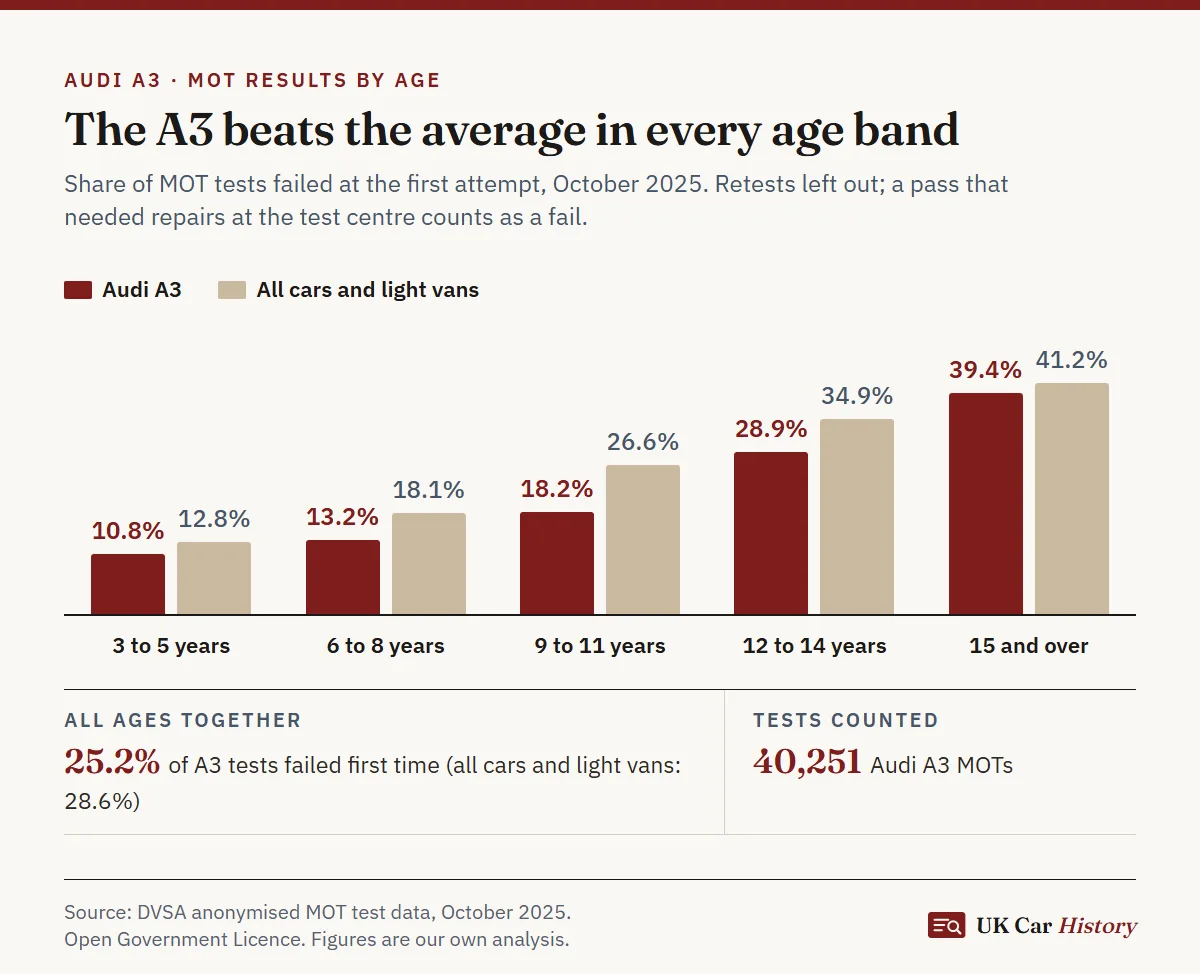
Less likely, in all five age bands. Overall, 25.2% of the A3s tested in October 2025 were first-time fails, while the national figure for every car and light van tested was 28.6%. Both include cars that left with a pass only because something was repaired at the test centre on the day.
Comparing within age bands is fairer, since the older a car, the likelier a fail, and the chart does exactly that. Nine-to-eleven-year-old A3s were the biggest group, with 12,189 tests, and also the band where the A3 led by most: a fail rate of 18.2%, set against 26.6% nationally for that age. Among A3s aged 15 and over, the lead had shrunk to 39.4% against 41.2%.
Where these numbers come from: DVSA releases every MOT result in anonymised form, under the Open Government Licence, and we analysed the October 2025 release. Only first attempts count, never retests, and a fail includes a car whose pass depended on a repair made during the test. The guide to the most common MOT failures sets out the method and the same measures for 13 other popular models. A single month is a small window, so a gap of a point or two may not mean much.
Audi A3 MOT failures: which items come up most?
These are the ten failure items testers recorded most on A3s. Each share is of all the A3's failure items, because one failed test often lists several, and faults fixed at the test centre during the test are included. The right-hand column sums up what the MOT inspection manual says.
| Failure item | Share | What the MOT looks for |
|---|---|---|
| Coil spring fractured or seriously weakened | 7.3% | A major defect, so an automatic fail |
| Headlamp aim outside the limits | 7.0% | Measured with aiming equipment: the dipped beam's cut-off has to fall inside a narrow band |
| Tyre tread below the legal depth | 6.6% | Main grooves 1.6mm or deeper across the central three-quarters, around the whole tyre |
| A tyre seriously damaged | 6.2% | A cut reaching the ply or cords is major; a lump, bulge or tear from the structure failing is dangerous |
| Anti-roll bar link: ball joint's rubber cover split or missing | 4.7% | Perished but sealing is minor; letting dirt in is major |
| Tyre cords visible or damaged | 4.0% | Graded dangerous |
| Engine warning light showing a fault | 3.5% | Must come on at switch-on, then go out; stuck on for a fault is major |
| Drive shaft joint boot missing or split | 3.3% | Grouped by DVSA with body and structure items |
| Brake pads worn below 1.5mm | 3.2% | Dangerous. Reaching the wear indicator alone is major |
| Windscreen washers not working | 2.9% | Major, even if they work but cannot clear the screen |
A beam aimed too high can dazzle other drivers, which is why the Highway Code says headlights must be properly adjusted. Testers may make minor corrections to the aim during the test, although they may not carry out repairs.
Why do coil springs feature so often in A3 results?
No fault came up more on A3s: 1,648 springs found broken or badly weakened in a single month. Under the inspection manual that is a major defect, and a major defect means the car does not pass.
A broken spring does not always show from outside. The car may sit low at one corner or thump over bumps, but it can do neither and still have a spring in two pieces.
Look out instead for the advisory "coil spring: corroded". Testers gave it to A3s 1,868 times, 3.2% of all A3 advisories, and DVSA's list of test items links it to the broken-spring fail. Spot it in a history and the next questions are obvious: have new springs gone on since, and where is the receipt?
Two rubber parts also feature: the rubber cover on the ball joint of an anti-roll bar link, and the boot over each drive shaft joint. Both exist to keep dirt out of a joint, the test fails them once they stop doing that, and both are easy to inspect at a viewing.
Which parts of an A3 make up its failure list?
Sorting every A3 failure item by the part of the car it concerns shows a mix tilted towards suspension and tyres, and away from lights, visibility and steering, compared with cars in general:
| Part of the car | Audi A3 | All cars and light vans |
|---|---|---|
| Suspension | 26.0% | 21.4% |
| Lights, reflectors and electrics | 19.9% | 24.9% |
| Tyres | 17.9% | 12.6% |
| Brakes | 13.7% | 14.8% |
| Noise, emissions and leaks | 6.7% | 5.9% |
| Body, chassis and structure | 5.9% | 6.4% |
| Visibility | 5.5% | 7.3% |
| Steering | 1.0% | 3.7% |
A share is not a rate. That suspension accounts for 26.0% of A3 failure items tells you what dominates when an A3 fails, not how often A3s fail on suspension compared with other cars.
How do the A3's tyre figures compare with other cars?
For tyres, the A3's share of failure items was 17.9%, well above the national 12.6%, and tyres account for three of its six most frequent failure items: shallow tread (6.6%), serious damage (6.2%) and exposed cords (4.0%).
Tread wear dominated the advisories: 21.0% of all A3 advisories were for tyres "worn close to legal limit/worn on edge", and tyres "slightly damaged/cracking or perishing" were the third most common note, at 7.7%.
Wear concentrated on one edge is worth asking about: the Highway Code links uneven wear to brake or suspension faults and to misaligned wheels, so the tyre may be a symptom rather than the whole problem.
Do A3s cover more miles than other cars?
Until about eight years old, an A3's MOT mileage is in line with everyone else's. After that the A3 pulls ahead, and from 12 years the gap widens sharply:
| Age band | Audi A3, average miles | All cars and light vans |
|---|---|---|
| 3 to 5 years | 37,919 | 38,187 |
| 6 to 8 years | 56,170 | 55,582 |
| 9 to 11 years | 80,577 | 76,786 |
| 12 to 14 years | 107,793 | 93,592 |
| 15 years and over | 128,521 | 108,155 |
Higher mileage means more use of what the MOT examines: tyres, brakes, suspension joints. Whether that explains why older A3s lose most of their advantage, the data cannot say, but it does argue for judging an older A3 on its miles, not just its age. And individual cars sit well above and below any average.
The A3s tested were split almost evenly by fuel: 50.3% petrol, 47.5% diesel and 2.2% hybrid. Each car's own readings are in its MOT history, and our page on how to check mileage history explains how to spot one that falls.
What do A3 advisories say about the next MOT?
Advisories are notes on parts that passed but are wearing, damaged or rusting. Each standard advisory has a matching fail in DVSA's lists, which makes them a preview, and the table pairs the A3's most common advisories with the fail each one leads to:
| Advisory | Share of A3 advisories | The fail it can become |
|---|---|---|
| Tread nearly at the legal limit, or worn on one side | 21.0% | Tread below the legal depth |
| Discs worn, pitted or scored | 9.5% | A disc badly weakened, insecure or fractured |
| Tyre slightly damaged, cracking or perishing | 7.7% | A seriously damaged tyre |
| Pin or bush worn, no excessive movement | 7.3% | Excessive wear in the pin or bush |
| Brake pads wearing thin | 6.5% | Pads below 1.5mm |
| Suspension arm corroded, not seriously weakened | 5.9% | The arm excessively corroded |
| Shock absorber lightly misted with oil | 4.6% | Severe leakage, or not working |
| Engine oil leak, not excessive | 3.8% | Pool wider than 75mm in 5 minutes |
| Sub-frame corroded, not seriously weakened | 3.6% | The sub-frame excessively corroded |
| Coil spring corroded | 3.2% | A spring fractured or seriously weakened |
On an older A3, corrosion notes on the suspension deserve the most weight, since rust does not stop between one test and the next. The inspection manual singles out suspension parts made from thin pressed steel: their hollow sections and upward-facing surfaces gather road dirt and salt, which can eat badly into one spot.
The difference between an advisory and a minor, major or dangerous defect is explained in our guide to MOT advisories.
Buying a used Audi A3: what should you check?
Begin with the car's own record. The free look-up on our car check home page shows every MOT test with its failures, advisories and mileage, and the recall status DVSA reports for the car. Go back three tests at least, looking for the A3's usual suspects: springs, tyres, lamps and brakes, plus worn joints or bushes and corroded arms or sub-frames underneath. An advisory that reappears at every test was never fixed.
| Check | How | Why on an A3 |
|---|---|---|
| Ride height | Park on the flat and look from each corner | Broken springs top its fail list |
| Tyres | Feel across each tread, inner edge too; inspect both sidewalls | Three of its top six fails |
| Drive shaft boots | Full lock, then look behind each front wheel for torn rubber or flung grease | A split boot fails the test |
| Dampers | Press down hard on each end and let go | The Highway Code says continued bouncing means worn shock absorbers |
| Brakes | Look through the wheel for deep grooves or a raised outer lip | Discs and pads lead the brake advisories |
| Receipts | Ask for bills for any springs, joints, tyres or brakes replaced | Proof beats a promise |
Drive it over rough surfaces and through tight turns: knocking or clicking deserves an explanation, and our test drive checklist explains what each sound may mean. Everything else, from the logbook to under the bonnet, is in the used car checklist.
Recalls run separately from the MOT. When a manufacturer recalls a model over a safety defect, owners usually pay nothing for the repair or the parts, according to GOV.UK, so an outstanding recall in the look-up is something to raise with the seller.
Newer A3s can carry a tax surcharge. The expensive car supplement applies to cars first registered on or after 1 April 2017 with a list price over £40,000, and it lasts five years from the second time the car is taxed. See the expensive car supplement on used cars to check a particular car.
So is a used Audi A3 a sound choice?
On the MOT evidence the A3 holds up well, beating the national fail rate at every age. Those results describe condition on the day of the test, which depends as much on wear and upkeep as on the design, so they are no verdict on reliability.
The advantage fades with age, though: by 15 years and over the A3 was barely ahead of the national figure, on higher average mileage. For any single car, its own MOT history counts for more than the model's average, and a pre-purchase car inspection settles what the records cannot.
Questions and answers
What percentage of Audi A3s fail their MOT first time?
25.2% in October 2025, below the national 28.6%. The A3 was ahead in every age band, though only just at 15 years and over, where the figures were 39.4% and 41.2%.
Should a corroded coil spring advisory put me off an A3?
No. The note means the tester saw rust on a spring that had not broken. Find out whether it has since been replaced; if not, look at how the car sits and build new springs into your offer.
Will the MOT tell me if an A3's gearbox is healthy?
No. GOV.UK states that the engine, clutch and gearbox are outside the MOT, even though emissions, leaks and the engine warning light are checked. For those, rely on the service record, a long test drive and an independent mechanic.
What mileage is normal for a 10-year-old Audi A3?
80,577 miles was the average for A3s aged 9 to 11 at their October 2025 MOT; the national average for that age was 76,786. Any single car may sit well above or below.
Is a used A3 more likely to be petrol or diesel?
Roughly half and half: petrol 50.3%, diesel 47.5% and hybrid 2.2% among the A3s tested in October 2025. The registration years seen most were 2015, 2016 and 2014.
Sources
- DVSA: Anonymised MOT tests and results (open data, October 2025 extracts)
- GOV.UK (DVSA): MOT inspection manual for cars, section 5: axles, wheels, tyres and suspension
- GOV.UK (DVSA): MOT inspection manual for cars, section 1: brakes
- GOV.UK: Getting an MOT, how the MOT test works
- GOV.UK: Check if a vehicle, part or accessory has been recalled
- The Highway Code, Annex 6: vehicle maintenance, safety and security
This guide is general information for people buying or owning a car in the UK, not legal or financial advice. UK Car History is an independent service, not affiliated with the DVLA, the DVSA or GOV.UK.