The short answer
The BMW 3 Series common problems that show up at the MOT are mostly about light and grip: badly aimed headlamps, sidelights and rear lights that do not work, worn or damaged tyres, shock absorbers that leak or have given up, and brake wear. The striking part of DVSA's October 2025 data is that 3 Series cars failed less often than average at every age while carrying more miles than average at every age.
We analysed all 44,148 MOT tests on the 3 Series that month. This guide puts the fail rate and the mileage side by side, ranks the failure items and the advisories that warn of them, takes the dampers, lamps, brakes and wheels in turn, explains what a mostly diesel line-up means in a clean air zone, and ends with what to check when buying a used BMW 3 Series.
Is a BMW 3 Series less likely to fail its MOT?
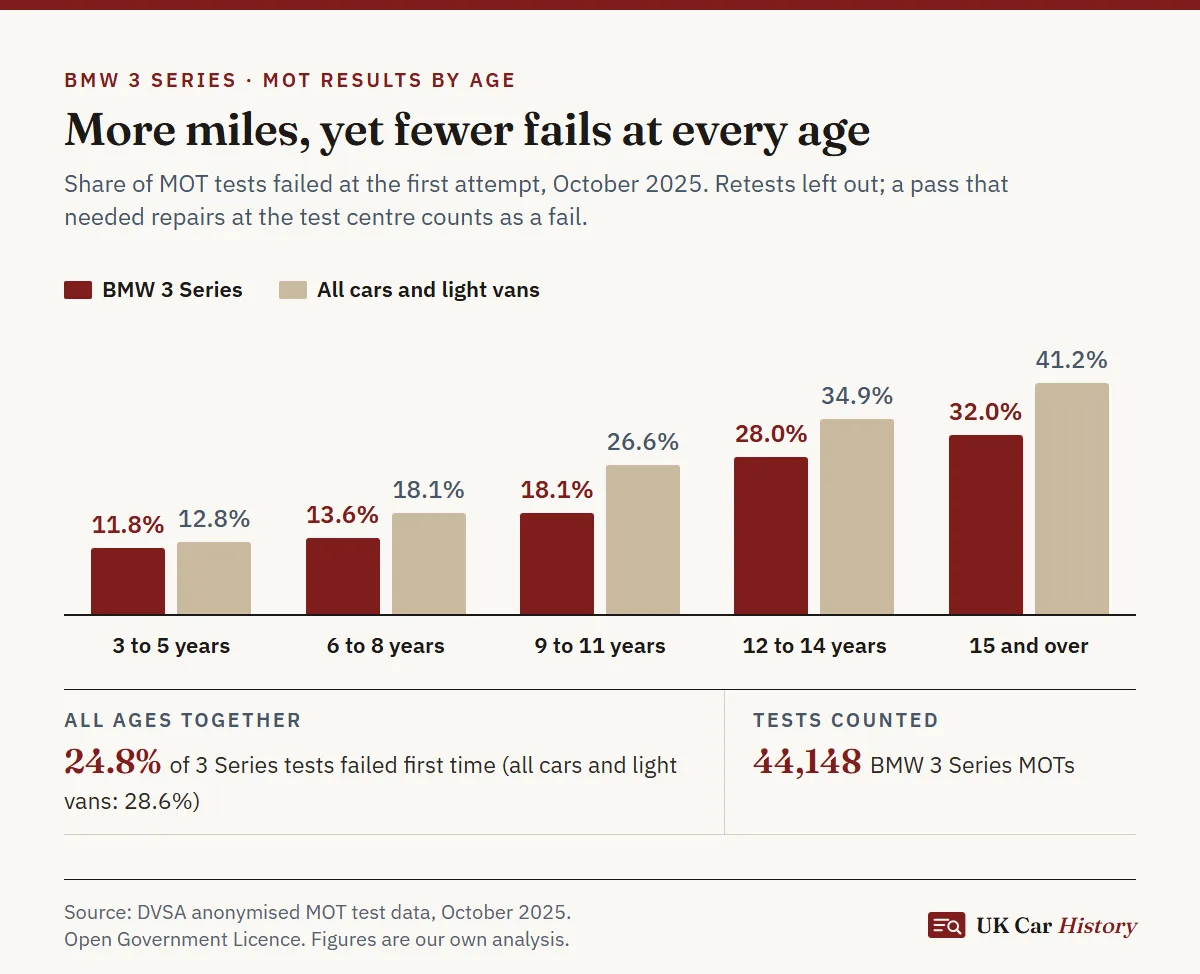
Yes. In October 2025 the 3 Series had a first-time fail rate of 24.8%, set against 28.6% for every car and light van tested. Because a car's age drives its chances of failing, the chart splits the comparison into five age bands, and the 3 Series comes out ahead in each.
Its lead was slimmest among the youngest cars, aged 3 to 5: 11.8% against 12.8% nationally. It was widest at the other end, where 32.0% of 3 Series cars aged 15 and over failed first time against 41.2% of all cars that old. That oldest band was also the model's busiest, accounting for 17,130 of its 44,148 tests.
The source is DVSA's anonymised MOT data, published under the Open Government Licence, which we analysed ourselves. Every first attempt on a 3 Series that month was counted, whether the car was recorded as a 3 Series or by a model number such as 320 or 330; retests were not. A pass that came only after repairs at the test centre during the test is counted as a fail. Method and comparison figures for 13 other models are in the most common MOT failures. With only one month of results, small differences may be noise.
Are 3 Series cars driven further than most?
Consistently. From the youngest band to the oldest, the 3 Series reached its MOT with a higher average reading than cars in general:
| Age band | BMW 3 Series, average miles | All cars and light vans |
|---|---|---|
| 3 to 5 years | 48,233 | 38,187 |
| 6 to 8 years | 65,630 | 55,582 |
| 9 to 11 years | 92,662 | 76,786 |
| 12 to 14 years | 114,688 | 93,592 |
| 15 years and over | 126,517 | 108,155 |
Put that next to the fail rates and the 3 Series looks better still: more miles, fewer fails. Why, the data cannot tell you. A test result is a snapshot of condition, and it carries no record of driving style or servicing.
When you look at a particular car, a reading above the all-car average is normal for a 3 Series. The thing to confirm is a smooth climb, test after test; the mileage history check page explains what a falling reading can mean.
BMW 3 Series MOT failures: what are the top ten?
Headlamp aim and tyre tread were the two items recorded most often. The other eight follow, with each one's share of all 3 Series failure items, faults fixed at the test centre during the test included:
| Failure item | Share of 3 Series failure items |
|---|---|
| Headlamp aim outside the limits | 7.5% |
| Tyre tread below the legal depth | 6.3% |
| Shock absorber not working, or leaking severely | 5.4% |
| Tyre seriously damaged | 5.4% |
| Sidelight or rear light faulty, or over half of a multi-source unit dark | 5.0% |
| Tyre cords visible or damaged | 4.2% |
| Washers dead, or too weak to clear the glass | 4.1% |
| Suspension pin, bush or joint excessively worn | 3.6% |
| Handbrake too weak on the roller test | 2.9% |
| Brake pads worn below 1.5mm | 2.9% |
The sections below explain what the inspection manual says about each group of faults, and what you can check yourself.
Where on the car do 3 Series faults cluster?
Grouped by area, the 3 Series failure list leans further towards tyres, brakes and road wheels than the national list does, and much less towards body, structure and steering. The figures are shares of the faults found, not chances of failing:
| Area | BMW 3 Series | All cars and light vans |
|---|---|---|
| Lights, reflectors and electrics | 23.5% | 24.9% |
| Suspension | 20.2% | 21.4% |
| Tyres | 17.2% | 12.6% |
| Brakes | 16.6% | 14.8% |
| Visibility | 6.7% | 7.3% |
| Noise, emissions and leaks | 6.3% | 5.9% |
| Body, chassis and structure | 2.7% | 6.4% |
| Road wheels | 2.7% | 0.7% |
| Steering | 1.3% | 3.7% |
What goes wrong with the dampers and bushes on a 3 Series?
Shock absorber failures numbered 1,361 across the month. Three conditions make a damper a major defect in the manual: damage that stops it working, severe leakage, or damping so weak it is negligible. Slight seepage that leaves a film of fluid on the outside is not a reason to fail it.
The most common damper advisory records exactly that film. "Has light misting of oil" was noted 3,307 times, 5.1% of all 3 Series advisories, and DVSA links it to the damper failure above, so a shock absorber that was misting at the last test is one to look at before the next.
Bushes deserve the same attention. Only tyre wear was advised on more often than "pin or bush worn but not resulting in excessive movement", at 7.5% of advisories, and pins and bushes worn beyond the limit accounted for 3.6% of failure items. Steering is the opposite story: just 1.3% of the 3 Series failure list, where the national share is 3.7%.
Lamps, washers and brakes: what fails on a 3 Series, and why?
Lights were the 3 Series's biggest area of failure items at 23.5%, a little below the national 24.9%. Headlamp aim alone was recorded 1,886 times. The test centre measures each dipped beam with aiming equipment. For a European-type headlamp, the bright cut-off at the top of the beam must sit in a narrow zone just under the horizontal, because a beam that rises too high dazzles oncoming traffic, and the Highway Code likewise requires headlights to be properly adjusted. Testers may tweak the aim on the spot, but such a car arrived with the fault, so it still appears in these numbers.
Sidelights and rear lights, which the manual calls position lamps, failed 1,260 times. The rule is two at the front and two at the back. A lamp that is missing or dead is a major defect, as is a multi-source unit with more than half its sources failed; if half or fewer have failed, the defect is minor.
Washers come under the visibility checks. They must give the wipers enough fluid to clear the windscreen, and washers that fail to do so are a major defect, so even an empty bottle can cost a pass.
Brakes took 16.6% of 3 Series failure items, against 14.8% nationally. The two leading brake items tied at 2.9% each. One is pads worn under 1.5mm, which the manual grades dangerous. The other is a parking brake that falls short of the required efficiency on the roller tester: major, and dangerous if it reaches less than half of what is required. Of the twelve advisories most often given to the 3 Series, five are about brakes:
| Brake advisory | Share of 3 Series advisories | The manual's fail point |
|---|---|---|
| Discs worn, pitted or scored | 7.1% | Significantly and obviously worn |
| Pads wearing thin | 6.2% | At the wear indicator (major); under 1.5mm (dangerous) |
| Flexible hoses slightly deteriorated | 4.4% | Only once damage exposes the reinforcement |
| Rigid pipes corroded or covered in grease | 4.2% | Wall thickness reduced by a third |
| Discs worn, but not excessively | 2.5% | Significantly and obviously worn |
Why do tyres and wheels feature more on a 3 Series?
Tyres accounted for 17.2% of 3 Series failure items, compared with 12.6% for cars in general, and three of its ten most common items were tyre faults: the tread too shallow (6.3%), a seriously damaged tyre (5.4%), and exposed or damaged cords (4.2%). The legal minimum for a car is 1.6mm in the main grooves, measured over the central three-quarters of the tread and right round the tyre, and visible cords are graded dangerous.
Tread wear led the advisories by a distance, at 22.0% of the 3 Series total. A tyre near the limit at one test may be below it by the next, so measure the tread yourself instead of trusting the last result.
Road wheels were a small area but a bigger one than usual, at 2.7% of 3 Series failure items against 0.7% nationally. The wheel inspection covers loose or missing nuts, bolts and studs, worn hubs, cracks, bad distortion, and wheels whose fixings do not match them.
Will a diesel 3 Series be charged in the ULEZ or a Clean Air Zone?
It might. Diesel made up 60.1% of the cars tested, petrol 33.6% and hybrids 6.2%, and 2013, 2015 and 2014 were the registration years seen most.
London's ULEZ asks Euro 6 of a diesel car and Euro 4 of a petrol one, or a daily charge is due. The English Clean Air Zones that include cars, such as Birmingham and Bristol, set the same two standards. TfL's rule of thumb is that diesels first registered new after September 2015 generally comply, but what counts is the emissions figure declared for the car, not its age, so 2015 diesels need checking one by one.
For new vehicles the Euro standard may be listed in the V5C, TfL notes, and its online checker gives the answer for London. More on the standards: which cars are ULEZ compliant.
Buying a used BMW 3 Series: what should you check?
Start at home, with the car's MOT record. Our free car check look-up sets out each test's failure items, advisories and mileage, plus the recall status DVSA holds for the registration. Oil leaks, worn suspension bushes, brake pipes and hoses, and misting dampers are the advisories to weigh most on a 3 Series. Did each one vanish after a repair, or reappear at the next test? Then, at the viewing:
| Check | How to do it |
|---|---|
| Dampers | Shine a torch at each damper for wet oil, then push each corner down and release; if the body goes on bouncing, the Highway Code says the shock absorbers are worn |
| Lamps and washers | Work through sidelights, dipped beams, indicators and hazards while you walk round; a helper checks the brake lights; then try the washers |
| Tyres and wheels | Tread across every tyre, inner edges too; cuts and exposed cords; cracks or buckles in each wheel |
| Brakes | A straight, judder-free stop on the test drive, and a parking brake that holds the car on a slope |
| Oil | Fresh oil under the engine or where the car stood |
Passing the MOT is not proof that an engine is oil-tight. The MOT fails an oil leak only when it forms a pool more than 75mm across within five minutes, and an engine oil "leak, but not excessive" made up 5.2% of 3 Series advisories.
The used car checklist handles the logbook checks and everything else at the viewing.
Once moving, use the test drive checklist to judge the brakes and steering.
Newer cars may cost more to tax. If a 3 Series was first registered from 1 April 2017 and listed at more than £40,000, the expensive car supplement is added for five years once it is taxed for the second time. Whether a given car is still paying it is explained in our guide to the expensive car supplement.
What does the MOT evidence say about the 3 Series overall?
The MOT data is kind to it: fewer first-time fails than average in all five age bands, by the widest margin among the oldest cars, on higher mileage than average throughout.
That measures condition at the test, which owes a great deal to how each car was kept, so it is not a reliability score. GOV.UK also notes that the test leaves the engine, clutch and gearbox unexamined. The car you are offered has its own record, which matters more than any average: read it, check the service history, and pay for a pre-purchase car inspection if anything worries you.
Questions and answers
How does the 3 Series compare with other cars at the MOT?
Better than average. Its first-time fail rate in October 2025 was 24.8%, against 28.6% nationally, with a lead in every age band. Averages cannot show how any single car was maintained.
Does an oily shock absorber fail the MOT?
No, not if it is only a thin film from slight seepage, which gets an advisory. The fail comes with severe leakage, a damper that has stopped working, or one with almost no damping effect.
What mileage should I expect on a 10-year-old 3 Series?
In October 2025, 3 Series cars aged 9 to 11 averaged 92,662 miles at their MOT, against 76,786 for all cars of that age. Readings that rise steadily matter more than the total.
Can a diesel 3 Series drive in the ULEZ without paying?
Only if it meets Euro 6. Diesels first registered new after September 2015 generally do, according to TfL, but each car is judged on its declared emissions, so use TfL's checker on the registration.
Why would a 3 Series fail on its handbrake?
Because it could not reach the minimum efficiency when tested, usually on a roller brake tester. Falling short is a major defect, and reaching under half the requirement is dangerous. Parking brake efficiency was 2.9% of 3 Series failure items.
Sources
This guide is general information for people buying or owning a car in the UK, not legal or financial advice. UK Car History is an independent service, not affiliated with the DVLA, the DVSA or GOV.UK.