The short answer
The Mercedes C-Class common problems that MOT testers record most sit in the suspension, led by a worn ball joint, the model's single most frequent failure item in October 2025. Rusty brake pipes, tyres and an engine warning light left on come next. The good news for a buyer: from six years old, the C-Class failed first time less often than other cars of the same age.
Those findings come from our analysis of the DVSA's anonymised results for 32,930 C-Class MOTs that month, which record each car's condition on test day rather than its reliability. Below: what fails and how testers judge it, how the C-Class compares age for age, what its mileage and diesel-heavy mix mean for you, and the checks for buying a used Mercedes C-Class.
What goes wrong most often on a Mercedes C-Class?
Each fault that fails a test is recorded as a failure item, including faults the test centre put right during the test, and one failed MOT can hold several. These were among the C-Class's most frequent, as a share of all its failure items:
| Failure item | Share of all C-Class fails | How the manual grades it |
|---|---|---|
| Suspension ball joint excessively worn | 9.8% | Major; dangerous if likely to come apart |
| Tread under the legal minimum | 7.4% | Dangerous |
| Headlamp aim outside the limits | 5.6% | Major |
| Broken or badly weakened coil spring | 5.5% | Major |
| Tyre seriously damaged | 5.0% | Major for a cut to the cords; dangerous for a bulge, lump or tear |
| Engine warning light showing a fault | 4.9% | Major |
| Tyre cords on show or damaged | 3.4% | Dangerous |
| Split or missing cover, anti-roll bar link joint | 3.3% | Major when it lets dirt in |
| Metal brake pipe damaged or badly corroded | 3.2% | Major; a leaking pipe is dangerous |
| Split or missing cover, other suspension joint | 3.0% | Major when it lets dirt in |
| Brake pad thinner than 1.5mm | 2.6% | Dangerous |
The worn ball joint alone was logged 1,933 times in the month. With the springs and the two dust covers, the suspension fills four of the ten highest places; tyres take three, and the metal brake pipes and the pads follow further down the list.
How do older and younger C-Class cars do at the MOT?
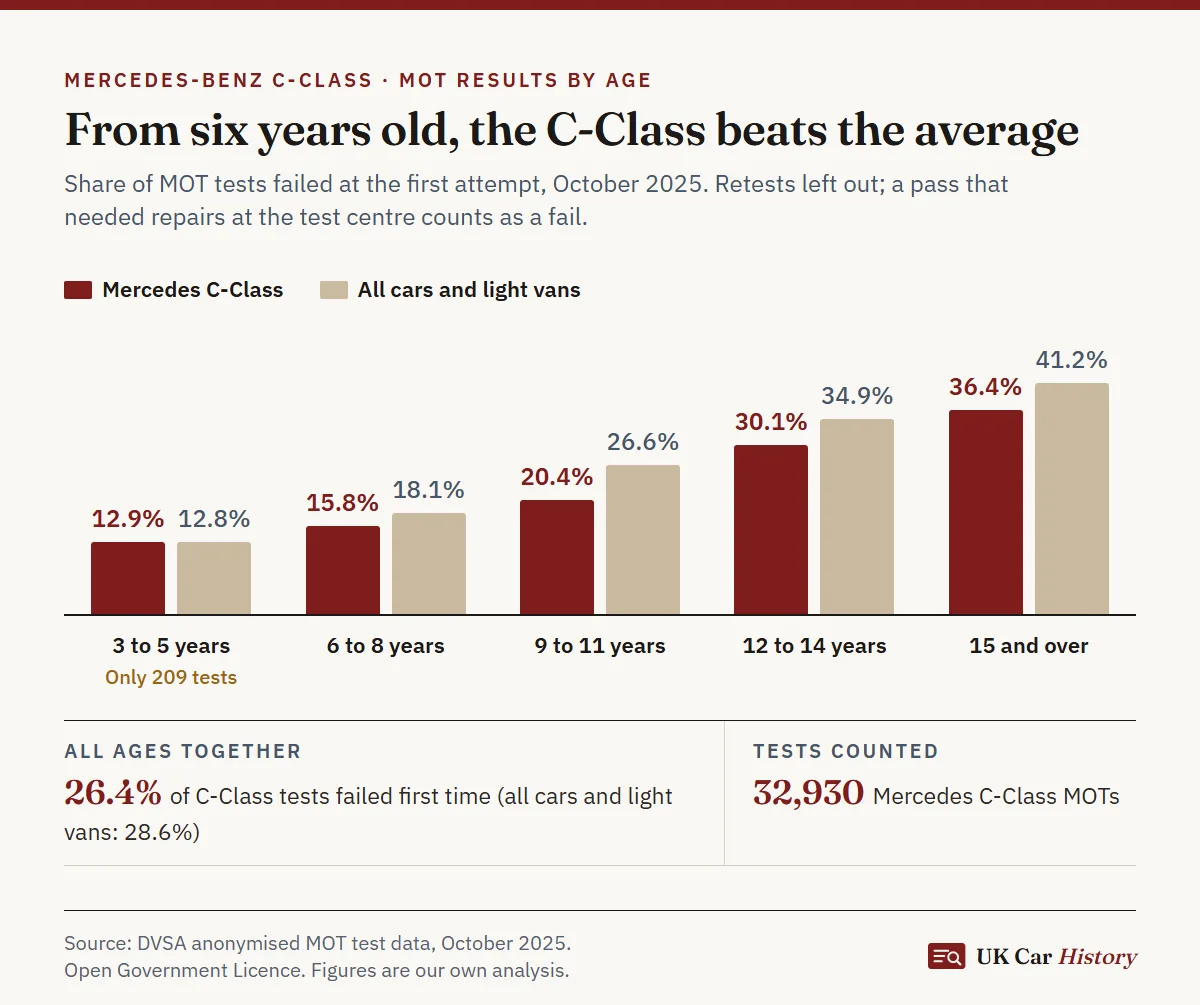
From six years old it does better than average. In the 6 to 8 band, 15.8% of C-Class cars failed first time where 18.1% of all cars and light vans did. It stayed ahead as the cars aged. For 9 to 11 year olds the C-Class rate was 20.4% and the national one 26.6%; for 12 to 14 year olds, 30.1% and 34.9%; for cars of 15 or more, 36.4% and 41.2%.
Its biggest advantage came in the 9 to 11 band, and that band also held more C-Class tests than any other: 10,471 of them. Among the youngest cars, aged 3 to 5, the C-Class was level with the rest at 12.9% against 12.8%, but that rests on just 209 tests and says little either way. Across all ages, 26.4% of C-Class tests failed first time, under the 28.6% recorded for all cars and light vans.
The method is simple. Retests were dropped, so each C-Class MOT in the October 2025 data counts once, and a car scored as a fail if it failed outright or only passed after repairs at the test centre. One month gives a snapshot rather than a trend; our guide to the most common MOT failures applies the same approach to 14 models.
Which areas of a C-Class fail more than average?
Grouping the failure items by area shows where the C-Class parts company with the national pattern. The rows run from the biggest excess over the average to the biggest shortfall:
| Area of the car | C-Class share | All cars and light vans | Against the average |
|---|---|---|---|
| Suspension | 28.8% | 21.4% | Well above |
| Tyres | 17.3% | 12.6% | Well above |
| Brakes | 17.8% | 14.8% | Above |
| Noise, emissions and leaks | 7.3% | 5.9% | Above |
| Road wheels | 1.9% | 0.7% | Above |
| Visibility | 5.2% | 7.3% | Below |
| Steering | 1.5% | 3.7% | Below |
| Body, chassis and structure | 2.2% | 6.4% | Well below |
| Lights, reflectors and electrics | 15.4% | 24.9% | Well below |
Read it as the make-up of the C-Class's failures, not their frequency. Suspension and tyres take bigger slices than they do across all cars, and lamps a much smaller one, which says what tends to be wrong when a C-Class fails rather than how often its suspension gives up compared with other cars.
One lighting item still ranks high: headlamp aim, third on the list. To check it, the tester lines up beam-setting equipment with each dipped headlamp. A European-type lamp throws a beam with a crisp horizontal top edge, and that edge must land between two marks a little below the horizontal. A beam pointing too high dazzles oncoming traffic, which the Highway Code forbids, and the tester is allowed to make small corrections to the aim on the spot.
How do testers judge C-Class ball joints, springs and covers?
A ball joint is checked for play, either on wheel play detectors or by raising the wheels, levering under each one in turn and rocking it. Under the inspection manual, a joint that is excessively worn is a major defect, and one at risk of becoming detached is dangerous.
A coil spring fails when it is fractured or seriously weakened, 5.5% of C-Class failure items. The rubber covers that keep grit out of the suspension joints are judged too: a cover that is missing or no longer seals is a major defect, while one that has only perished badly is a minor defect and still passes.
In the DVSA's lists, each standard advisory is paired with the defect that fails the same part, and several of the C-Class's commonest advisories pair with its commonest fails:
- Suspension pins and bushes showing wear, though not enough to move excessively: 5.5% of C-Class advisories.
- A ball joint with slight play: 5.1%. Its failure form, an excessively worn joint, heads the fail list.
- A wheel bearing with slight play: 3.3%. Too much play is a major defect, and so is a bearing that sounds excessively rough when the raised wheel is spun.
- Rust on a coil spring: 3.0%. The defect it is paired with is a spring that has broken or lost much of its strength.
What should you make of a brake pipe advisory on a C-Class?
Price it in. The metal pipes are the reason the brakes, at 17.8% of C-Class failure items against 14.8% nationally, deserve attention. Testers noted rigid pipes "corroded, covered in grease or other material" 4,700 times, the C-Class's second most frequent advisory at 9.8% of the total, and failed pipes as damaged or excessively corroded 632 times (3.2% of failure items).
The manual draws the line for a fail at a pipe whose wall has lost a third of its thickness to chafing, corrosion or damage, roughly 0.25mm on a typical hydraulic pipe. It admits this is hard to judge and tells testers to give the benefit of the doubt, so a pipe can pass while well worn. The same advisory also covers pipes hidden under grease or other material, whose true state the tester may not have seen. A hydraulic pipe that leaks is a dangerous defect.
Elsewhere in the brakes, pads below 1.5mm made up 2.6% of failure items. Three advisories hint at brake bills on the way: discs with pitting or scoring (8.1% of all advisories), thin pads (6.2%) and discs with some wear that is not yet excessive (3.6%).
Does the engine warning light fail a C-Class MOT?
Yes, when it shows a fault. The lamp, which the manual calls the engine malfunction indicator lamp, was found lit and signalling a fault 974 times on C-Class cars, 4.9% of failure items, and each one is a major defect. The tester turns on the ignition and watches the lamp light up and then go out; some cars only put it out once the engine is running.
Which cars are covered depends on fuel and the date the car was first used: petrol models from July 2003 onwards, diesels from July 2008 onwards, with hybrids treated the same way. The lamp only reports that the engine's own monitoring has found something wrong, not what it is, so ask for the fault codes to be read before you agree a price.
The data files the lamp under noise, emissions and leaks, an area that took 7.3% of C-Class failure items (all cars: 5.9%). The same area holds an advisory worth noticing: an oil leak too small to fail, noted in 3.1% of C-Class advisories. A leak fails once, with the engine idling, it leaves a pool more than 75mm across within five minutes.
Why do tyres matter so much on a C-Class?
They make up 17.3% of its failure items, where the all-car figure is 12.6%. Tread below the legal minimum was the second most frequent item of all at 7.4%, a seriously damaged tyre took 5.0% and visible or damaged cords 3.4%. Thin tread and bare cords both count as dangerous; a cut that reaches the ply or cords is a major defect, and a lump, bulge or tear from the tyre's structure breaking up is dangerous again.
The C-Class's commonest advisory of all, 22.9% of the total, was tread "worn close to legal limit/worn on edge". If the latest test noted it, set aside money for tyres, and look at all four yourself, inner edges included, since wear there is easy to miss from the kerb.
What mileage and fuel should you expect on a used C-Class?
More miles than average, at every age, and by the widest margins between 9 and 14 years:
- 3 to 5 years: 41,546 miles on average (all cars and light vans: 38,187)
- 6 to 8 years: 57,995 (55,582)
- 9 to 11 years: 85,260 (76,786)
- 12 to 14 years: 105,151 (93,592)
- 15 years and over: 116,087 (108,155)
Most C-Class cars tested were diesels, 61.1%, with 34.3% on petrol, 3.6% hybrids and a further 1.0% recorded as diesel-electric. Cars registered in 2017 were the most numerous, ahead of 2016 and then 2015.
That diesel share matters in towns. London's ULEZ and the Clean Air Zones in England that charge cars both ask for Euro 6 from a diesel and Euro 4 from a petrol car; below that, you pay. TfL says diesels meeting its standard are generally those first registered as new after September 2015, but it is the car's declared emissions that count. The free look-up shows the Euro status whenever the DVLA holds it, and our guide to ULEZ-compliant cars covers the rest.
Tax is the other cost to look at on a recent one. A C-Class first registered from 1 April 2017 onwards that cost more than £40,000 new pays the expensive car supplement for five years, counted from its second tax payment.
What to check on a used Mercedes C-Class
- Start at home: enter the registration in the free look-up at the bottom of this page to read the MOT history. Note every advisory or fail for ball joints, wheel bearings, springs, brake pipes and the engine lamp, then read on through the later tests to see whether each was dealt with or kept coming back. The same page shows the DVSA's recall status.
- At the car, turn the key to the ignition position and watch the dashboard: the engine lamp should glow and then go out when the engine fires. If it stays lit, or never lights at all, ask why.
- Park on flat ground and check that the car sits level at all four corners.
- On the drive, listen for a knock over bumps and for a hum that grows with road speed.
- Check the tread right across every tyre, inner edges included, and look for cuts, bulges or exposed cords.
- Book a garage ramp if the seller will allow it. From standing height you cannot judge a pipe's corrosion or a joint's play.
- Ask for invoices for any joints, springs, brake pipes or diagnosed warning light, and for proof that any open recall has been done.
The rest of the viewing, the paperwork included, is set out in our used car checklist.
For the drive itself, the test drive checklist lists the noises and the feel worth noticing.
When the history leaves you unsure, an independent pre-purchase car inspection puts a trained eye under the car before you commit.
Does a used C-Class make sense?
On the October 2025 data, the odds favour an older C-Class: past six years old it failed first time less often than the average car of its age, and younger ones were level on a small sample. Bear in mind that an MOT shows the state a car was in on one day, which is not the same as how reliable it will be.
When a C-Class does fail, the costs gather around the same parts: the joints and springs that carry it, the metal pipes under it and the tyres. Every one of those wears or rusts, so the record and condition of the car you are looking at say far more than any model average.
Recalls sit outside the MOT. GOV.UK says the manufacturer carries out recall work and owners will not usually pay for repairs or parts, so ask for any open recall to be finished before the sale. Finance still owed, an insurance write-off and a stolen marker never show in an MOT history either: a full car check by registration searches for those records in the Premium report (£7.99).
Questions and answers
Does a C-Class fail its MOT more often than other cars?
Less often, on the whole. Across all ages, 26.4% of C-Class MOTs in October 2025 failed at the first attempt, when the figure for all cars and light vans was 28.6%. From six years old it was ahead in each age band; the youngest group was level but small.
What does an excessively worn ball joint mean on a C-Class MOT?
It is the C-Class's most frequent failure item, 9.8% of the total: a suspension joint with more play than the manual allows. It is a major defect, or a dangerous one if the joint could come apart, so ask for proof that it was replaced.
Is a corroded brake pipe advisory worth worrying about?
It is worth pricing. The pipe passed, but it carries the fluid that works the brakes, a leaking pipe is a dangerous defect, and the same advisory can mean the pipe was hidden under grease. Have it looked at on a ramp before you buy.
Can a C-Class pass its MOT with the engine light on?
Not when the lamp is reporting a fault on a car that falls under the check, which means petrol cars first used since mid-2003 and diesels since mid-2008. Testers grade that as a major defect, and it made up 4.9% of C-Class failure items.
How many miles do used C-Class cars usually have?
More than most cars of the same age. At 9 to 11 years, the average C-Class showed 85,260 miles at its October 2025 MOT, against 76,786 for all cars and light vans.
Are most used C-Class cars diesels?
In this data, yes: 61.1% of the C-Class cars tested were diesels and 34.3% ran on petrol, with small shares of hybrids. Avoiding the daily charge in London's ULEZ, or in an English Clean Air Zone that charges cars, takes Euro 6 for a diesel.
Sources
- DVSA: Anonymised MOT tests and results (open data, October 2025 extracts)
- GOV.UK (DVSA): MOT inspection manual, section 5: axles, wheels, tyres and suspension
- GOV.UK (DVSA): MOT inspection manual, section 1: brakes
- GOV.UK (DVSA): MOT inspection manual, section 8: nuisance (emissions, warning lamp, leaks)
- TfL: Ultra Low Emission Zone, cars
- GOV.UK: Vehicle tax rate tables (cars registered on or after 1 April 2017)
This guide is general information for people buying or owning a car in the UK, not legal or financial advice. UK Car History is an independent service, not affiliated with the DVLA, the DVSA or GOV.UK.